Learning how to read a CBD lab report is one of the simplest ways to protect yourself as a shopper. A certificate of analysis, usually shortened to COA, is the document that shows what is actually inside a product, from the amount of CBD to the presence of contaminants. At first glance, these reports look like a dense page of numbers, abbreviations, and charts. The good news is that you only need to understand a handful of sections to get the full picture. This beginner’s checklist walks you through each part so you can confirm that a product matches its label before you buy.
What Is a CBD Lab Report (COA)?
A COA is a document created by a testing laboratory after it analyzes a sample from a specific batch of product. It reports measured results rather than marketing claims. A complete report may cover cannabinoid content, including CBD and THC, along with safety tests for pesticides, heavy metals, residual solvents, and microbes. Think of it as a report card for one batch. Because batches can differ slightly, a COA applies only to the batch it names.
Why Third-Party Lab Testing Matters
A third-party lab is an independent company that is not owned by the brand selling the product. That independence makes the results more objective than a company testing its own products. It also matters because the FDA does not review most CBD products before they are sold, so independent testing is one of the few ways shoppers can verify what they are buying. EarthE CBD states that its products are third-party lab tested, and its Laboratory Testing page is a helpful place to see how testing fits into its process.
Step 1: Check the Basic Information
Start at the top of the report. This section tells you whether the document is trustworthy and whether it belongs to the product in your hand. Look for:
- Product name: It should match the product you are considering.
- Batch or lot number: This identifies the exact production run that was tested.
- Date of testing: The report should be recent and relevant to the product’s manufacture date.
- Lab name and contact details: A real lab lists its name, address, and often a contact number or website.
- Accreditation: Many reputable labs follow the ISO/IEC 17025 standard, which is an international benchmark for testing laboratories.
If any of these items are missing or look edited, treat the report with caution.
Step 2: Match the Batch Number
This step takes only a few seconds and is one of the most important. Find the batch or lot number printed on the bottle, pack, or box, then compare it with the number on the COA. If the numbers do not match, the report may describe a different batch, which means it cannot confirm what is in your product. Many brands add a QR code to the packaging that links directly to the correct report, which makes this check even easier.
Step 3: Read the Cannabinoid Profile
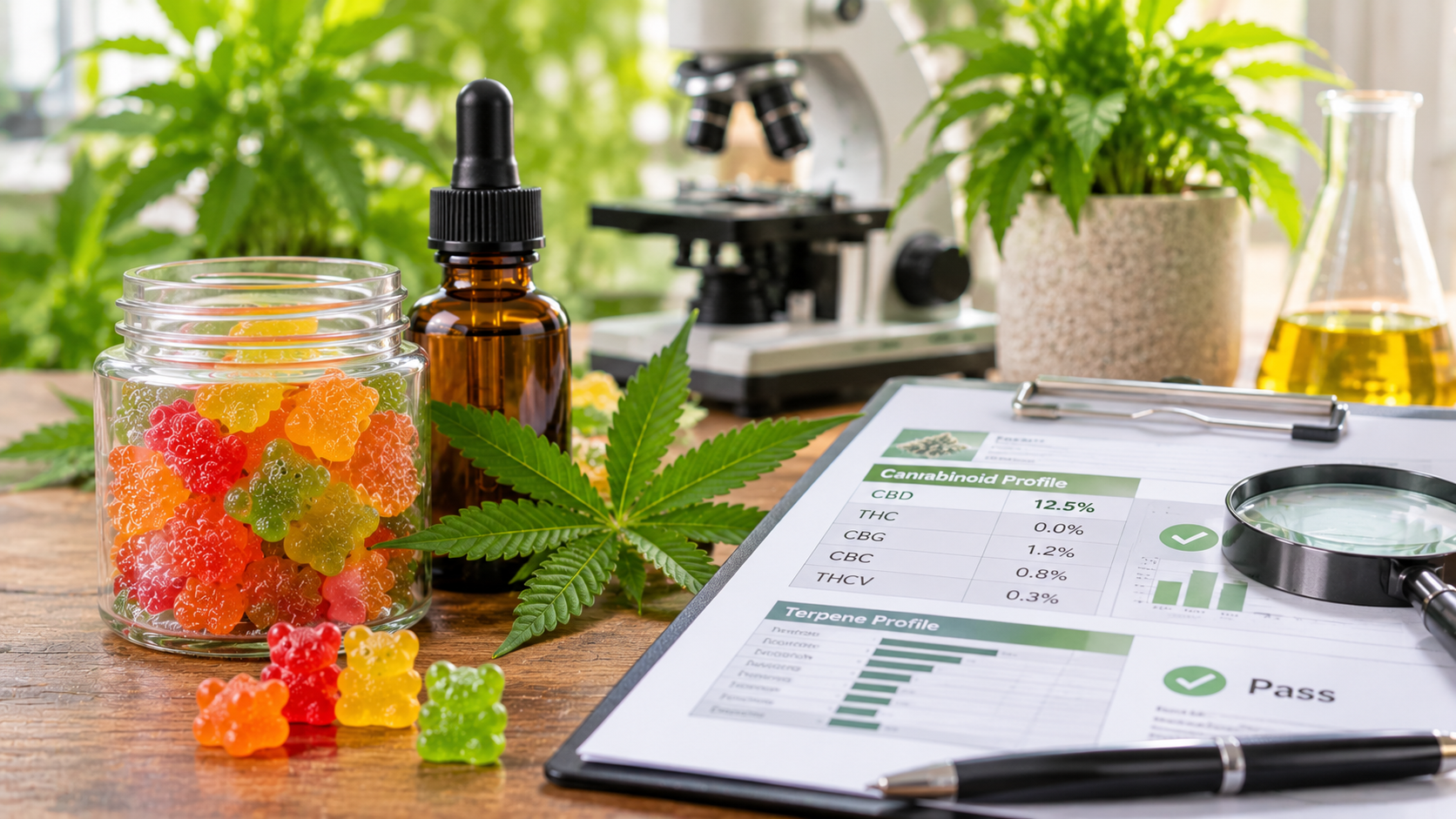
The cannabinoid section lists each compound the lab measured, along with the result. You will usually see CBD, THC, and sometimes CBG, CBN, and others. Results appear in units such as mg/g, mg/mL, or percent, so it helps to know a few common terms:
- ND (not detected): The lab did not find that compound at a measurable level.
- LOD and LOQ: The limit of detection and the limit of quantification, which are the smallest amounts the lab can detect or accurately measure.
- mg/g and percent: These are two ways of showing the same thing. For example, 10 mg/g equals 1%.
- THCA: The raw, acidic form of THC found in hemp flowers. It converts to THC when heated.
- Total THC: A calculation that combines delta-9 THC with a portion of THCA. The common formula is delta-9 THC plus THCA multiplied by 0.877.
Once you find the numbers, compare them with the label. A gummy labeled 25mg of CBD should test close to that amount. Small differences are normal because testing and manufacturing both have a margin of error, but large gaps, whether higher or lower, are worth questioning. Keep in mind that hemp laws are changing, so always check current federal and state rules on THC limits.
Step 4: Review the Safety Tests
Potency is only part of the story. A good COA also shows that the product was tested for substances you do not want in it. Common safety panels include:
- Pesticides: Chemicals used during farming that should not remain in the final product.
- Heavy metals: Typically lead, arsenic, cadmium, and mercury, which can be absorbed by hemp as it grows.
- Residual solvents: Leftover chemicals from the extraction process.
- Microbial contaminants: Yeast, mold, and bacteria such as E. coli and Salmonella.
- Mycotoxins: Toxins produced by certain molds.
- Moisture content: Mostly relevant to hemp flowers, where too much moisture can lead to mold.
For each panel, look for a “Pass” result or numbers that fall below the stated limits. If a report only lists cannabinoids and skips safety testing entirely, it is incomplete.
Step 5: Look at the Terpenes (Optional)
Some reports include a terpene profile. Terpenes are aromatic compounds that give hemp its scent and flavor. They are not required for safety, but they can show how detailed a lab’s analysis is, and they help explain why one strain smells and tastes different from another.
Full Spectrum vs. Broad Spectrum on a COA
The COA is also the best place to verify what type of product you are buying. Full spectrum products contain a range of hemp compounds, including trace amounts of THC, while broad spectrum products are made to be free of THC. If you are avoiding THC, check the THC line on the report. For a non-THC option such as the Broad Spectrum CBD Tincture (Non-THC), the report is where you can confirm the THC result for yourself rather than relying on the label alone.
Your Quick COA Checklist
Use this list each time you check a report:
- The product name matches what you are buying.
- The batch number matches the packaging.
- The testing date is recent.
- The lab is independent and identifies itself clearly.
- CBD levels are close to what the label states.
- THC levels match the product type (full spectrum or THC-free).
- Pesticides, heavy metals, solvents, and microbes were all tested.
- Every safety result passes or falls within limits.
Red Flags to Watch For
Some warning signs should make you pause before you buy:
- No COA is available, or the brand refuses to share one.
- The report is for a different product or batch.
- The lab is owned by the brand or cannot be identified.
- Only potency is tested, with no safety panels.
- The results look blurry, edited, or incomplete.
- Reported CBD levels are far above or below what the label says.
Final Thoughts
Knowing how to read a CBD lab report turns a page of confusing numbers into a clear answer to a simple question: is this product what it claims to be? Check the basics, match the batch number, compare the cannabinoid results with the label, and make sure safety tests are included. A brand that shares complete, easy-to-find COAs is showing confidence in its products, and that transparency is one of the best signs of quality you can look for. If you have any health concerns or take medication, speak with a healthcare professional before using CBD.
FAQs
1. What does COA stand for?
COA stands for certificate of analysis. It is a report from a testing laboratory that shows the measured contents of a specific product batch.
2. Where can I find a CBD product’s COA?
Many brands post COAs on their websites or link them through a QR code on the packaging. If you cannot find one, contact the company and ask for the report for your batch number.
3. What does ND mean on a lab report?
ND means “not detected.” The lab did not find that compound at a level it could measure.
4. How recent should a COA be?
The test should be tied to the same batch as your product and performed after that batch was made. An old report from a different batch does not confirm what is in your product.
5. Does a COA mean a product is safe for everyone?
No. A COA confirms what is in a product and whether it meets testing limits, but it is not medical advice. Anyone who is pregnant, nursing, taking medication, or has a health condition should speak with a healthcare professional first.