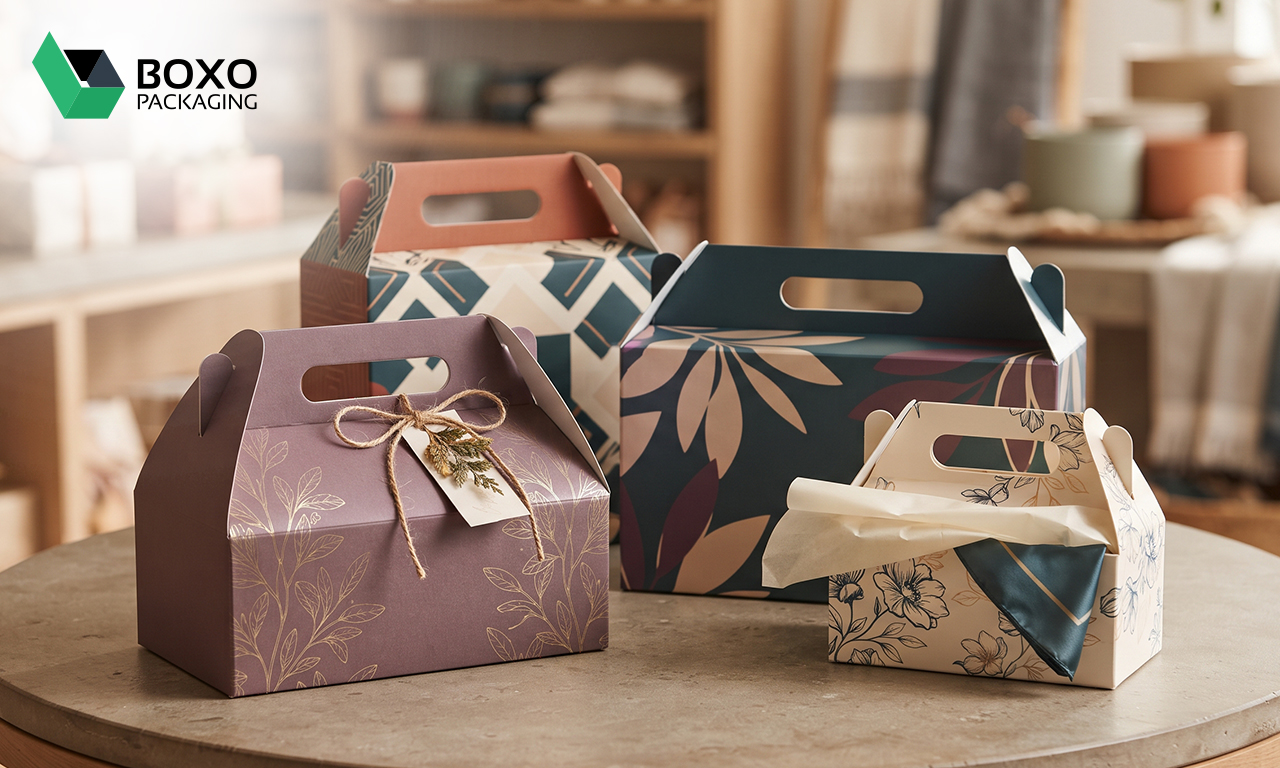
Every custom gable packaging order begins as a flat sheet with a drawing on it. That drawing, called a dieline, marks where cutting blades will separate the board and where crease rules will score it. Once the press finishes, one connected piece carries the side walls, the roof panels, and both halves of a built-in handle. Folded along its creases, it becomes a carrying box without glue, tape, or a separate handle part.
The fold is where quality shows. A crease pressed at the right depth lets the board bend in a clean line and hold its shape; a shallow crease springs open and fights assembly, while an over-pressed one cracks the fiber along the bend. Printers pull the first sheets off a run and fold them by hand before the rest of the order moves.
The Dieline That Draws the Handle Of Custom Gable Boxes
The handle is not an added component. It is a region of the dieline itself. Two angled roof panels rise from the side walls, and slots cut near their peaks interlock when the roof folds shut. Where those slots sit decides how wide the grip opens and how much finger room the carrier gets. A tight slot pattern suits small favor gables carried a short distance; a wider, deeper pattern suits a bakery box loaded with pastries for the walk to the car.
Board Caliper Against the Contents
Board choice follows the load. Light folding boxboard carries cookies, soaps, and small gifts comfortably. Heavier calipers support takeout containers, jars, or stacked items, and for genuinely heavy contents, small-flute corrugated takes over the job. Since the handle shares the same sheet as the walls, its strength is the board’s strength. Heavier contents call for heavier board, or a dieline that doubles the handle zone for reinforcement. A window patched into a front panel adds product visibility, and the film choice belongs in the same conversation as the board.
Mixing Sizes in One Order
Most businesses that buy custom gable boxes buy more than one size. A bakery might run three: a mini for single pastries, a mid format for half dozens, and a large carrier for full trays. Keeping the dielines proportional, with matched handle patterns and a consistent roof pitch, gives the custom gable packaging range a family look even at different sizes. When contents need separation, folding cartons with inserts fill in around the gables, and display boxes present multiples at the counter.
A printer like Boxo Packaging can prepare several dielines under one artwork system, so the whole range prints as a set.
Before the order goes to press, four points deserve a check:
- The heaviest planned contents, which set the board caliper and any reinforced handle zone
- Crease depth, confirmed on a folded sample rather than assumed
- Interior height with room for inserts or food liners
- Artwork orientation, so the front panel reads correctly once the roof locks
Healthcare Boxes Beyond the Pharmacy Shelf
Care happens in more places than a pharmacy counter. Healthcare boxes do their job in hospital supply rooms, on ward carts, in care homes, inside visiting clinicians’ bags, and on wellness shelves in ordinary retail. Wherever they travel, the assignment stays constant: keep the contents identified, grouped, and protected until the moment of use.
Hospital Departments and Supply Runs
A hospital orders supplies by department, and the carton often becomes the label. Boxes dedicated to wound care basics, sampling consumables, or patient hygiene items let staff restock a ward cart without recounting loose pieces. Consistent outer dimensions stack into supply room shelving, and a printed department field speeds the evening restock round. What started as packaging quietly becomes the system that keeps the supply room legible.
Kits That Travel With Visiting Nurses
Home visits pack many small necessities into one trip: gloves, dressings, wipes, documentation. A boxed kit organized by visit type lets the clinician confirm contents at a glance between appointments and restock in minutes rather than sorting loose supplies at the end of a shift. Medicine cartons for dispensed items can ride inside the same kit, grouped by patient. The box takes the inventory work out of the day.
Wellness and Over-the-Counter Lines
Wellness brands use healthcare boxes for supplements, first aid basics, and self-care ranges that sell next to food and cosmetics in mixed retail. These cartons borrow display thinking from retail packaging while keeping the clear identification of medical stock. Printed sleeve boxes add a seasonal or promotional layer without disturbing the identification panel underneath.
Reading Order on a Busy Carton
When a carton carries a name, a strength, a quantity, and directions, the layout decides what gets read first. Strong contrast, larger type for the identity line, and calm spacing guide the eye through the information in order. On a ward round or at a bedside, that reading order does quiet work.
What a well-planned healthcare carton covers:
- Identification fields sized for the name and strength that matter most
- Handling notes like orientation arrows, kept near the closure edge where hands look first
- An interior layout planned around the exact kit contents
- A closure that visibly reveals any opening between packing and use
A gable and a healthcare carton come off the same kind of press, cut from the same discipline of board, dieline, and crease. One gets engineered to be carried, the other to be read, and both earn their place when the details are settled before the run starts.