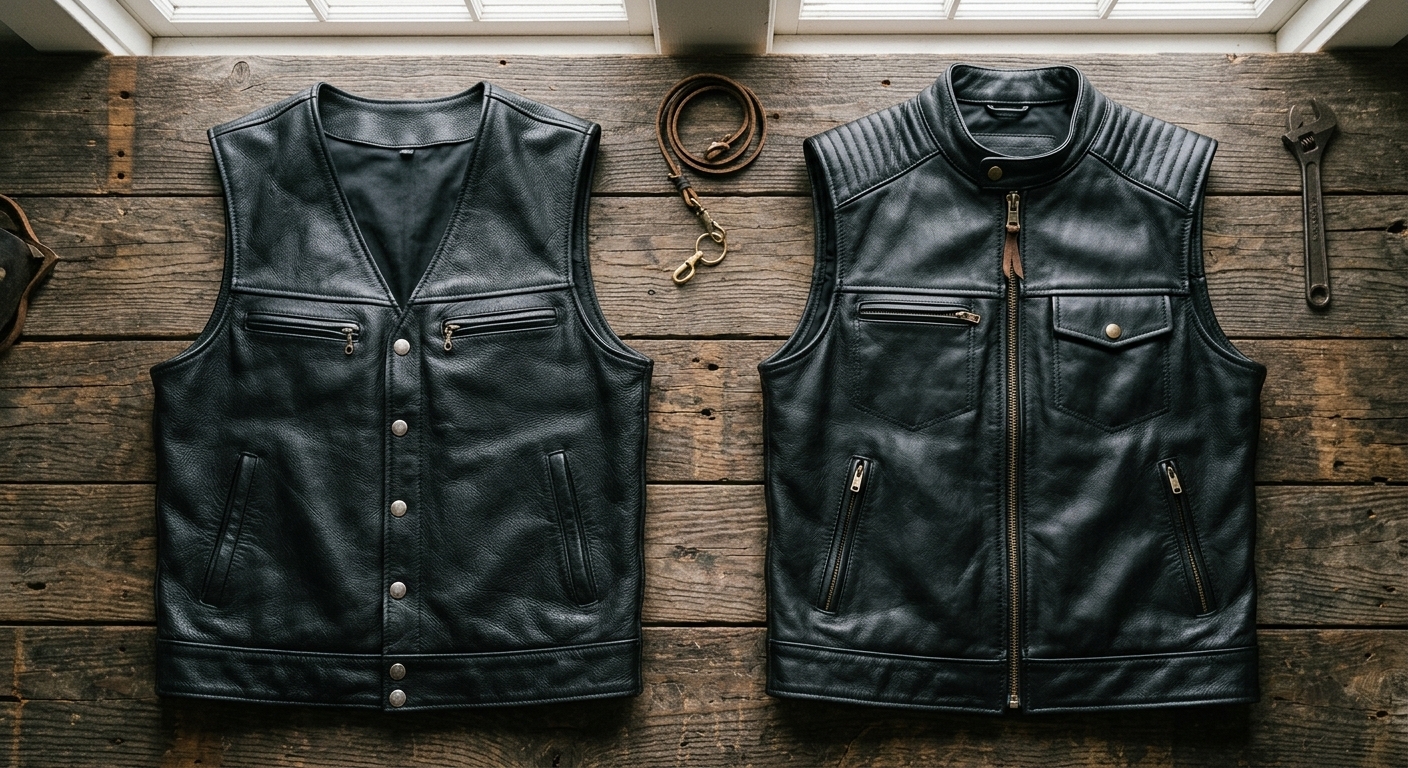
Patches become part of a rider’s identity, but the vest underneath determines how clean the final layout looks. V-neck biker vests offer classic styling with an open neckline, while club-style vests provide structured silhouettes often designed around riding function. Both can work well for large back patches, chest patches, and rockers, but the deciding factor is not simply the neckline shape.
When choosing a heavy duty men’s leather biker vest for patches, panel construction, seam placement, back-panel size, and fit all matter. So, does the neckline really determine which vest works best for patches, or is there more to it?
V-Neck Biker Vests: With Classic Cut & Plenty of Character
V-neck vests remain popular because they balance traditional motorcycle styling with practical versatility. The design features:
- Open V-shaped neckline that creates a classic biker appearance
- Snap or button front closure for easy on and off
- Easy layering over T-shirts, hoodies, and flannel shirts
- Visible chest area that works well for smaller patches
- Traditional motorcycle-club styling that has stood the test of time
A V-neck can work extremely well for patches, especially when the vest includes a large, uninterrupted back panel. The neckline provides visual openness that complements chest patches, name patches, and small logos without creating a cluttered appearance. However, the back-panel construction matters more than the neckline itself for large patches.
Club-Style Vests:Built Around a More Structured Look
Club-style vests have become popular with modern motorcycle riders who want a vest that looks purpose-built for riding. The style typically includes:
- Higher neckline or stand collar for a structured silhouette
- Shorter riding-oriented cut that works better in seated position
- Motorcycle-focused design with utility in mind
- Concealed carry or storage pockets on many models
- Full-panel backs on many designs, though not all
Club-style vests often work well for large back patches and rockers because many are constructed with patch placement in mind. However, not every club-style vest automatically provides better patch space. Construction varies between manufacturers.
V-Neck vs. Club Style: Where Do the Patches Actually Fit Better?
Comparing the two styles across patch-relevant features shows that neither wins universally:
| Area | V-Neck | Club Style |
| Chest patches | Plenty of visible space | Structured placement |
| Large back patch | Depends on back construction | Often well suited |
| Top/bottom rockers | Possible with enough panel room | Often easier |
| Traditional appearance | Strong | More modern |
| Layering | Easy | Easy |
| Patch-heavy look | Works with the right panel | Often naturally suited |
A simple V-neck with one clean back panel can be more patch-friendly than a club-style vest broken up by multiple seams, pockets, or decorative stitching.
The Real Patch Question: How Clean Is the Back Panel?
Riders buying a vest specifically for patches should inspect the back before focusing on the front neckline. The back panel determines whether large patches, rockers, and multiple emblems will fit cleanly or fight against seam placement.
Key construction features to check:
- Full back panel: One uninterrupted piece of leather provides maximum flexibility
- Minimal seams: Horizontal and vertical seams interrupt large patch layouts
- Shoulder seam placement: Patches placed too high interfere visually with shoulder construction
- Armhole clearance: Enough space so patches do not sit too close to movement areas
- Vest length: Large patches and rockers need vertical space as well as width
A vest with a clean, large back panel makes patch placement easier, allows centered alignment, supports top and bottom rockers without crowding, and creates a balanced appearance. This matters more than whether the front has a V-neck or collar.
Do You Need Big Back Patch, Rockers, or Chest Patches? Match the Vest to the Layout
Different patch layouts have different construction requirements.
Large Center Back Patch
Prioritize vests with uninterrupted back-panel space. The patch should sit centered without running into shoulder seams, side panels, or waistband construction. Measure the available space before buying the vest.
Top and Bottom Rockers
Rockers curve across the upper and lower back, requiring enough vertical room around the center patch. Check that the vest provides clearance above and below without forcing rockers too close to the collar or waistband.
Chest and Name Patches
Both V-neck and club-style vests work well for chest patches. V-necks provide a visually open chest area that complements smaller patches, while club styles offer structured placement that can frame patches cleanly.
Multiple Small Patches
Smaller patches provide more flexibility because individual patches can be positioned around construction details. Riders planning to add many small patches over time have more vest options.
Men’s and Women’s Biker Vests Need the Same Patch Planning, Not the Same Fit
Patch planning is similar for men’s and women’s vests, but fit requirements differ.
For a men’s leather biker vest, check:
- Shoulder width for comfortable movement
- Back width for large patch layouts
- Vest length for rocker placement
- Layering room over hoodies or shirts
- Comfortable fit in riding position
For a handcrafted women’s leather biker vest, check:
- Bust fit without restriction
- Waist shaping that follows natural curves
- Contoured construction and where seams sit
- Available back-panel space despite shaping
- Comfortable fit while seated on the bike
Do not size up excessively just to create more patch room. A vest should still move comfortably with the rider and maintain proper proportions. The vest needs to fit correctly both before and after patches are added.
Look Beyond Genuine Leather Before Choosing Your Patch Vest
Riders should consider more than just confirming the vest contains genuine leather. Leather quality varies significantly, and construction details affect how well the vest holds up after patches are sewn on.
Check these details before buying:
- Leather type and quality: Full-grain and top-grain offer different characteristics
- Leather thickness: Affects durability and how well it holds stitching
- Stitching quality: Reinforced seams support the vest structure
- Liner construction: Should remain intact when patches are added
- Hardware durability: Zippers and snaps need to last
A vest made from quality leather with strong construction will hold patches better and age more gracefully than one with weak seams or thin leather.
Which Cut Should You Patch Up?
The smartest choice depends on the rider’s priorities and the specific vest construction.
Choose a V-neck if:
- You prefer classic biker styling and traditional appearance
- You want an open neckline for layering
- Chest patches and name patches are priorities
- The specific vest has a clean, uninterrupted back panel
- You value the timeless leather vest silhouette
Choose a club-style vest if:
- Large back artwork is the main priority
- You want a structured, riding-focused look
- You plan to use top and bottom rockers
- The specific vest offers a full back panel without seam interruptions
- You prefer modern motorcycle styling
For patches, the smartest choice is not simply V-neck versus club style. It is the vest that gives your patch layout enough clean leather surface without compromising fit, comfort, or riding function.
Final Thoughts
The smartest choice depends on the rider’s priorities and the specific vest construction, not simply the style name. Both V-neck and club-style vests can support excellent patch layouts when built correctly.
The real answer is that for patches, the smartest choice is not simply V-neck versus club style. It is the vest that gives your patch layout enough clean leather surface without compromising fit, comfort, or riding function. Inspect the back panel construction carefully, check seam placement and how it affects your planned patches, confirm the vest fits properly in riding position, and choose based on actual construction rather than style name alone. The vest you can wear comfortably with patches you are proud to display is the right choice.