The choices we make in our personal style are rarely just about following a seasonal trend; they serve as a silent language through which we communicate who we are to the world. Every texture we choose, every color silhouette we layer, and every piece of jewelry we put on adds another line to a personal story.
For decades, traditional jewelry rules suggested that the safest path to elegant presentation was absolute uniformity. A person was strictly designated as either a gold enthusiast or a silver collector, and fine jewelry pieces were expected to be completely monochromatic to look refined.
However, modern identity is far too complex, fluid, and multidimensional to be contained by a single color tone or a uniform metal finish. Today’s luxury collectors are moving away from predictable paths and looking for pieces that embrace visual tension.
By turning contrast into a primary design medium, contemporary jewelry artisans are rewriting the script. Placing opposing metallic hues side-by-side breaks down traditional constraints, producing a dynamic aesthetic that captures human individuality with incredible accuracy.
The Visual Architecture of Dual-Tone Structures
At the core of contrast-driven ring design is a deep understanding of optical physics and visual weight distribution. When a band is forged from a single metal, environmental light bounces off its surface in a completely uniform manner. While undeniably beautiful, the continuous reflection can occasionally cause intricate structural choices or delicate hand-carved edges to flatten out and blend together.
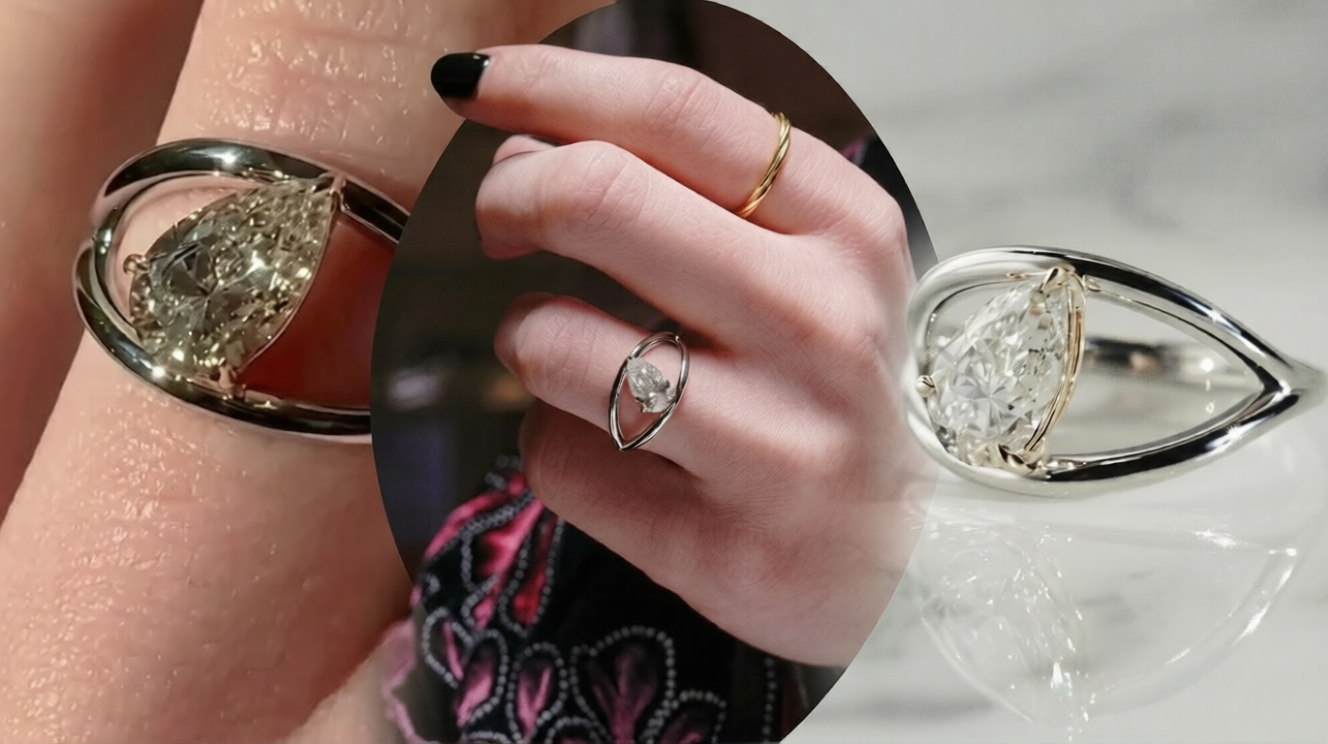
Introducing a deliberate contrast completely transforms this interaction. When a crisp, icy precious metal—such as white gold or platinum—is paired directly with a warm metal like yellow or rose gold, a clear structural conversation begins.
The cool white surface acts as a mirror, accentuating the natural, fiery light dispersion of a central stone and keeping its color clear and crisp. Meanwhile, the warm-toned precious metal anchors the design, adding an organic, sun-warmed element that stops the entire piece from appearing overly sterile or cold.
This layout creates distinct architectural layers within a very compact space. Instead of processing the ring as a flat, single plane, the eye recognizes a three-dimensional journey. The clear boundary line where the two distinct metal alloys fuse creates natural highlights and micro-shadows, ensuring that the piece shifts, adapts, and reveals entirely new facets of its personality depending on the direction of the light.
True design excellence occurs when a piece challenges the boundaries of traditional metalwork to create something entirely unexpected. For those who wish to experience how master artisans flawlessly execute this balance of metallic contrast, color theory, and light reflection under strict quality standards, you can browse two tone diamond engagement rings curated by the design experts at Antiquecut.
Freedom from the Limitations of Uniform Styling
Beyond the profound artistic and physical principles that guide mixed-metal design, there is an immensely practical advantage that aligns directly with modern lifestyles: universal styling adaptability.
Our daily routines demand absolute fluidity; we no longer wear one type of clothing or stick to one strict color family across our entire wardrobe. Traditional fashion codes often forced an uncomfortable daily choice.
If you wore a watch with a stainless steel strap, you might hesitate to put on your favourite warm gold accessories for fear of looking uncoordinated. A design built on balanced metallic contrast eliminates this daily friction completely.
Because the jewelry itself unifies warm and cool tones, it functions as a natural visual anchor for your entire accessory collection. It seamlessly ties together white gold earrings, vintage yellow gold chains, and silver bracelets into a single, cohesive statement.
This effortless versatility extends to clothing fabrics and seasonal tones as well. A single-metal piece can occasionally fight with specific textiles—crisp white gold can look washed out against soft earth tones, while intense yellow gold can feel overly aggressive against cool neon shades.
A balanced dual-tone design possesses both temperature properties, moving from a structured slate gray business suit to a warm olive weekend sweater with absolute ease.
Metallurgical Integrity and Advanced Hand-Bench Precision
Bringing a high-concept, multi-layered ring to life requires a technical precision that goes far beyond basic studio manufacturing.
A common misconception is that a dual-toned appearance is achieved by applying a thin surface plating to half a finished ring. In true luxury manufacturing, such shortcuts are completely rejected because surface coatings cannot withstand the physical wear and tear of a lifetime.
To build an enduring, structurally sound piece, entirely separate metal alloys must be independently cast, shaped, and meticulously joined together through advanced metallurgical techniques.
Every precious metal alloy carries its own unique physical properties—melting at different temperatures, offering varying levels of hardness, and responding uniquely to the polishing wheel.
Fusing them requires absolute mathematical precision to ensure that the seam where the two worlds meet is completely smooth to the human touch, yet remains razor-sharp and clearly defined to the eye.
Crafting Contemporary Heirlooms of Intention
As the world of fine jewelry continues to move forward, the most compelling statement pieces are those that look toward the future while paying deep homage to traditional artistry.
Modern couples are looking for symbols of commitment that break away from generic, mass-produced melds, choosing instead to reflect their unique, shared journeys through innovative design.
For those who wish to experience how master artisans flawlessly execute this balance of metallic contrast, color theory, and light reflection under strict quality standards, you can browse two tone diamond engagement rings curated by the design experts at Antiquecut.
Their philosophy merges heritage bench craftsmanship with progressive architectural silhouettes, ensuring that every individual ring stands as a timeless, durable showcase of visual balance and sophisticated self-expression.
Conclusion
The intersection of modern identity and contrast-driven aesthetics has permanently altered the landscape of luxury jewelry design. By embracing the vibrant visual tension between cool and warm precious metals, contemporary design has moved past the limitations of predictable uniformity to create multidimensional art forms.
These sophisticated creations offer an elegant, practical solution to modern styling while showcasing the absolute peak of metallurgical precision and technical bench skill. Choosing a piece built on this disciplined equilibrium is a powerful way to celebrate a personal story—providing an enduring statement of style that remains brilliantly relevant today and deeply cherished for generations to come.