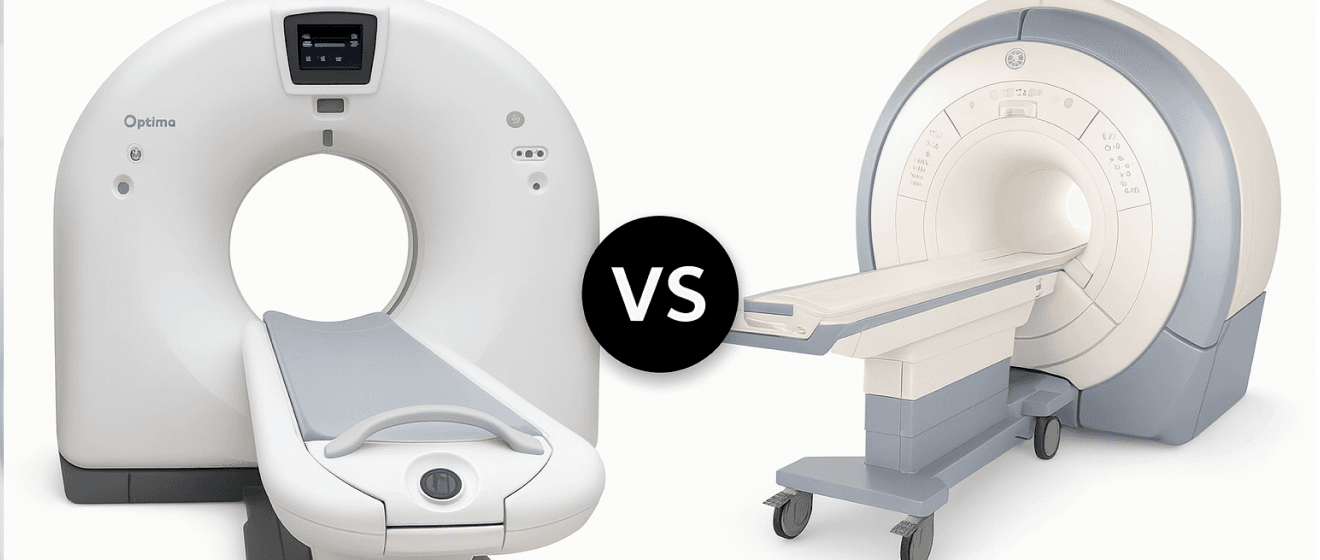
If your doctor has asked for a scan, you’ve probably wondered why they chose an MRI over a CT, or the other way round. Both produce detailed, cross-sectional images of the inside of your body — but they work on completely different physics, and each is better at seeing certain things. Knowing the difference helps you understand your own care and ask better questions.
Here’s a plain-English comparison. (Which scan you actually need is always your treating doctor’s call — this is background, not a substitute for their advice.)
The 30-second summary
– CT (Computed Tomography) uses X-rays and is fast — often just a few minutes. It’s excellent for bone, lung, bleeding, and emergencies.
– MRI (Magnetic Resonance Imaging) uses a powerful magnet and radio waves — no X-ray radiation — and takes longer. It’s superior for the brain, spinal cord, joints, and soft tissues.
Neither is “better” overall. They’re different tools for different jobs.
How they actually work
A CT scanner rotates an X-ray beam around you and reconstructs the data into detailed slices. Because X-rays pass easily through soft tissue but are blocked by dense structures, CT excels at showing bone, bleeding, and air-filled organs like the lungs.
An MRI scanner uses a strong magnetic field and radio waves to map the water (hydrogen) content of your tissues. Soft tissues differ a lot in their water content, so MRI produces beautifully detailed images of structures that CT struggles with — the brain, nerves, ligaments and cartilage.
When is a CT scan usually preferred?
CT’s speed and clarity for dense structures make it the go-to for:
– Emergencies and trauma — accidents, suspected internal bleeding, head injury
– Suspected stroke — a rapid first scan to rule out a bleed
– Lungs and chest — nodules, infections, suspected clots
– Bone injury — complex fractures and pre-surgical planning
– Kidney stones and many acute abdominal problems
When minutes matter, CT’s speed is a genuine advantage.
When is an MRI usually preferred?
MRI’s exquisite soft-tissue detail — without radiation — makes it the choice for:
– Brain and spinal cord — tumours, multiple sclerosis, seizure workup
– Spine — disc problems and nerve compression causing back or leg pain
– Joints — ligament and cartilage injuries of the knee, shoulder and others
– Pelvic and abdominal soft tissue — including characterising findings seen on ultrasound
– Soft-tissue masses anywhere in the body
If your symptoms point to nerves, joints or soft tissue, an MRI usually tells the fuller story. You can read about the available scanners and tests on the page for an MRI scan in Delhi.
Radiation: an important difference
This is one area where the two genuinely differ. CT uses ionising X-ray radiation; a single CT delivers a dose far higher than a plain X-ray. The benefit almost always outweighs the small risk when a CT is medically needed — but it’s a reason doctors avoid unnecessary repeat CTs, especially in children and younger patients.
MRI uses no ionising radiation at all, which is part of why it’s favoured when repeated imaging or soft-tissue detail is needed.
Speed, comfort and cost
– Speed: CT is quick (often under 10 minutes). MRI takes longer — commonly 20–45 minutes — and you need to stay still throughout.
– Noise and space: MRI is noisy and the tube is more enclosed, which can feel confining; wide-bore and open options help, and the staff can talk you through it.
– Cost: MRI is generally more expensive than CT, reflecting the technology and scan time.
– Implants: Because MRI uses a strong magnet, you must declare any pacemaker, metal implant or device beforehand so staff can screen you for safety.
So — which one do you need?
In practice, you don’t choose; your doctor does, based on your symptoms, what they’re looking for, how urgent it is, and your safety considerations. The useful thing to know is why: if it’s bone, bleeding or an emergency, expect a CT; if it’s brain, nerves, joints or soft tissue, expect an MRI. If you’re unsure why a particular scan was ordered, it’s perfectly reasonable to ask — or to talk to the radiology team at the centre before your appointment.
Frequently asked questions
Is an MRI safer than a CT because there’s no radiation?
MRI avoids ionising radiation, which is an advantage for repeated or soft-tissue imaging. But “safer” depends on the clinical question — for a suspected bleed or a lung problem, a CT is the right and safe choice. The best scan is the one that answers your doctor’s question.
Why can’t one scan do everything?
Because they see different things. CT is unmatched for bone, bleeding and speed; MRI is unmatched for soft-tissue detail. Sometimes a patient needs both, for different reasons.
Do I need to prepare?
It depends on the scan and whether contrast is used. For MRI, remove all metal and declare any implants; for some scans, light fasting is advised. The centre will give you specific instructions when you book.
—
This article was contributed by the team at Saral Diagnostics, a diagnostic centre in Pitampura, New Delhi offering imaging (MRI, CT and more), pathology and preventive health check-ups, with home sample collection across Delhi NCR. Learn more at saraldiagnostics.com
Educational information only — not a substitute for personalised medical advice. Your treating doctor decides which scan is right for you.