Every agency knows the real moment of truth isn’t the campaign — it’s the monthly report. That’s when a client silently decides whether you’re worth the retainer. Great work with a weak report gets churned; solid work with a clear, confident report gets renewed and referred.
Yet most agency reports are either a data dump nobody reads or a handful of vanity numbers that don’t answer the only question the client actually has: “What did I get for my money?” Here’s a framework for reporting social media ROI in a way that retains clients.
Reporting is really a retention activity
Reframe the monthly report from “admin we owe the client” to “the most important client-facing deliverable we produce.” A client who understands the value they’re getting renews. A client who can’t see it churns — even if the underlying work was excellent. Your report is where perceived value is created or lost.
Start with the client’s goal, not the platform’s metrics
The fastest way to write an irrelevant report is to open the analytics dashboard and start copying numbers. Instead, start with what the client is paying you to achieve. Awareness? Leads? Foot traffic? Online sales? Community?
Every report should open by restating that goal, then show progress against it. The same “10,000 impressions” is a triumph for an awareness client and a near-irrelevance for a leads client. Context is the whole job.
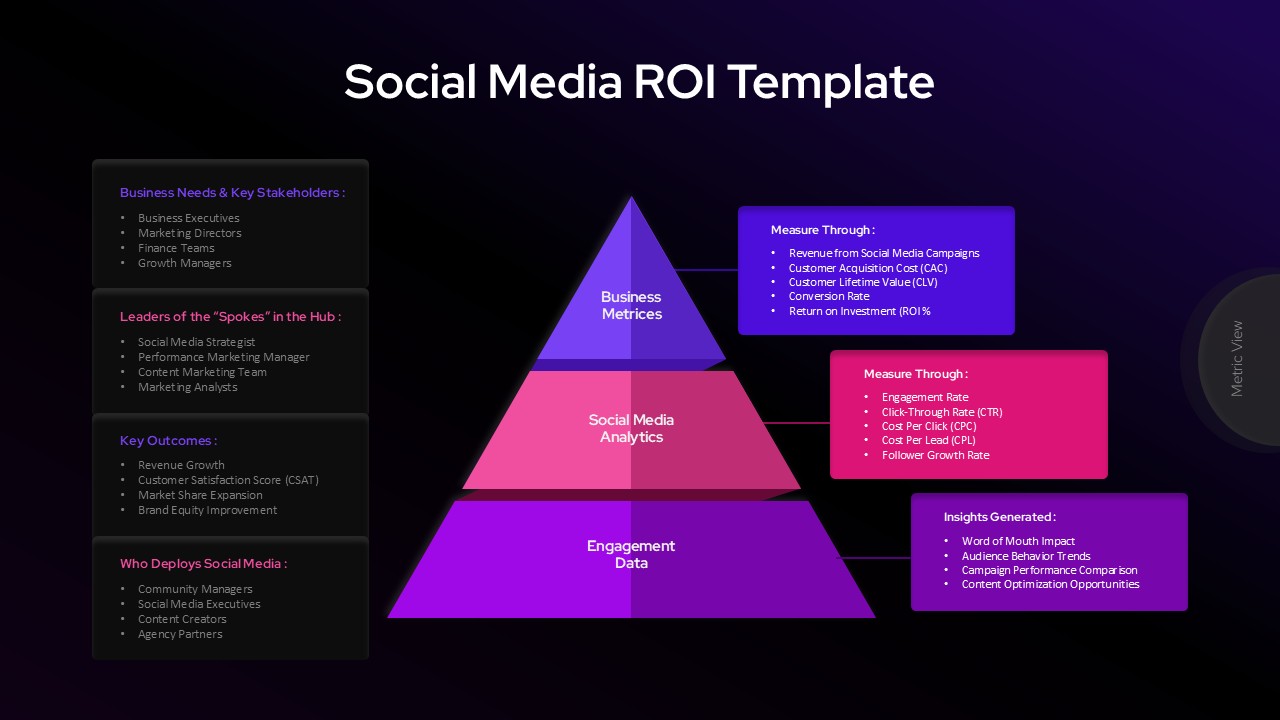
The three layers of a social report
Structure every report as a pyramid, narrow at the top:
Layer 1 — Outcomes (what the client cares about). Leads, bookings, sign-ups, sales, calls, direction requests — whatever maps to their goal. This goes first.
Layer 2 — Engagement (how the audience responded). Saves, shares, comments, click-through, profile actions. These explain the outcomes.
Layer 3 — Activity (what you did). Posts published, stories, reels, response times. This is proof of work, and it goes last — never first.
Most agencies invert this and lead with activity. Clients don’t pay for posts; they pay for outcomes. Lead with outcomes.
Metrics that matter vs. vanity metrics
Be ruthless about what earns a place on the page:
Keep: reach to the right audience, engagement rate, saves and shares, click-through, profile and website actions, lead or conversion volume, review growth, and response time.
Cut or caveat: raw follower count, raw impressions with no context, and “likes” as a headline. They feel good and prove nothing.
A shorter report built from meaningful metrics beats a ten-page export every time.
Make it readable: the anatomy of a report that gets read
A one-line executive summary up top. “This month we drove X leads, up Y% — here’s what worked.” Busy clients read this and nothing else; make it count.
Progress against the stated goal, with a simple month-over-month comparison.
Three to five highlights, not fifty metrics. Your best post, your biggest win, your most important trend.
A short “what we learned and what’s next” section. This is where you sound like a strategist, not a vendor.
Visuals over tables. One clear chart beats a wall of numbers.
Tie it back to money — even when attribution is messy
Social attribution is rarely perfect, and clients know it. Don’t overclaim; do connect the dots honestly:
Use the client’s own numbers. “You told us you closed 6 new patients from Instagram DMs this month” is more persuasive than any impression count.
Translate actions into value where you reasonably can — a direction request, a call, a form fill each has a rough worth the client can estimate.
Be transparent about what you can’t attribute. Honesty here builds the trust that renews contracts.
Automate the gathering so you spend your time on insight
The trap most agencies fall into: spending hours each month screenshotting dashboards across ten client accounts, leaving no time for the part that actually earns the retainer — the thinking. Pull your numbers automatically instead. A good social media reporting tool aggregates each client’s cross-channel metrics into one place, so the data assembles itself and you spend your hours on interpretation, not collection. The agencies that scale are the ones that stopped hand-building reports.
The one slide that renews the contract
If you add nothing else, add a single “so what?” slide: in plain language, what this month’s results mean for the client’s business and what you’ll do next month to push the goal further. That slide — not the raw data — is what makes a client feel the retainer is working.
The takeaway
Reporting isn’t the boring tax on real work; it’s where client relationships are won or lost. Start from the client’s goal, lead with outcomes over activity, cut vanity metrics, write a summary a busy owner will actually read, connect results to money honestly, and automate the data-gathering so your time goes into insight. Do that and your reports stop being a monthly chore and start being your best retention tool.
Author bio: [Your Name] is [role] at OwlKonnect, a social media management platform for scheduling, analytics, and client reporting across every major channel.