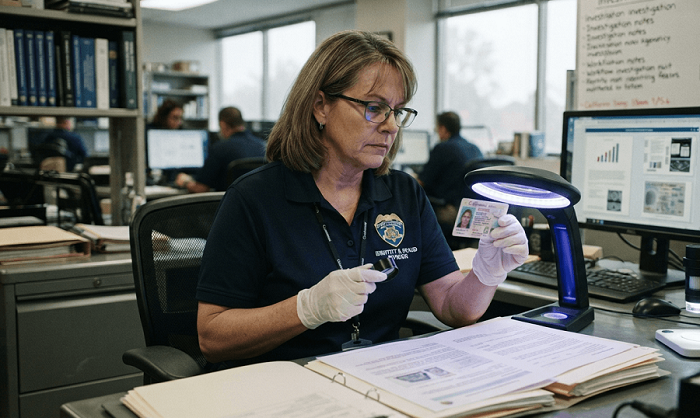
A fake ID can appear to offer a quick solution to an identification problem, but the consequences of using, purchasing, or distributing counterfeit identification can extend far beyond the document itself. What may initially seem like a simple transaction can expose someone to financial scams, identity theft, legal trouble, and complications involving future identification applications.
The term fake ID covers several different situations, including counterfeit government identification, altered identity documents, unauthorized reproductions, and novelty cards that are not valid for official identification purposes. Understanding these distinctions matters because a novelty card used as a film prop is not necessarily the same thing as a counterfeit document presented to deceive a business or government agency.
Online searches for fake identification also raise an important consumer-protection question: How can someone distinguish a legitimate identification service from a website making misleading promises?
This guide examines the legal framework, online purchasing risks, identity theft concerns, document verification, and lawful alternatives available in the United States. It also explains why attractive product claims, customer testimonials, and barcode-related marketing should not be treated as proof that an identification document is genuine or legally acceptable.
Understanding What a Fake ID Actually Means
A fake ID is generally an identification document that is counterfeit, forged, altered, or otherwise presented as genuine without proper authorization.
However, not every unofficial identification card has the same legal meaning or intended purpose. Context, intent, document type, and applicable law all matter.
Counterfeit, Altered, and Novelty Identification
Understanding the differences helps prevent confusion.
| Identification type | General meaning | Official identification status |
| Counterfeit ID | An unauthorized reproduction of an identification document | Not genuine |
| Altered ID | A genuine document modified without authorization | Not valid as an authentic unaltered document |
| Forged ID | A document containing unauthorized or fraudulent information or execution | Not genuine |
| Novelty ID | A decorative or entertainment-oriented identification card | Not an official government credential |
| Prop identification | A document created for a production or fictional setting | Not valid for official identity verification |
| Government-issued ID | A credential issued by an authorized government agency | Subject to its issuing authority’s requirements |
The distinction between novelty products and fraudulent identification is particularly important.
A clearly fictional prop created for a film production may have a legitimate entertainment purpose. However, representing an unauthorized document as genuine to obtain access, services, financial benefits, or age-restricted products can create serious legal consequences.
Why the Intended Use Matters
The purpose behind possessing or presenting a document can influence how authorities evaluate the situation.
For example, a fictional identification card displayed in a theater production is different from an altered driver’s license presented to establish someone else’s identity.
A document’s physical appearance alone does not establish its legal status. Authorization, intended use, and applicable regulations must also be considered.
Why Fake ID Searches Can Lead to Consumer Risks
People searching for fake identification may encounter online stores advertising customized cards, realistic appearances, holographic features, barcode functionality, and international shipping.
These marketing claims can create an impression of reliability. Nevertheless, a professionally designed website does not establish that a seller is legitimate, that a product is genuine, or that its use is lawful.
There are several important risks to understand before interacting with an unfamiliar identification-related website.
Misleading Product Claims
Some websites advertise features such as:
- Government-style identification designs.
- Holographic visual effects.
- Barcode or QR-code functionality.
- Personalized photographs and information.
- Premium plastic materials.
- Discreet shipping.
- International delivery.
These descriptions are marketing statements, not independent verification.
A barcode that can be read by a scanning application does not establish that a credential was issued by a government agency. Similarly, a holographic appearance does not establish authenticity or legal recognition.
Consumers should avoid treating technical-sounding product descriptions as proof of legitimacy.
Financial Scams and Unfulfilled Orders
Online sellers may request payment without providing meaningful consumer protections.
Potential problems include:
- Payments accepted without delivery.
- Unresponsive customer support.
- Unexpected additional charges.
- Misleading refund policies.
- Payment information collected through suspicious websites.
- Difficulties disputing international transactions.
A low advertised price is not evidence of a trustworthy transaction.
Consumers should also understand that payment disputes do not automatically eliminate potential legal exposure associated with purchasing or using counterfeit identification.
Personal Information Exposure
Identification-related websites may request photographs, names, dates of birth, addresses, and other personal information.
This creates a separate privacy concern.
Information submitted to an untrustworthy operator could potentially be retained, disclosed, misused, or exposed through inadequate security practices.
The consequences may include targeted phishing, impersonation attempts, fraudulent account applications, or other forms of identity misuse.
Consumers should be especially cautious when an unfamiliar website requests sensitive information without providing verifiable information about its ownership, privacy practices, and legitimate business purpose.
Legal Risks of Buying, Possessing, or Using a Fake ID in the United States
The legal consequences of counterfeit identification depend on the document involved, the conduct, the person’s intent, and the jurisdiction.
There is no single penalty that applies to every fake ID situation across the United States.
Federal Identification Document Laws
One important federal statute is 18 U.S.C. § 1028, which addresses fraud and related activity involving identification documents, authentication features, and personal identifying information.
Depending on the circumstances, the statute covers conduct such as:
- Knowingly producing identification documents without lawful authority.
- Transferring documents known to have been stolen or unlawfully produced.
- Possessing certain false identification documents with unlawful intent.
- Using another person’s identifying information in connection with specified unlawful activities.
- Trafficking in authentication features intended for fraudulent identification documents.
The statute establishes different penalties depending on the particular offense and circumstances. Certain violations can carry substantial fines and imprisonment.
Importantly, not every possession or use scenario automatically falls under the same federal provision. The statutory requirements must be evaluated individually.
State Laws and Local Regulations
States also establish their own rules concerning identification fraud, driver’s licenses, age-restricted transactions, and false statements.
A situation involving an altered driver’s license may be treated differently from one involving an attempt to purchase alcohol using another person’s identification.
Possible consequences, depending on the applicable law, include:
- Criminal charges.
- Monetary fines.
- Court appearances.
- Probation.
- Suspension or other licensing consequences.
- Additional penalties for related fraud or identity theft.
Some situations may involve both state and federal laws.
For example, Georgia’s Department of Driver Services identifies making and using counterfeit identification as criminal conduct and discusses related driver’s-license fraud provisions.
Why Legal Consequences Cannot Be Reduced to One Number
Online articles sometimes advertise a single fine or prison sentence as the universal penalty for using a fake ID.
That approach is misleading.
Consider these different situations:
| Situation | Important legal consideration |
| Possessing a fictional novelty card | Its purpose and applicable laws matter |
| Presenting a counterfeit driver’s license | State law and circumstances matter |
| Using another person’s identity | Additional identity-fraud laws may apply |
| Producing unauthorized government-style documents | Federal and state provisions may apply |
| Selling counterfeit identification | Production, transfer, and fraud-related laws may apply |
Anyone facing an investigation or criminal allegation should consult a qualified attorney in the relevant jurisdiction rather than relying on generalized online penalty estimates.
How to Evaluate Online Fake ID Websites Without Falling for Scams
An identification-related website may appear professionally designed while providing little independently verifiable information about its business operations.
Consumers should separate three questions:
- Does the website provide verifiable business information?
- Are its product claims independently supported?
- Is the advertised product lawful for the intended purpose?
A positive answer to the first question does not automatically establish the other two.
Examine Business Transparency
Before trusting an unfamiliar website, consider whether it clearly identifies:
- The legal business name.
- Its operating jurisdiction.
- A verifiable business address.
- Customer-service contact information.
- Privacy practices.
- Refund and cancellation policies.
- The actual purpose of its products.
A website that provides vague ownership information or makes broad international claims without supporting details deserves additional scrutiny.
Treat Customer Testimonials Carefully
Testimonials are not independent proof of a company’s reliability.
A page displaying positive customer statements does not necessarily establish that:
- The reviewers are genuine customers.
- The transactions occurred as described.
- The business delivered the advertised products.
- The products are legally acceptable.
- The business has been independently evaluated.
Consumers should not mistake a collection of favorable statements for an independently verified reputation.
Understand the Difference Between Technical Claims and Legal Validity
A particularly important misconception involves scannable identification.
A product description may mention barcodes, QR codes, holographic effects, or compatibility with scanning applications.
However, these features do not establish government authorization.
Technical functionality and legal validity are separate questions. A digital or physical representation that contains readable information does not automatically become an authorized identity credential.
For this reason, consumers should never rely on a seller’s marketing claims when deciding whether a document can legitimately be used for official identification.
How Fake Identification Can Create Identity Theft Problems
Financial loss is not the only risk associated with suspicious identification websites.
Personal information can be more valuable than the original payment.
Someone who submits identifying details to an untrustworthy operator may expose information that can be reused in other fraudulent activities.
Information That Deserves Protection
Sensitive information includes:
- Full legal name.
- Date of birth.
- Residential address.
- Personal photographs.
- Government identification numbers.
- Account credentials.
- Payment details.
The combination of several ordinary personal details can make impersonation and targeted fraud easier.
What to Do if You Have Already Shared Personal Information
If you believe a suspicious website has collected your information, take practical steps.
1. Secure your important accounts.
Change passwords for affected accounts, especially if you reused the same password elsewhere. Enable multifactor authentication where available.
2. Contact your financial institution.
If you submitted payment information to a suspicious seller, contact your bank or card issuer using its official contact details.
3. Monitor your financial records.
Review account activity and statements for unfamiliar transactions.
4. Consider a credit freeze.
A credit freeze can restrict access to your credit report and make it more difficult for someone to open new credit accounts in your name. Contact the three nationwide credit bureaus for their procedures.
5. Report identity theft.
The Federal Trade Commission provides an official reporting and recovery resource through IdentityTheft.gov.
6. Preserve relevant records.
Keep transaction confirmations, correspondence, and other relevant records if you need to dispute a payment or report suspected fraud.
The appropriate response depends on what information was disclosed and whether it has been misused.
What Modern Identity Verification Actually Establishes
Identity verification is not simply a matter of looking at a photograph or reading information printed on a card.
Organizations may use different procedures depending on their responsibilities, regulatory requirements, and the risk associated with a transaction.
Visual Examination
A person reviewing an identification document may compare the information presented with the individual and the purpose of the transaction.
This is one part of an identification process, not universal proof of authenticity.
Electronic Verification
Some organizations use authorized electronic verification services to confirm information.
Depending on the service and applicable permissions, these processes may involve comparisons against trusted records or issuing-authority information.
The specific checks differ across organizations.
Identity and Transaction Context
Verification can also involve examining whether the identification information is consistent with the transaction being requested.
For example, a financial institution may have obligations that extend beyond simply recording a customer’s name.
Its identity-verification procedures may be part of broader customer identification and anti-fraud requirements.
Why No Single Feature Guarantees Acceptance
An identification document may contain information that appears consistent without being legally issued.
Likewise, an authentic document may not be accepted for every purpose.
Acceptance depends on the institution, transaction, document category, applicable requirements, and verification procedure.
This is why a private seller’s claim that a product is universally accepted should never be treated as authoritative.
Legitimate Identification Alternatives in the United States
People sometimes search for fake identification because they do not understand the legitimate options available to them.
In many situations, an official replacement, state-issued identification card, or alternative government credential can address the underlying problem.
State-Issued Identification Cards
Every state has an official agency responsible for driver’s licenses and state identification services.
A person who does not drive may still be eligible for a state-issued identification card.
Requirements differ by state, but applications commonly involve identity, residency, and other supporting documentation.
The correct procedure is to consult the official state motor vehicle agency.
REAL ID-Compliant Identification
REAL ID is a federal standard for certain state-issued driver’s licenses and identification cards.
Since May 7, 2025, REAL ID-compliant identification or another acceptable document has been required for covered federal purposes, including boarding federally regulated commercial aircraft.
A REAL ID-compliant driver’s license or identification card is not required for every ordinary identification situation.
The appropriate credential depends on what the person needs to do.
U.S. Passports and Passport Cards
A U.S. passport is an official federal identity and travel document.
A passport card is another government-issued option with different travel limitations.
Both may be accepted for certain identification purposes, although individual organizations can have requirements specific to their services.
Other Acceptable Travel Identification
Depending on the traveler and circumstances, other credentials may be accepted at airport security checkpoints.
These include certain Department of Homeland Security trusted-traveler cards, permanent resident cards, military identification, and qualifying tribal identification documents.
Travelers should consult the current Transportation Security Administration requirements before departure.
Replacement of Lost or Stolen Identification
If an identification document has been lost or stolen, the appropriate response is to contact the issuing agency.
Depending on the document, this may involve:
- Reporting the loss or theft.
- Requesting a replacement.
- Providing supporting documentation.
- Paying an applicable replacement fee.
- Following identity-verification procedures.
Using the issuing authority’s official process helps preserve the validity of the replacement credential.
What to Do If You Need Identification for a Specific Purpose
The best identification option depends on why the document is needed.
Different institutions have different acceptance requirements.
| Identification need | Legitimate approach |
| Domestic air travel | REAL ID-compliant license or another TSA-accepted credential |
| Age verification | Government-issued identification accepted by the business |
| Opening a bank account | Documents accepted under the institution’s identity-verification requirements |
| Employment verification | Documents permitted under applicable federal employment-verification rules |
| Replacing a lost driver’s license | Apply through the state licensing agency |
| General identification | Apply for an official state identification card |
| International travel | Obtain the appropriate government-issued passport |
If You Need Identification for Air Travel
Travelers should not assume that a standard identification card will meet every airport requirement.
The Transportation Security Administration maintains an official list of acceptable identification documents.
If someone does not have a REAL ID-compliant driver’s license, a passport or another qualifying credential may provide an alternative.
As of February 1, 2026, TSA also offers ConfirmID as a paid identity-verification option for eligible travelers who arrive without an acceptable identification document. This process does not guarantee successful verification.
If You Need Proof of Age
A business selling age-restricted products may have its own identification acceptance procedures, subject to applicable law.
A novelty card or privately produced identification document is not a substitute for an authorized government credential.
If your existing identification is expired, lost, or unavailable, ask the business which legitimate alternatives it accepts.
If You Need Identification for Banking
Financial institutions must follow applicable customer-identification requirements.
A bank may request specific information and documents to establish a customer’s identity.
If you do not have the requested document, contact the institution directly and ask what alternative documentation it accepts.
Requirements can vary according to the account, institution, and applicable regulations.
Common Misconceptions About Fake IDs
Several misunderstandings contribute to unnecessary financial and legal risks.
Misconception 1: A Scannable Barcode Means an ID Is Genuine
A barcode that produces readable information does not prove that a document was lawfully issued.
Technical functionality and official authorization are separate matters.
Misconception 2: A Novelty ID Can Be Used Anywhere
Novelty identification products may have legitimate entertainment or collectible purposes.
That does not make them acceptable for banking, travel, government transactions, or age verification.
Misconception 3: Online Customer Reviews Prove a Seller Is Trustworthy
Reviews can provide context, but they do not independently establish business legitimacy, product authorization, or legal compliance.
Misconception 4: Ordering a Document From Overseas Removes U.S. Legal Risks
International shipping does not automatically remove the potential application of U.S. laws.
The circumstances of production, transfer, possession, and use remain important.
Misconception 5: Only the Person Using a Fake ID Can Face Consequences
Depending on the applicable law and conduct, individuals involved in producing, transferring, or facilitating fraudulent identification may also face legal exposure.
Misconception 6: All Identification Documents Have the Same Acceptance Rules
A driver’s license, passport, passport card, student identification card, and novelty credential serve different purposes.
An organization accepting one type of identification is not required to accept every other type.
A Practical Consumer Protection Checklist
Before interacting with an identification-related website, consider these questions:
- Does the website clearly explain its business identity?
- Are its claims independently verifiable?
- Does it distinguish novelty products from government-issued credentials?
- Does it explain how submitted personal information is handled?
- Are payment and refund terms transparent?
- Is it asking for unnecessary sensitive information?
- Does it make unrealistic claims about universal acceptance?
- Can the intended identification need be addressed through an official government agency instead?
A website that makes extraordinary claims without verifiable supporting information should not be treated as a reliable identification provider.
The safest approach is to obtain official credentials directly from the government agency responsible for issuing them.
Conclusion
The subject of fake ID involves much more than the appearance of an identification card. It raises important questions about legal authorization, identity verification, online consumer protection, privacy, and personal responsibility.
A website advertising realistic identification, barcode functionality, holographic effects, or international delivery does not establish that its products are genuine government credentials or lawful substitutes for official identification.
Under U.S. law, certain activities involving counterfeit identification, unauthorized document production, and identity misuse can result in serious consequences. The exact legal treatment depends on the applicable federal, state, and local provisions and the circumstances of the conduct.
Consumers should also consider the financial and privacy risks associated with unfamiliar online sellers. Submitting photographs, personal information, and payment details to an unverified operator can create problems that continue long after an online transaction.
Fortunately, legitimate options exist. State-issued identification cards, driver’s licenses, passports, passport cards, and other authorized credentials can meet many common identification needs.
When identification is required for travel, employment, financial services, or age verification, the most responsible approach is to confirm the applicable requirements with the relevant organization and obtain documents through authorized issuing agencies.
Ultimately, a genuine identification credential is valuable because of its lawful issuance and recognized validity, not simply because it looks convincing.
Frequently Asked Questions
1. What is a fake ID?
A fake ID is an identification document that is counterfeit, forged, altered, or otherwise unauthorized. It may be designed to resemble a government-issued credential, but its appearance does not establish legal authenticity.
2. Is using a fake ID illegal in the United States?
It can be illegal. Federal and state laws address different forms of identification fraud, including unauthorized production, fraudulent use, and identity misuse. The specific offense and potential penalties depend on the circumstances and applicable jurisdiction.
3. Can buying a fake ID create legal problems?
Yes. Depending on the transaction, document, intent, and applicable laws, purchasing or possessing counterfeit identification may create legal exposure. Buying a document online does not automatically make its possession or intended use lawful.
4. Are scannable fake IDs considered genuine identification?
No. A readable barcode or QR code does not establish that an identification document was issued by an authorized government agency. Technical functionality is not equivalent to official validity.
5. Are novelty identification cards legal?
Novelty cards may have legitimate uses in entertainment, collecting, and theatrical productions. However, their legality depends on applicable laws, design, labeling, and intended use. They should never be represented as genuine government-issued identification.
6. What should I do if an online fake ID website takes my money?
Preserve transaction records and contact your bank or payment provider through its official channels. If you suspect fraud, report it to the appropriate consumer-protection authorities. Avoid submitting additional personal or financial information to the seller.
7. Can fake ID websites steal personal information?
Untrustworthy websites may misuse information submitted by visitors. Personal photographs, addresses, birth dates, payment details, and other identifying information can create privacy and identity-theft risks if improperly handled.
8. What can I use instead of a fake ID?
Legitimate alternatives include state-issued identification cards, driver’s licenses, U.S. passports, passport cards, and other government-issued credentials. The correct option depends on the purpose and the organization’s acceptance requirements.
9. What is REAL ID, and do I need one?
REAL ID establishes federal security standards for certain state-issued identification documents. Since May 7, 2025, REAL ID-compliant identification or another acceptable credential has been required for covered federal purposes, including domestic air travel. A passport is one alternative. Not every everyday identification situation requires REAL ID.
10. Where can I replace a lost or stolen identification card?
Contact the government agency that originally issued the document. For a driver’s license or state identification card, consult your state’s official motor vehicle agency. For a U.S. passport, use the official U.S. Department of State process.