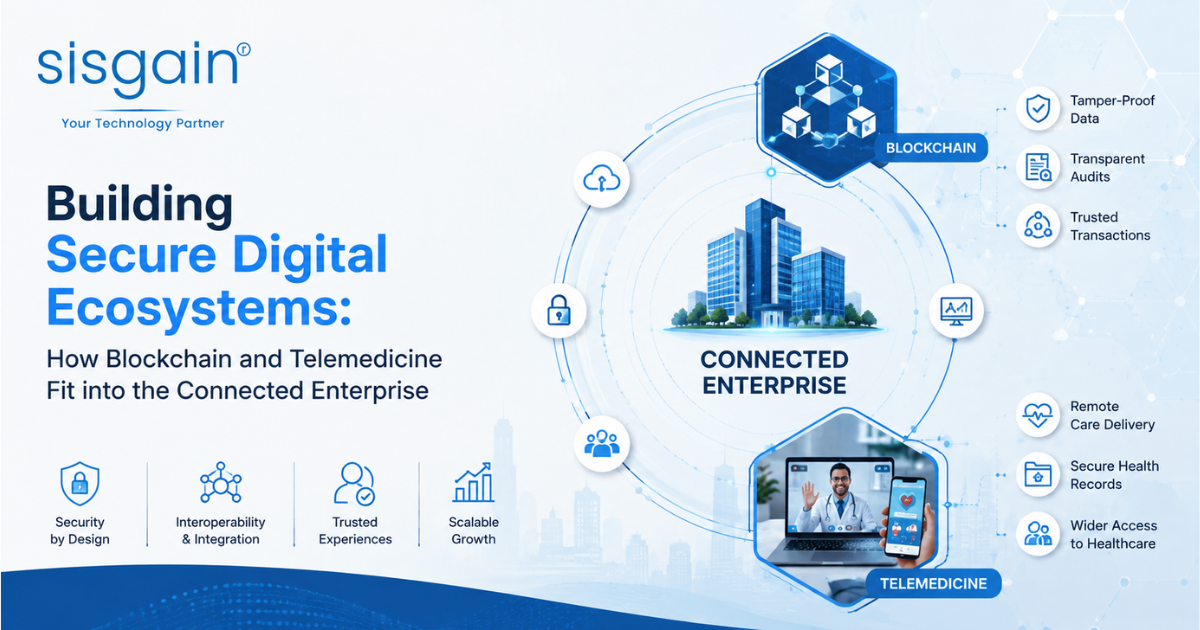
Building Secure Digital Ecosystems: How Blockchain and Telemedicine Fit into the Connected Enterprise
Why Businesses Need Secure Digital Ecosystems
U.S. businesses are moving past the era of standalone applications. A patient portal here, a billing tool there, and a collaboration suite somewhere else—each product may work well alone, yet the gaps between them are where friction, cost, and risk accumulate. Organizations now want a Secure Digital Ecosystem where data moves safely, systems communicate seamlessly, and users enjoy a consistent experience across interconnected platforms.
Five priorities keep surfacing in these conversations: data security, interoperability, scalability, real-time information exchange, and polished digital experiences. Two technologies often enter the discussion. Blockchain offers a way to create shared, tamper-evident records between parties who do not fully trust one another. Virtual care, meanwhile, has matured from simple video calls into a connected clinical channel.
The central argument of this article is simple: technology alone is not enough. Results depend on architecture, governance, security controls, and a disciplined implementation strategy. Blockchain is genuinely useful for specific problems, but it is not a cure-all, and any vendor promising otherwise deserves skepticism.
Healthcare raises the stakes. Patient information is among the most sensitive data an organization can hold, and U.S. rules around privacy and security shape nearly every design decision. The sections below explain what a secure ecosystem looks like, where each technology belongs, and how to build one that lasts.
What Is a Secure Digital Ecosystem?
A secure digital ecosystem is an interconnected technology environment in which applications, users, data, APIs, cloud infrastructure, and business processes operate together under consistent protections. The word “secure” matters as much as “ecosystem”: connection without control simply spreads risk faster.
So what makes a digital ecosystem secure? In practice, several characteristics work in combination:
- Protected data exchange between systems
- Identity and access management that confirms who is asking and what they may see
- API-based interoperability built on documented standards
- Clear data governance covering ownership, retention, and sharing
- Encryption and privacy controls applied by default
- Scalable cloud infrastructure
- Continuous monitoring and a rehearsed incident response plan
- Dependable integration so records stay consistent across platforms
For U.S. companies, the alternative is costly. Fragmented applications produce data silos, security gaps, duplicate records, frustrating customer journeys, painful integrations, and wasted staff time. A well-designed ecosystem replaces that patchwork with a coordinated whole.
How Blockchain Strengthens Digital Ecosystems

Business leaders should think of blockchain as shared record-keeping infrastructure rather than as cryptocurrency. Its value lies in a handful of capabilities.
Data integrity. Records written to a blockchain are tamper-evident, so any later alteration is detectable. Authorized participants can view the same version of a record, and transactions can be verified without relying on one party’s word.
Decentralized trust. In suitable cases, multiple organizations can coordinate around a common ledger instead of depending on a single database owner or intermediary. This is most helpful when several independent parties need to agree on facts.
Smart contracts. Automated rules can handle approvals, verification steps, agreements, and workflow triggers. When defined conditions are met, the next action fires without manual follow-up.
Auditability. Because activity is time-stamped and difficult to rewrite, blockchain-based records support traceability and accountability during reviews and investigations.
A crucial expert caution: sensitive information should not be dumped directly onto a blockchain. Immutable ledgers collide with privacy obligations, deletion requests, and storage limits. A more realistic pattern keeps sensitive data in secure off-chain storage and records only a verification reference on the chain. That design preserves privacy and scalability while still delivering proof that a record has not been altered.
Because these design choices are hard to reverse once records are written, the choice of partner matters. A capable Blockchain Development Company should be able to explain which data belongs on-chain, how cryptographic keys will be managed, and how the ledger will connect to your existing systems before any code is written.
Why Telemedicine Is Becoming a Core Component of Digital Healthcare Ecosystems
Virtual care has outgrown the video visit. A modern platform is a web of connected services, including:
- Patient mobile applications and provider portals
- Video consultations and appointment scheduling
- Electronic health records
- Digital prescriptions
- Remote patient monitoring and medical IoT devices
- Secure messaging
- Payment systems
- Analytics platforms
- APIs linking to outside healthcare systems
Every one of those connections is a potential point of exposure, and each must still feel effortless to a patient using a phone or a clinician between appointments. Usability and protection cannot be traded against each other; both must be designed in.
HHS guidance stresses that telehealth platforms need safeguards for protected health information, and that the privacy requirements in play can vary depending on which organizations and technologies are involved. That variability is exactly why architecture decisions should be made early.
Businesses investing in telemedicine app development services should prioritize secure architecture, interoperability, user authentication, data protection, and scalable infrastructure from the beginning, rather than treating security as a later-stage feature. Retrofitting controls after launch is slower, costlier, and rarely as effective.
Combining Blockchain and Telemedicine: Where the Technologies Fit
This is where the two ideas meet, and where discipline matters most. Several use cases show genuine promise.
Patient data verification. Blockchain can help confirm the integrity or provenance of selected healthcare records, proving a document was not changed after it was created.
Consent management. Distributed records can support auditable consent workflows, showing when a patient granted or withdrew permission and for what purpose.
Provider credential verification. Credentials and organizational relationships can be checked against shared records where appropriate, reducing manual verification effort.
Medical data exchange. Here blockchain should complement, not replace, existing healthcare interoperability infrastructure. It can add a trust and audit layer on top of established exchange methods.
Prescription and transaction tracking. Selected workflows benefit from traceability across the steps between prescriber, pharmacy, and patient.
Insurance and claims workflows. Verification, automated workflow triggers, and reduced reconciliation friction are plausible gains.
One clarification deserves emphasis: blockchain does not automatically make healthcare data “100% secure,” and no responsible provider should say so. Actual protection depends on architecture, access controls, encryption, key management, governance, infrastructure, application security, and compliance processes. A chain is only as trustworthy as the systems and people surrounding it.
Building Interoperability Into the Ecosystem
An ecosystem that cannot exchange information is just a collection of tools. Interoperability turns separate systems into a coordinated environment, and it becomes more important as new components join.
Systems that commonly need to connect include EHR and EMR platforms, virtual care applications, CRM systems, billing and payment gateways, insurance systems, laboratory and pharmacy platforms, IoT devices, and analytics tools.
A sound integration pattern follows this sequence: API layer, authentication, data validation, interoperability layer, secure storage, and monitoring. Standards-based integration and an API-first mindset keep that chain maintainable, because new partners can be added without rebuilding what already works.
The national picture points the same way. HHS reported in June 2026 that exchange supported by TEFCA had surpassed one billion records, a sign that secure, standardized health information exchange continues to gather momentum across the United States. Organizations that design for open standards now will be better positioned to participate.
The Role of a Digital Workplace in a Connected Ecosystem

So far the focus has been customer-facing technology. Yet an ecosystem is only as strong as the internal operations behind it. A digital workplace links employees, applications, workflows, communication, documents, data, and business processes into one coherent environment.
A digital workplace company can help organizations connect employee workflows, collaboration systems, business applications, and secure data environments into a more unified digital operating model. Instead of staff hunting across disconnected tools, information and approvals move where people already work.
The benefits are tangible:
- Better collaboration across teams and locations
- Faster access to the right information
- Automated workflows that remove repetitive handoffs
- Higher employee productivity
- Centralized access with consistent permissions
- Stronger governance and visibility
When employees can work securely and efficiently, the customer-facing side of the ecosystem becomes more dependable too.
Service Management: Keeping the Ecosystem Reliable
Launching the ecosystem is only the beginning. Reliability over years depends on ongoing operational discipline: IT service management, incident and change management, service monitoring, asset management, security monitoring, performance optimization, and business continuity planning.
A service management consultancy can help organizations establish governance, incident processes, service-level frameworks, monitoring practices, and continuous improvement strategies across complex technology environments. That outside perspective is especially valuable when several vendors, platforms, and internal teams share responsibility for uptime.
This closes the loop between implementation and long-term performance. A beautifully designed platform that nobody monitors, patches, or governs will eventually fail its users.
Security and Data Privacy Considerations for U.S. Businesses
Because healthcare data is so sensitive, security deserves the most rigorous treatment of any topic in this article. Core practices include:
Identity and access management. Apply role-based access, enforce least privilege, and require multi-factor authentication for users and administrators.
Encryption. Protect data in transit and at rest, and manage cryptographic keys securely. Poor key handling can undo otherwise strong designs.
Privacy by design. Build privacy requirements into the architecture from the start instead of bolting them on after deployment.
Auditability. Maintain appropriate logs and monitoring so unusual activity can be detected and investigated.
Vendor and third-party risk. Evaluate cloud providers, API providers, telehealth vendors, blockchain infrastructure providers, and data processors. Your ecosystem inherits their weaknesses.
HIPAA considerations. Organizations that handle protected health information need appropriate safeguards and, where applicable, contractual arrangements such as business associate agreements. HHS notes that covered entities and business associates must address protection of electronic protected health information, with risk analysis playing a central role in deciding which safeguards are appropriate.
It is also important not to treat HIPAA compliance as a software feature that can be purchased and switched on. Compliance rests on organizational processes, policies, contracts, risk management, and technical safeguards working together. This article is general information, and organizations should consult qualified legal and compliance professionals for their specific situation.
Designing for Scalability From Day One
Success creates its own problems. More users, more integrations, and more data will strain any platform that was built only for today’s needs. A few architecture principles reduce that risk:
- Cloud-native infrastructure
- Modular design, with microservices where they genuinely help
- API-first development
- Containerization where useful
- Automated testing and CI/CD pipelines
- Observability across services
- Horizontal scaling and database optimization
- Tested disaster recovery
Leaders should also ask pointed questions before committing to a design:
- Can the platform support many more users?
- Can additional applications be integrated later?
- Can data volumes grow without a major redesign?
- Can new locations be added easily?
- Can security controls scale alongside the business?
- Can the system support future AI capabilities?
If the honest answer to any of these is “not sure,” the architecture deserves another look.
Real-World Use Cases for Secure Digital Ecosystems
Virtual care provider. A patient books an appointment, attends a consultation, has the record updated, receives a prescription, and gets a follow-up. Secure APIs connect each step, identity management controls who can see what, and verified records protect integrity.
Healthcare network. Hospitals, clinics, laboratories, pharmacies, and virtual care teams share information. The emphasis here is interoperability and controlled exchange, so each party sees only what it is entitled to see.
Enterprise digital workplace. Employees use applications that feed workflows, which connect to IT service management and analytics. Issues surface quickly, and leaders can see how systems perform.
Healthcare technology platform. Blockchain-based verification sits alongside secure cloud infrastructure, virtual care tools, APIs, and analytics. Only proofs and references live on the chain; sensitive data stays in protected off-chain stores. Each technology does the job it suits best, and nothing is forced onto a ledger unnecessarily.
Expert Implementation Roadmap
A practical seven-step framework keeps projects grounded:
- Assess the existing environment. Map systems, data flows, risks, and integration gaps.
- Define business and user requirements. Set measurable objectives.
- Build the security and compliance framework. Map privacy, security, governance, and regulatory needs.
- Design the architecture. Choose cloud infrastructure, APIs, databases, blockchain components, identity systems, and integration layers.
- Develop and integrate. Begin with high-value use cases rather than attempting total transformation at once.
- Test and validate. Examine security, performance, interoperability, usability, scalability, and disaster recovery.
- Monitor and improve. Use real-world performance data to keep refining.
The order matters. Requirements and security thinking come before technology selection, not after.
Common Mistakes Businesses Should Avoid
- Adopting blockchain simply because it is trending
- Treating blockchain as a replacement for cybersecurity
- Storing sensitive information unnecessarily on-chain
- Ignoring interoperability
- Designing patient-facing care tools without privacy in mind
- Underestimating integration complexity
- Choosing technology before defining business requirements
- Neglecting employee workflows
- Treating compliance as a one-time activity
- Failing to plan for scale
- Building without monitoring and governance

Conclusion
Blockchain can provide trusted, auditable infrastructure for the right workflows. Virtual care expands access to healthcare and deepens patient engagement. Digital workplace technologies connect people to the processes they depend on, while service management keeps everything running. APIs and interoperability tie the landscape together, and security, privacy, compliance, and scalability remain the foundation under all of it.
The goal is not to deploy more technology. The goal is to create a connected digital ecosystem that organizations, employees, providers, and customers can trust.
Frequently Asked Questions
What is a secure digital ecosystem?
It is an interconnected environment of applications, data, users, and infrastructure that exchange information under consistent security, privacy, and governance controls.
How can blockchain improve healthcare data security?
It can make records tamper-evident, support auditable consent and access histories, and verify that a document has not changed. It does not replace encryption, access controls, or sound governance.
Can blockchain and telemedicine work together?
Yes, in selected scenarios such as record verification, consent tracking, and credential checks. Sensitive patient data is usually kept off-chain, with only references or proofs recorded on the ledger.
How can businesses make telemedicine platforms scalable?
Use cloud-native, modular, API-first architecture, automate testing and deployment, monitor performance, and plan for disaster recovery before user numbers climb.
What security considerations are important for telemedicine applications in the U.S.?
Strong authentication, role-based access, encryption in transit and at rest, audit logging, vendor risk reviews, and a documented risk analysis aligned with HIPAA obligations where they apply.
Why is interoperability important for digital healthcare ecosystems?
It lets EHRs, virtual care tools, laboratories, pharmacies, and payers share information accurately and securely, reducing silos, duplicate data, and care delays.