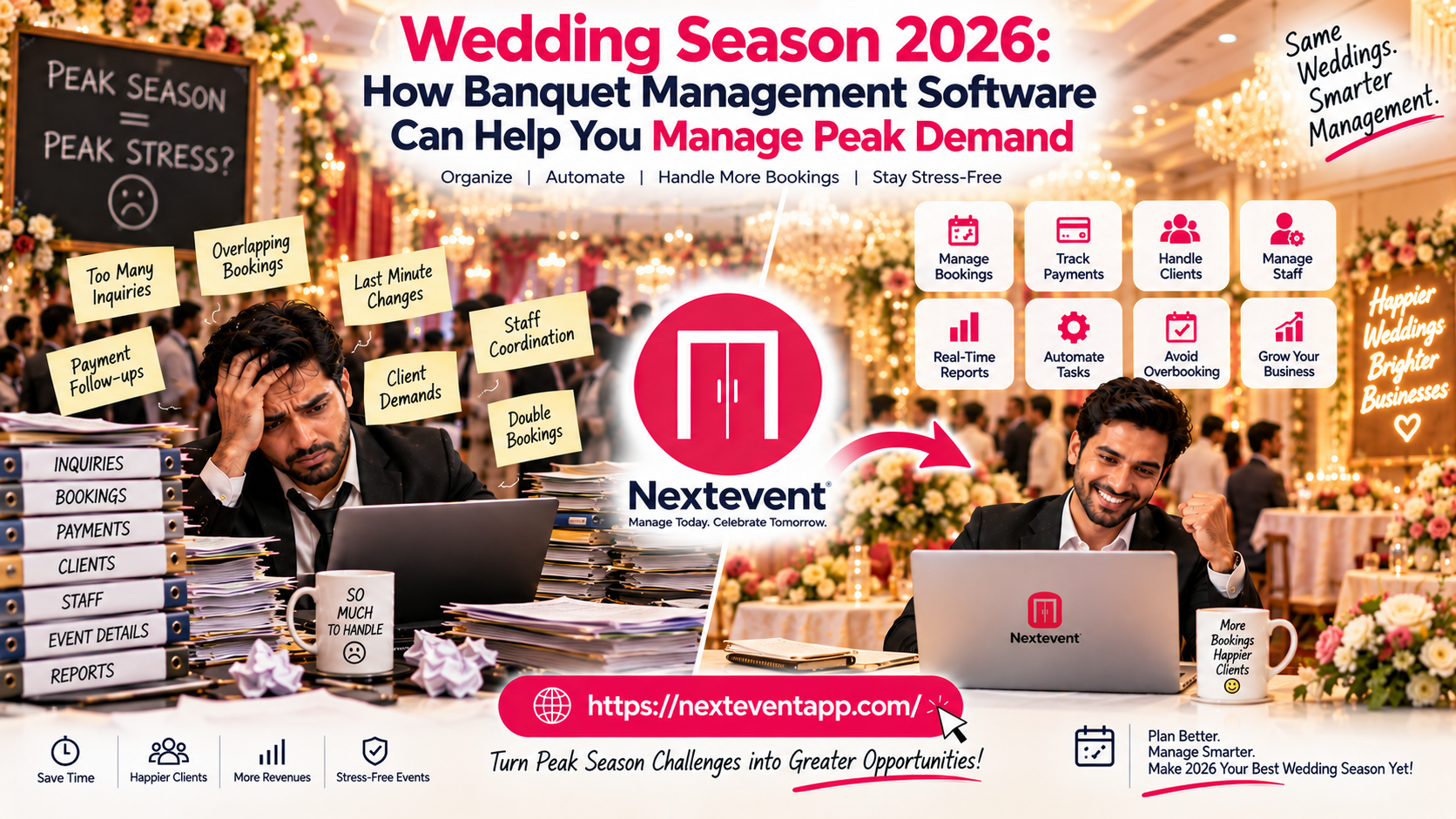
Wedding season is exciting for banquet hall owners. More enquiries come in, calendars fill faster, advance payments increase, and every available date suddenly becomes valuable. But there is another side to the rush: peak demand can expose every weakness in your venue’s management process. When bookings are written in registers, enquiries are scattered across WhatsApp and phone calls, payment details sit in different spreadsheets, and staff depend on verbal updates, even a successful wedding season can turn into operational chaos.
The need for better systems is becoming increasingly relevant as India’s broader events ecosystem expands. Recent reporting from the Financial Express noted that India’s organised live-events market is projected to grow from ₹14,500 crore in 2025 to ₹19,600 crore by 2028. At the same time, digital payments continue to become deeply embedded in Indian commerce: UPI processed 24.51 billion transactions worth about ₹29.82 trillion in August 2026, according to Reuters reporting based on the latest data.
For banquet halls, wedding lawns, function halls, resorts and convention centres, this creates a simple business question: when demand rises, can your existing management process handle it without creating mistakes? That is where banquet management software becomes valuable. Instead of adding more registers, spreadsheets and manual follow-up work, a digital system can connect bookings, enquiries, payments, billing, customers, staff and venue operations in one workflow. The objective is not simply to make your business look modern; it is to help your team handle more activity with greater control.
Why Wedding Season 2026 Will Put More Pressure on Venues
Peak wedding season does not behave like an ordinary business period. On a normal weekday, your team might have enough time to answer enquiries, check availability, prepare quotations, confirm payments and coordinate with staff. During the wedding rush, all of those tasks can arrive at the same time. A customer may call about a date while another family is waiting for a quotation, a manager may need to confirm whether a hall is available, an accountant may be asking about an outstanding advance, and the kitchen team may need the final menu for an event happening tomorrow. When information is spread across notebooks, Excel files and individual phones, your team spends valuable time searching for information instead of serving customers.
The pressure becomes even greater when several halls or venues operate under the same business. A date that looks available in one person’s diary may already be blocked by another manager. A tentative enquiry may not be communicated to the sales team. A payment may arrive through UPI while the booking record remains unchanged. During a busy wedding season, small communication gaps can quickly become expensive mistakes. Banquet management software creates a central operational layer where the team can see the information that matters before making decisions.
The Hidden Cost of Peak-Demand Chaos
The cost of poor management is not limited to losing a booking. A double booking can lead to refunds, discounts, unhappy customers and damage to your reputation. A missed enquiry can send a high-value wedding to another venue. A forgotten payment reminder can delay cash flow. An incorrect quotation can create awkward negotiations later. Even staff confusion has a financial cost because managers spend time resolving issues that could have been prevented through better visibility.
The biggest problem is that these losses often remain invisible. You may know how much revenue your venue generated, but you may not know how many leads were lost because nobody followed up, how many hours staff spent checking spreadsheets, or how much additional revenue could have come from packages and add-ons. A digital management system helps turn these activities into measurable business processes. Instead of depending on memory, you can build a workflow where enquiries, bookings, payments and tasks move through defined stages.
What Peak Demand Really Means for a Banquet Hall
Peak demand means much more than having a full calendar. It means your venue is receiving more customer interactions, more transactions, more operational decisions and more coordination requirements in a shorter period. During wedding season, customers expect quick answers because they may be comparing several venues at the same time. If your team takes two days to respond while another venue responds within an hour, the customer may never come back.
Peak demand also creates a visibility problem. When five or ten enquiries arrive in one day, it becomes difficult to remember who requested a quotation, who wanted a site visit, who promised an advance payment and who needs a follow-up. The situation becomes even more complicated when leads arrive through different channels such as calls, WhatsApp, website forms, social media or walk-ins. A banquet management platform can bring these activities into a structured workflow so the team can understand what needs attention next.
1. Manage More Bookings From One Calendar
A busy wedding season demands an accurate view of venue availability. Instead of asking several people whether a particular hall is free, managers can use a central booking calendar to check confirmed, tentative and available dates. This simple change can dramatically improve decision-making because everyone is working from the same information. NextEvent, for example, describes its booking system as a visual calendar with availability and conflict detection designed for banquet and event venues.
Think of your booking calendar as the control room of your venue. Every wedding, reception, engagement, corporate event or social function needs a place on that calendar. When the information is updated in real time, your sales team can respond to customers without repeatedly calling the manager. During wedding season, this speed matters because customers often want immediate confirmation about their preferred dates. A well-organised calendar also makes it easier to see where demand is concentrated and which dates still have availability.
Prevent Double Bookings and Scheduling Conflicts
Few mistakes are more damaging to a venue than promising the same hall to two customers. Manual systems make this possible because different employees may maintain different records or accept bookings without checking the latest information. NextEvent’s current product information highlights real-time conflict detection and booking alerts as part of its venue management functionality.
The practical benefit is simple: before confirming a booking, your team can check the calendar rather than relying on memory. For venues handling multiple halls, lawns or locations, this becomes even more important. A central system helps reduce the possibility that one manager’s update remains invisible to another manager. During a high-demand season, that additional layer of control can protect both revenue and customer trust.
2. Capture Every Wedding Enquiry Before Competitors Do
Your booking calendar can be excellent and you can still lose revenue if your enquiry process is weak. Wedding customers rarely contact only one venue. They may compare prices, packages, food options, location, parking, decoration and availability before making a decision. If your team does not respond quickly or forgets to follow up, another venue can easily win the booking.
A proper enquiry management system gives every lead a place in your sales process. Instead of keeping customer details in a WhatsApp conversation or notebook, the team can record the event date, customer details, event type, expected guest count, requirements and enquiry status. NextEvent says its system can capture enquiries from channels including phone, WhatsApp and walk-ins and track their status through the booking process.
This matters because peak season creates volume. You might receive three enquiries one day and twenty the next. A person can remember three conversations; remembering twenty accurately is much harder. Software does not replace the human relationship, but it makes sure the relationship has a reliable record behind it.
3. Automate Follow-Ups When Your Team Is Busy
Follow-up is where many venue businesses quietly lose money. The customer makes an enquiry, receives a quotation and says, “I’ll confirm tomorrow.” Tomorrow arrives, the sales manager gets busy with another event, and nobody calls. Three days later, the customer has already booked somewhere else. During wedding season, this happens more easily because the team is dealing with existing events while trying to convert new enquiries.
Automated follow-ups create consistency. Instead of expecting every employee to remember every conversation, the system can remind the team when a lead needs attention or automate appropriate customer messages. NextEvent’s current product information describes AI-powered follow-up sequences and automated communication for enquiry management. The value is not simply automation; it is consistency. Every serious enquiry deserves a timely response, regardless of how busy the venue is that day.
Turn Missed Calls Into Potential Bookings
A missed call during a wedding event should not automatically become a lost opportunity. The customer may be calling because they are ready to discuss the date, price or package. If nobody records the enquiry, that opportunity can disappear completely. A structured lead management process gives the team a way to record the customer and make sure the conversation continues.
This is especially useful for owners who are not always physically present at the venue. With a cloud-based platform, the owner or manager can review lead activity remotely and understand what the sales team has handled. The result is a more dependable sales process that does not depend entirely on one employee’s memory.
4. Track Advances, Balances and Payments
Wedding bookings often involve multiple payments rather than a single transaction. A customer may pay an initial advance when confirming the date, another instalment several months later, and the remaining balance before the event. If those payments are recorded across different notebooks, bank statements and WhatsApp messages, your team may struggle to identify outstanding balances quickly.
A banquet management software platform can connect payment information to the relevant booking. NextEvent currently describes functionality for tracking advances, pending balances, payment history and booking-wise payment information. This gives the team a clearer picture of what has been collected and what remains due.
The benefit becomes particularly obvious during peak season. Imagine having fifty upcoming weddings and needing to identify which customers have pending balances. Manually checking every file can consume hours. A central payment dashboard can make the same task much easier to manage. Automated reminders can also reduce the uncomfortable situation where staff repeatedly have to chase customers for information that could have been communicated systematically.
5. Simplify GST Billing and Invoices
Billing becomes more complicated when a wedding includes several services. The customer may book the hall, catering, decoration, rooms, sound systems and additional services under the same event. Creating accurate invoices manually can take time and may increase the chance of errors, especially when the team is processing several bookings simultaneously.
Modern venue software can connect billing with the booking record. NextEvent highlights GST and non-GST invoicing, quotations and booking-linked payment management as part of its current banquet management offering. This means the team does not have to reconstruct every detail from scattered notes when preparing documents.
Professional billing also improves the customer experience. A clear quotation helps the family understand what is included, while an organised invoice provides a better record for both the venue and customer. During wedding season, when transaction volumes increase, having a repeatable billing workflow can save considerable administrative effort.
6. Coordinate Catering, Packages and Add-Ons
A wedding booking is rarely just a hall rental. Customers may want catering, decoration, rooms, photography coordination, sound systems, lighting, furniture, welcome drinks and other services. These additional requirements can increase the value of every booking, but they also increase operational complexity.
Venue management software can help keep these services connected to the main event. NextEvent lists menu management, packages, add-ons, room booking and staff management among its venue features. When these details are associated with the booking, different departments have a clearer understanding of what the customer actually purchased.
Increase Revenue From Every Confirmed Booking
Peak season creates an opportunity to improve revenue without simply increasing the number of bookings. Once your calendar is busy, the next question becomes: how much value are you generating from each event? Packages and add-ons can help answer that question. Instead of selling only a hall, a venue can structure combinations such as hall plus catering, room accommodation, decoration or other relevant services.
The key is to make the offer easy to understand. A well-organised package gives the customer clarity while giving the sales team a repeatable way to present additional services. Software can help keep these package components attached to the booking so operations and billing remain aligned.
7. Keep Staff and Multiple Venues Aligned
The bigger the venue operation, the harder communication becomes. A single banquet hall may have a manager, sales staff, accountant, kitchen team, housekeeping staff and event coordinators. A multi-location business may have several teams working across different properties. During wedding season, everyone needs access to accurate information without constantly calling the owner.
A central platform can provide role-based access and shared information so each person sees what they need. NextEvent says it supports staff and role management and multiple halls or venues from a connected system. This can reduce dependency on informal communication and make responsibilities clearer.
Imagine a wedding as a large orchestra. The sales team, kitchen, accounts department, housekeeping and event staff are all playing different instruments. If everyone follows a different sheet of music, the result is noise. A shared management system becomes the common schedule that keeps everyone moving toward the same event-day outcome.
8. Use WhatsApp to Keep Customers Updated
For Indian businesses, customer communication increasingly happens through messaging apps. Customers may ask for quotations, payment details, booking confirmations and reminders through WhatsApp rather than email. During wedding season, this communication volume can become enormous.
A venue management system that supports WhatsApp reminders and notifications can help standardise communication. NextEvent currently promotes automated WhatsApp communication for booking confirmations, payment reminders, invoices and other venue-related updates. This reduces the amount of repetitive manual messaging required from staff.
The larger trend is clear: customers expect digital convenience. India’s UPI ecosystem alone processed 24.51 billion transactions in August 2026, showing how deeply digital transactions have become integrated into everyday activity. A professional digital communication process therefore fits naturally into the way modern customers already interact with businesses.
9. Monitor Revenue and Occupancy With Analytics
During peak season, simply knowing that your venue is “busy” is not enough. You need to understand what is actually happening. Which halls are generating the most revenue? Which dates are filling first? How much money has been collected? How much remains outstanding? Which months have the highest occupancy? Which types of bookings generate better margins?
Analytics and reports can turn booking activity into business intelligence. NextEvent lists reporting around bookings, revenue, payments, occupancy and performance among its features. Instead of relying on assumptions, owners can use available data to identify patterns.
This becomes especially useful when planning the next wedding season. If certain dates consistently receive strong demand, you can plan pricing and staffing accordingly. If a particular package generates stronger revenue, your sales team can promote it more actively. Data does not replace business experience; it gives that experience a clearer foundation.
Why Cloud-Based Banquet Management Matters During Wedding Season
Wedding venues do not operate from a single desk. Owners may be visiting another property, managers may be walking through an event setup, sales employees may be meeting customers, and accountants may be working from another office. A system that requires everyone to be physically present at one computer becomes restrictive when the business is moving quickly.
Cloud-based banquet management software makes information accessible across supported devices and locations. NextEvent currently states that its platform works across Android, iOS and desktop environments. The practical advantage is flexibility: an owner can review activity away from the venue while the team continues updating information at the property.
For multi-venue businesses, this becomes even more valuable. Instead of maintaining separate systems for every location, a connected platform can provide a consolidated view. The goal is not to make every employee see everything; it is to make sure the right people can access the right information when decisions need to be made.
How to Prepare Your Venue Before Peak Demand Arrives
The biggest mistake is waiting until the wedding rush begins before implementing a new system. Technology becomes most useful when your team has already learned the workflow. If employees are trying to learn software while managing ten events, dozens of enquiries and hundreds of customer messages, adoption becomes much harder.
Start by organising your existing booking data. Enter upcoming events, customer information, payment schedules, hall availability and important operational details. Then define how your team will handle a new enquiry, quotation, follow-up, booking confirmation, payment and event completion. Once the process is clear, software becomes much more than a digital notebook; it becomes the operating system for the venue.
Training also matters. Every employee should understand what information they are responsible for updating. If the sales team fails to update a booking, the calendar becomes unreliable. If accounts does not record a payment, the balance becomes inaccurate. Technology works best when the business process behind it is consistent.
What to Look for in Banquet Management Software in 2026
Not every venue needs the same solution, but there are several capabilities worth evaluating before choosing software. Start with booking management because the calendar is the foundation of your operation. Then examine enquiry management, follow-up automation, payment tracking, GST billing, staff permissions, customer communication, reporting and multi-venue support.
A practical evaluation should also consider usability. A powerful platform that staff find difficult to use may create another layer of work rather than reducing it. Look for mobile accessibility, clear dashboards, onboarding and training, reliable support and workflows that match how Indian venues actually operate.
You should also ask whether the software can scale with your business. A venue may start with one hall and later add a lawn, rooms, a second property or another location. Choosing a platform that can accommodate growth can prevent another technology migration later. NextEvent positions its platform for banquet halls, function halls, wedding lawns, convention centres, resorts and other event venues across India.
How NextEvent Can Help Indian Wedding Venues
NextEvent is designed around the operational challenges faced by Indian banquet and event venues. Its current platform combines bookings, enquiries, payments, invoices, menu management, packages, room bookings, staff management, WhatsApp reminders and analytics in one system. Its Google Play listing also highlights visual booking calendars, conflict detection, enquiry tracking, payment management, GST invoicing and multi-hall management.
The value for a venue during wedding season comes from connecting these activities. A new enquiry can become a lead, the lead can be followed up, the confirmed event can appear on the booking calendar, payments can be recorded against the booking, invoices can be generated, and reminders can be sent as the event approaches. When those steps live in one connected workflow, your team spends less time searching for information and more time managing customers and events.
For wedding lawns specifically, NextEvent also highlights muhurtham date management, enquiry CRM, advance tracking and wedding-season workflows. That focus is useful in the Indian market, where auspicious dates can create concentrated demand and require careful availability management.
The important point is that software should support your team rather than complicate it. The objective for Wedding Season 2026 should be simple: respond faster, avoid preventable booking mistakes, collect payments on time, coordinate staff efficiently and make every confirmed booking easier to manage.
Conclusion
Wedding Season 2026 represents both an opportunity and a test for banquet hall owners. High demand can produce excellent revenue, but only if your operational systems can keep up with the number of enquiries, bookings, payments, customers and event-day tasks coming through the business. Manual registers, scattered WhatsApp conversations and disconnected spreadsheets may appear manageable during quieter periods, but peak demand exposes their limitations.
Banquet management software gives venue owners a way to bring those moving parts together. A central booking calendar can reduce scheduling conflicts, enquiry management can prevent valuable leads from disappearing, automated follow-ups can keep prospects engaged, payment tracking can improve financial visibility, digital invoicing can simplify billing, and analytics can help owners understand performance. When these capabilities work together, the venue becomes easier to manage even when the calendar is packed.
The best time to prepare for peak demand is before the first major rush begins. Set up your data, train your team, organise your workflows and make sure every booking has a clear path from enquiry to event day. Wedding customers may remember the decoration, food and atmosphere, but behind every successful celebration is an organised venue team. The right technology can give that team the visibility and control it needs to make Wedding Season 2026 more profitable, professional and manageable.
FAQs
1. How can banquet management software help during wedding season?
Banquet management software can centralise bookings, enquiries, customer records, payments, invoices, staff coordination and reminders. During peak season, this helps teams handle higher volumes of work without relying entirely on registers, spreadsheets or individual memory.
2. Can banquet software help prevent double bookings?
Yes. Platforms with real-time booking calendars and conflict detection can alert teams when a hall or venue is already occupied. NextEvent specifically lists conflict detection and visual availability management among its booking features.
3. How does software help banquet halls get more wedding bookings?
Software can help capture enquiries, organise lead stages and maintain timely follow-ups. By reducing missed enquiries and forgotten follow-ups, venue teams can create a more consistent sales process during periods when customer demand is high.
4. Can banquet management software track wedding payments?
Yes. Modern systems can record advances, payment history, pending balances and due dates against individual bookings. NextEvent includes payment tracking and automated payment reminders as part of its current platform.
5. When should a banquet hall implement software before wedding season?
Ideally, implementation should happen before peak demand begins. This gives owners enough time to migrate upcoming bookings, configure halls and pricing, train staff, test workflows and establish consistent processes before enquiry and booking volumes increase.