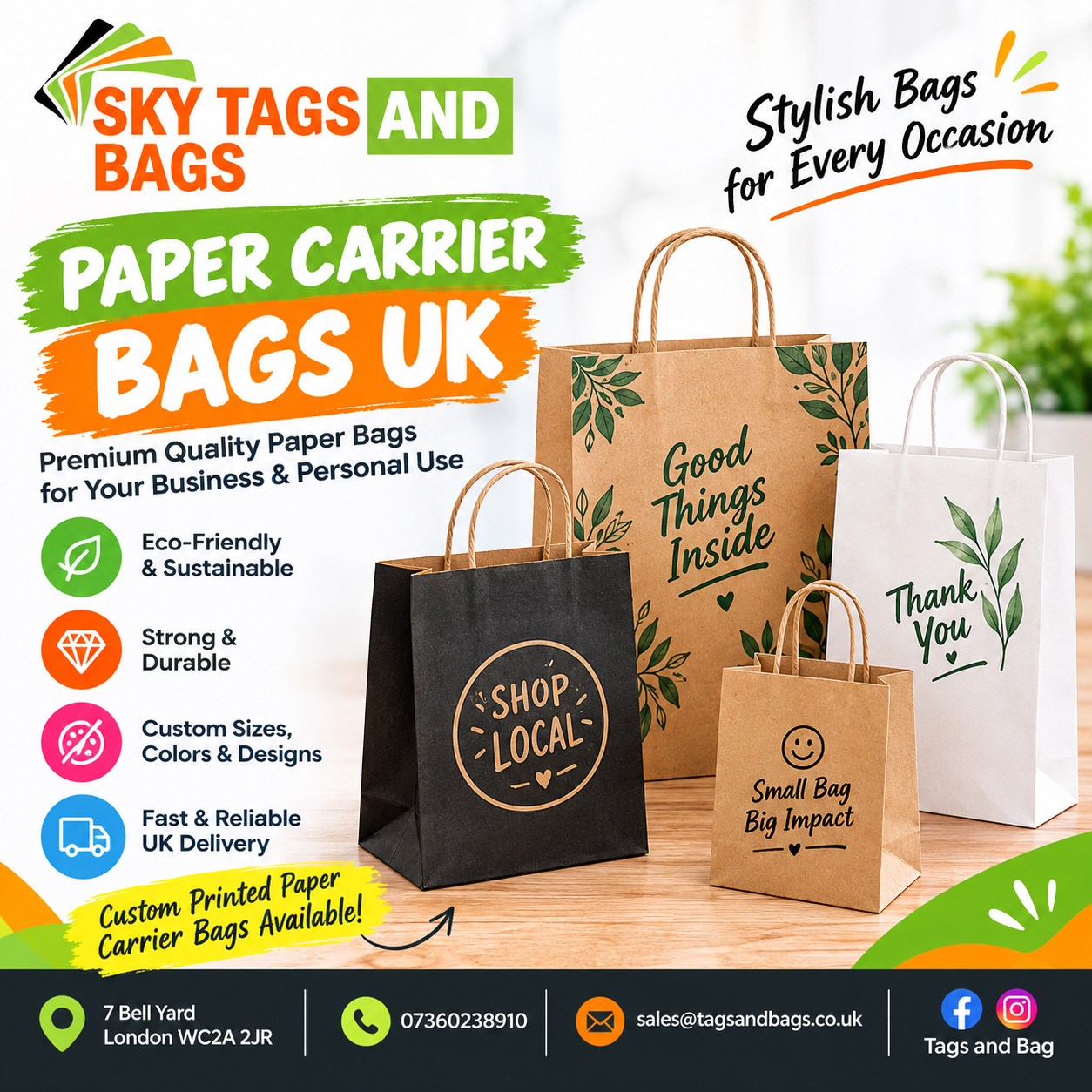
Packaging plays an important role in how products are transported, presented, and protected. For many UK retailers, cafés, boutiques, events, and e-commerce businesses, carrier bags are a practical part of the customer experience. Paper bags have become increasingly common because they can combine useful carrying strength with a simple, professional appearance.
When choosing Paper Carrier Bags UK businesses need to consider more than appearance alone. Bag size, paper quality, handle design, weight capacity, storage, branding requirements, and intended use can all affect whether a particular option is suitable.
Why Paper Carrier Bags Remain Relevant
Paper Carrier Bags are used across a wide range of retail environments. Clothing shops may use them for garments and accessories, while food retailers can use suitable paper formats for takeaway products. Gift shops, bookshops, beauty businesses, and market traders also use paper bags as part of their everyday packaging.
Several factors have contributed to continued interest in paper-based packaging:
- A familiar and versatile packaging format
- Easy storage when supplied flat
- Availability in different sizes and styles
- Suitable surfaces for printed branding and graphics
- A natural-looking alternative to some plastic packaging formats
- Applications across both physical retail and collection services
However, paper should not automatically be considered suitable for every product. Businesses need to select a bag according to the weight, shape, moisture exposure, and handling conditions involved.

Selecting the Right Paper Carrier Bag
The correct bag starts with understanding how it will be used. A lightweight bag may work well for clothing or small retail purchases, while heavier products require stronger paper and an appropriate handle construction.
Important factors include:
Size and Capacity
The dimensions should accommodate the product without excessive unused space. A bag that is too small can become difficult to close or carry, while an unnecessarily large bag can waste storage space and material.
Consider:
- Product dimensions
- Number of items normally placed inside
- Product weight
- Whether protective packaging is also required
- How customers will carry the bag
Handle Design
Handles affect both comfort and durability. Common options include twisted paper handles, flat handles, and other reinforced constructions. The appropriate choice depends on the expected load and the presentation required by the business.
For frequent customer use, handle attachment should be considered alongside the paper’s overall strength rather than treated as a separate feature.
Paper Quality and Construction
Paper thickness, folding, gluing, and reinforcement can influence performance. A well-designed carrier bag needs to withstand normal handling without the base or handle area becoming a weak point.
Businesses should therefore assess the complete construction instead of choosing solely on paper colour or finish.
Common Applications Across the UK
Paper Carrier Bags are particularly useful where businesses need convenient packaging that can accommodate different product categories.
Typical applications include:
- Fashion and clothing retail — Suitable for folded garments, footwear accessories, and smaller fashion purchases.
- Gift shops — Useful for presenting boxed gifts, souvenirs, stationery, and decorative products.
- Food and hospitality — Appropriate formats can be used for takeaway items, bakery products, and packaged food.
- Beauty and cosmetics — Bags can carry boxed skincare, toiletries, cosmetics, and related products.
- Events and exhibitions — Paper bags can be used for promotional materials, samples, brochures, and merchandise.
- E-commerce collections — Retailers offering click-and-collect services can use carrier bags to make handover and transportation easier.
The key consideration is matching the bag specification to the actual product and handling environment.

Practical Packaging Challenges and Solutions
One common challenge is choosing a bag based only on its appearance. A visually attractive bag may not perform adequately if it has to carry heavy or awkwardly shaped products.
A more reliable selection process is to:
- Establish the average and maximum product weight.
- Measure the products before selecting bag dimensions.
- Check the handle construction and attachment points.
- Consider whether products may be exposed to moisture.
- Test a sample under realistic carrying conditions.
- Estimate how much storage space the bags will require.
- Review whether printed branding is necessary or whether plain packaging is more appropriate.
Another consideration is consistency. Retailers using several bag sizes should maintain a logical range so employees can quickly select an appropriate option. This can reduce overpacking and make stock management easier.
For businesses researching UK packaging suppliers, Tags and Bags provides paper carrier bag options that illustrate how size, construction, and presentation can be considered together when selecting retail packaging.
Trends in Paper Retail Packaging
Packaging decisions are increasingly influenced by environmental considerations, but responsible selection requires looking beyond material labels. Businesses should consider how packaging is manufactured, how much material is used, how long the packaging remains functional, and what disposal or recycling systems are available to customers.
Reducing unnecessary packaging can be just as important as selecting a particular material. Right-sizing bags, avoiding excessive layers, and maintaining sensible stock levels can help reduce packaging waste.

Brand presentation is another continuing trend. Simple printed designs, restrained colours, and clear logos can turn a functional carrier bag into part of a consistent retail experience. At the same time, businesses should avoid adding unnecessary finishes when they do not provide a practical or meaningful benefit.
Final Considerations
Choosing Paper Carrier Bags UK retailers can rely on requires a balance between functionality, appearance, product requirements, and packaging efficiency. The most appropriate option is not necessarily the largest, thickest, or most decorative bag; it is the one that fits the intended products and handling conditions while meeting the business’s practical needs.
By assessing dimensions, weight, handles, paper construction, storage requirements, and end use before ordering packaging, retailers and e-commerce businesses can make more informed decisions. Paper carrier bags remain a flexible packaging format, particularly when their specifications are matched carefully to the products and customer experience they are intended to support.