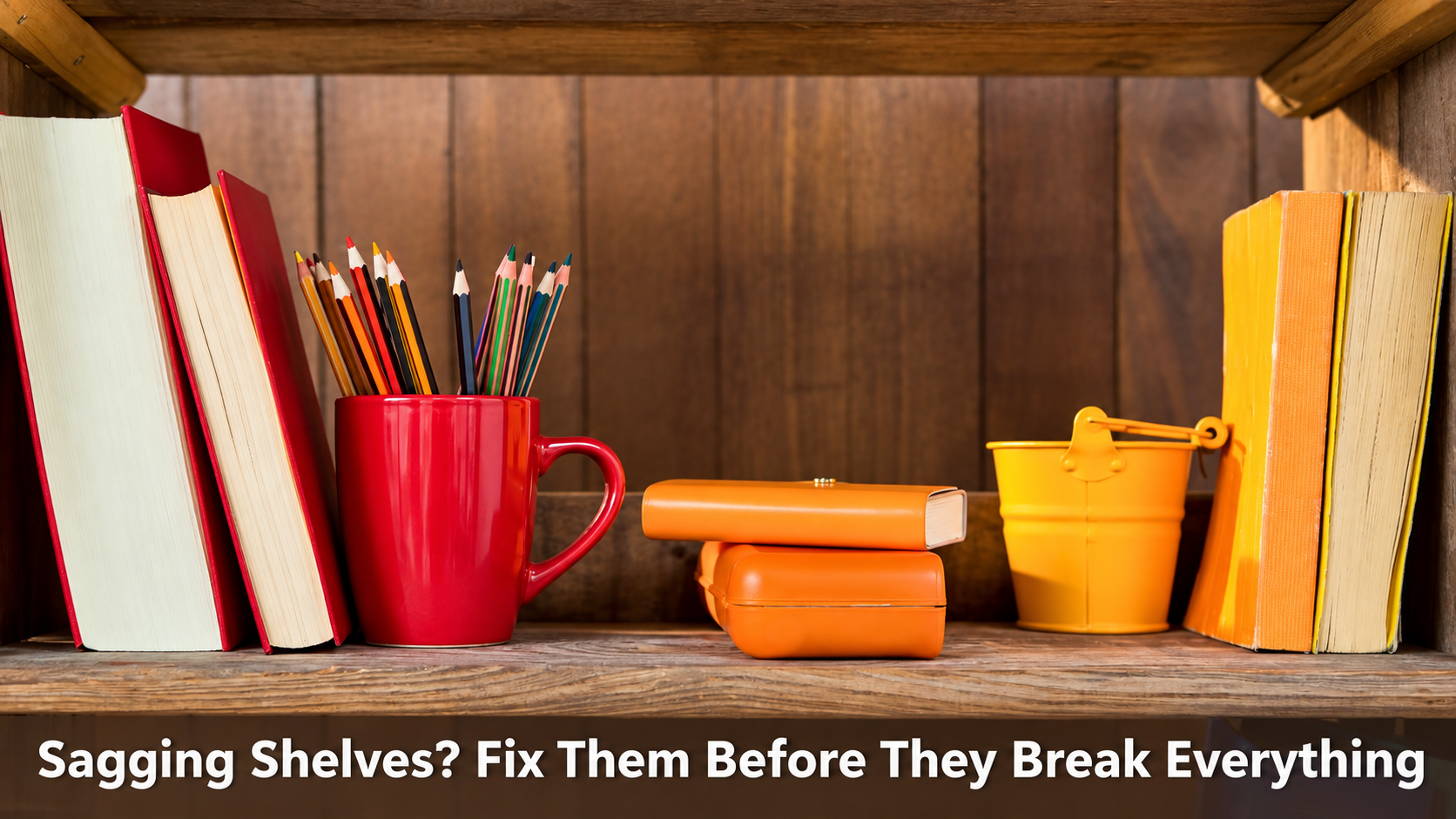
Books stack up . Then more books join. A décor piece appears. Maybe a “temporary” item gets dropped there and somehow stays forever.
Everything looks normal at first… until the shelf stops sitting straight. Instead, it starts dipping lower with each passing day.
Once a shelf begins to sag, the problem rarely stays the same — it worsens. Piling on more weight after that point only pushes the wood toward serious damage to belongings or to the wall itself.
In some cases, a sagging shelf becomes a safety hazard for someone standing nearby who has no idea the wood is close to giving way. This blog breaks down why wooden shelves sagging happens, walks through how to fix sagging shelves the right way, and explains when calling a Carpenter Dubai specialist becomes the smarter move.
Time to look closely at what’s really happening to the wood…
Why Wooden Shelves Sagging Happens (A Detail Most Owners Overlook)
▶ The Span Is Too Wide Without Middle Support
A long, unbroken shelf can look sleek in a home office or living room. But extended spans demand extra support points along the way.
Picture a lengthy bridge with no pillars holding the middle — it wouldn’t last.
Skip the middle shelf bracket installation, and the center absorbs every ounce of pressure alone. That’s exactly why bending shows up right in the middle stretch first.
The Rule of Threes: Any shelf stretching past 30–36 inches (roughly 90 cm) needs a center bracket. No shortcuts here.
▶ Weight Exceeds What the Shelf Can Actually Handle
Hardly anyone sits down to calculate a shelf’s true capacity. Items simply keep landing on it until space runs out.
Yet a limit exists for every shelf, whether holding books, binders, or kitchen supplies. Cross that line, and the wood starts giving in gradually.
A total break rarely happens instantly. Sagging shows up first, acting as an early warning sign that gets brushed aside too often.
▶ Low-Grade Wood Simply Can’t Bear the Load
Some shelves appear sturdy on the surface but rely on materials unable to support real weight over time.
Early performance might seem fine, but strength fades fast, and bending follows. Mass-produced furniture built around cost-cutting runs into this issue constantly.
▶ Fragile or Badly Fitted Brackets
Sometimes the real culprit sits behind the shelf itself. Loose or misaligned brackets can’t spread the weight evenly across the surface.
Consider the physics angle: torque and heavy load shelf support distribution matter more than looks.
A shelf can appear completely solid on top, yet weak support underneath still drags it into a sag — often faster than expected.
▶ Moisture and Heat Attack the Wood Quietly
Wood responds constantly to its surroundings. Humidity swings or steady AC airflow can trigger subtle expansion or warping over time.
The shift happens gradually, but the shelf gradually loses its original straight line. Kitchens, offices, and rooms with fluctuating temperatures see this constantly.
For a polished wood finish, ask a specialist about customized office carpentry services to give a working space a premium look instead of guessing how to solve it alone.
▶ Installation Errors From Day One
Sometimes the trouble traces back to the very first setup. A shelf installed slightly off-level, or screws that weren’t fully secured, creates hidden weaknesses.
Nothing seems wrong at the start… but as items keep accumulating, added weight exposes those early mistakes as visible sagging.
Smart Ways to Fix Sagging Shelves (Solutions Built to Last)
▶ Install Middle Support — Stop Making the Shelf Carry Everything Alone
Picture a shelf like a bridge or overpass. A structure supported only at both ends, stretched too far, won’t hold steady for long. The same principle applies to any extended wooden surface.
Add the center shelf bracket installation for backup strength. Results show up immediately — stronger, safer, more stable.
Steps to take:
- Install a support bracket at the midpoint of longer shelves
- Choose metal brackets for added strength
- Keep spacing even across the full length for balanced load
Apply This Rule of Threes: Any shelf past 30–36 inches (about 90 cm) genuinely requires a center bracket. There’s no exception worth risking.
▶ Cut Back the Load — Overloading Happens More Than Realized
Honest assessment usually reveals overloading. Books, folders, random objects pile up fast, and even the sturdiest shelf has a breaking point that bends the wood once crossed.
Actions to take:
- Clear excess weight right away
- Spread items evenly across the surface
- Position heavier pieces closer to brackets rather than the center
Pro tip: Noticeable bending already showing? Cutting weight becomes the first move toward recovery.
▶ Flip the Shelf (A Fast Trick That Genuinely Helps)
A lesser-known method works well for early-stage sagging. Turning the shelf upside down lets gravity slowly pull it back toward straight over time.
Steps involved:
- Take the shelf down carefully
- Flip it and reinstall
- Hold off on heavy loading afterward
Pro tip: Effective only for mild sagging. Severely bent wood won’t respond to this trick.
▶ Swap in Stronger Brackets — The Overlooked Fix
The shelf itself isn’t always the weak link — sometimes the support underneath fails first. Thin or cheap brackets give way under pressure, and replacing them can transform performance completely.
Steps to follow:
- Swap weak brackets for heavy-duty versions
- Use proper screws paired with wall plugs
- Confirm a tight, level installation
Pro insight: Sturdy brackets mean a longer-lasting shelf. This isn’t the place to cut corners.
▶ Select Better Wood (Quality Varies More Than Expected)
A stylish-looking shelf might hide weak internal material. Low-grade wood or MDF bends quicker under pressure, while solid wood or high-density boards hold up far longer.
Steps to take:
- Choose thicker shelving (18–25mm minimum)
- Favor solid wood or plywood over budget boards
- Skip thin decorative shelves for heavier items
Pro tip: Quality material prevents this problem from resurfacing down the line.
▶ Control Moisture — Wood Reacts to Its Environment
Wood responds to surrounding conditions more than most people assume. Heat and humidity can warp it gradually. That subtle curve might not stem from weight at all — moisture could be the actual cause.
Habits to build:
- Skip installing shelves in humid areas
- Apply protective polish or laminate coating
- Maintain balanced ventilation
Pro insight: A stable environment supports stable shelving.
▶ Correct Installation Mistakes Early
Sometimes the issue starts at setup — misaligned brackets or uneven positioning. It holds up briefly before pressure exposes the weakness.
Steps to take:
- Confirm the shelf sits level
- Tighten every screw securely
- Reinstall if alignment appears off
Pro tip: A quick 10-minute fix now can prevent a full replacement later.
▶ Consider Custom Shelving for Long-Term Reliability
Daily use, especially in office settings, often exposes the limits of ready-made shelving. Custom-built options are designed around actual load and space requirements.
Steps to take:
- Plan shelving based on real weight demands
- Apply correct spacing and thickness
- Bring in expert design input for lasting durability
Pro tip: This is exactly where professional office carpentry services make a real difference.
When to Call a Carpenter Dubai (Don’t Gamble on Collapse)
A shelf already bending significantly calls for an immediate stop — reach out to a carpentry specialist right away. DIY tricks won’t solve this stage. One additional item could send the whole shelf down.
Quick fixes that keep failing to hold are a clear signal too. The root issue goes beyond the surface and needs a proper assessment along with wooden shelf reinforcement.
Also Read – What is a Carpenter? Why hire a professional?
At this stage, skip the experiments. Reach out to a carpenter Dubai who understands structural integrity and weight distribution. For workspace setups specifically, professional office carpentry services are the better route.