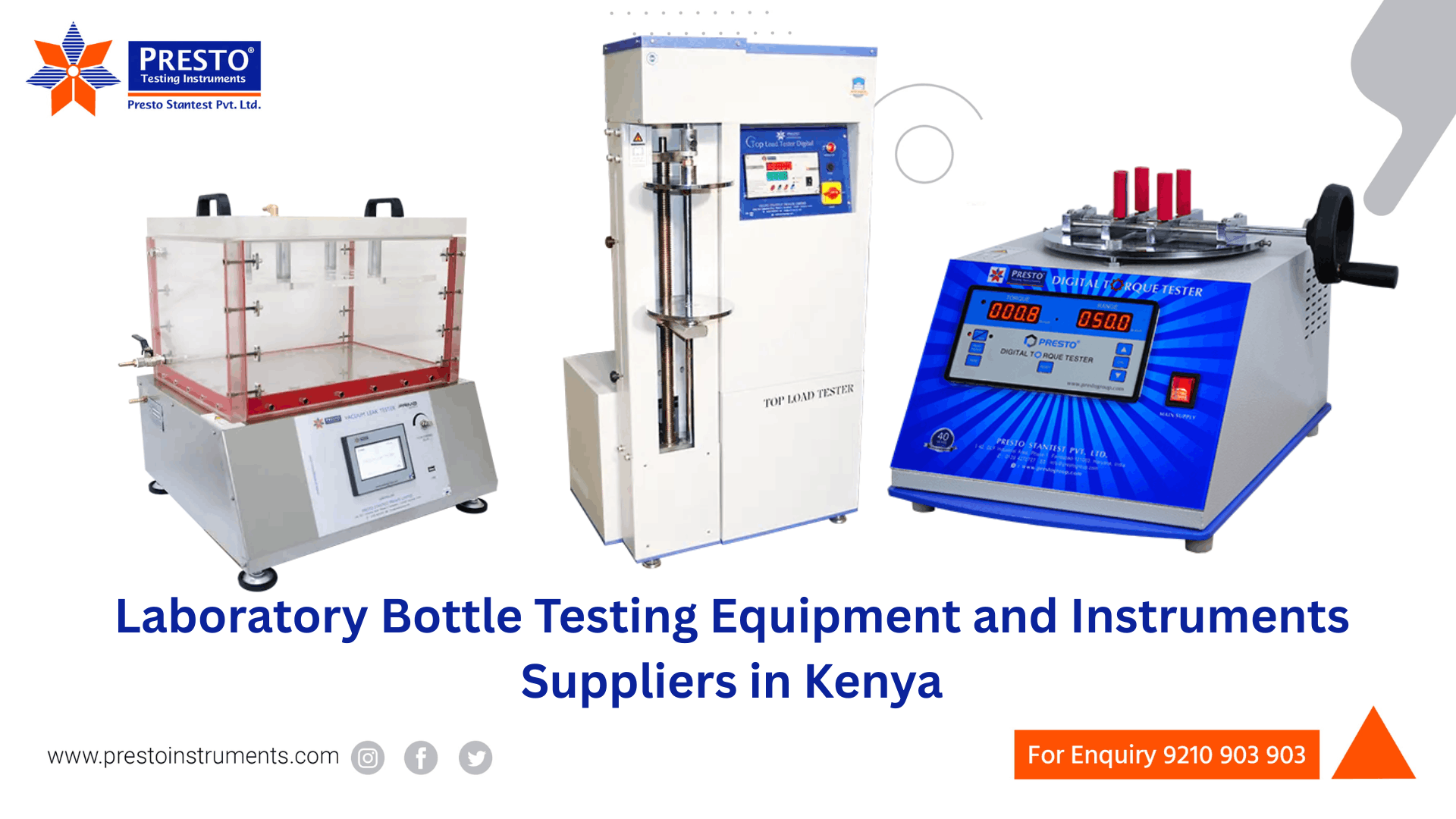
Product safety, shelf life, and transport stability are influenced by the performance of the bottle. Testing of products is being increasingly adopted as a normal production control in emerging markets such as Kenya, Thailand, and India.
Industries served by highly developed bottle testing equipment manufactured by a company trusted in Kenya inspect the compression strength, leakage, burst pressure, and durability. These tests are conducted against internationally recognized standards like ASTM D642 compressions, ASTM D1598 pressure evaluations, and so on, assisting manufacturers to confirm actual performance.
Through prestoinstruments.com, Presto Instruments distributes its high-quality lab bottle testing machines that can be used continuously in industrial applications, constructed in Kenya. As the demand increases in the beverage, pharmaceutical, and packaging industries, these industries rely on correct bottle test systems in Kenya to minimize the risk of damage and ensure uniform quality throughout the storage and distribution process.
Introduction
When selecting a supplier of bottle testing equipment in Kenya, it is not only the cost. It entails precision, service throughout life, and calibration support of service.
And in the manufacturing area, such as the city of Nairobi, factories require machines capable of certain heavy testing without compromising on accuracy. A dependable bottle testing equipment supplier in Kenya, Nairobi, offers both equipment and technical support that keeps operations stable.
Presto Instruments has a reputation as the supplier of laboratory bottle testing instruments in Kenya, with suppliers providing systems compatible with international standards, like ISO 7458 on top load testing and ISO 2234 on stacking performance evaluation. Their machines accommodate the testing of plastic and PET bottles along with glass bottles of various industries.
Understanding Bottle Testing Equipment Pricing in Kenya
Bottle testing equipment prices are determined by technical characteristics and the ability of the system. Simple models deal with the normal testing, whereas sophisticated systems are automated, have digital controls, and record the data.
Some of the important aspects that affect cost are as follows:
- Testing capacity and load range
- Sensor accuracy and repeatability
- Automation level and software features
- Compliance with standards like ASTM and ISO testing methods
- Availability of service and calibration support
For export-focused industries, investing in systems from a bottle testing equipment manufacturer in Kenya that follow ASTM D1599 and ISO testing methods helps reduce product rejection and strengthen packaging performance.
Types of Bottle Test Systems in Kenya
Different industries require specific machines depending on bottle type and usage conditions. A complete setup often includes multiple systems.
- Compression testing machines measure how much load a bottle can bear before deformation. These tests are commonly performed as per ASTM D642 standards.
- Top load testers are used to test vertical strength and stacking capabilities (including ISO 7458 testing processes).
- The internal pressure resistance (especially important in carbonated bottles) is measured by burst testing systems ASTM D1598 and ASTM D1599.
- The vacuum leak testing machine identifies the leaking faults that can result in contaminants or possible product loss.
- Drop testing systems simulate handling conditions to study impact resistance during logistics and transport cycles.
- PET bottle testing machines specialize in lightweight plastic containers and how they respond to pressure and stress conditions.
- Glass jar testing devices also consider the impact strength and brittle characteristics because of the frailty of glass vessels.
The adoption of the appropriate bottle test systems in Kenya assists in ensuring uniformity and the ability to export, as well as ensuring testing of international standards.
Standards Followed in Bottle Testing Equipment
Bottle testing equipment is designed and used according to internationally accepted testing standards.
- ASTM D642 defines methods for compression strength testing of packaging containers.
- ASTM D1598 and ASTM D1599 cover internal pressure and burst testing of plastic bottles.
- ISO 7458 specifies top-load testing methods for bottles and containers.
- ISO 2234 and ISO 8113 relate to stacking and compression testing during transport conditions.
These standards guide testing procedures, accuracy levels, and acceptance criteria. Following them helps manufacturers confirm that bottles perform safely under real operating conditions.
After-Sales Support and Calibration Services
After-sales support has a direct impact on machine performance and testing accuracy.
A professional bottle testing equipment supplier in Kenya provides the following:
- Installation and commissioning support
- Operator training for lab teams
- Scheduled calibration services aligned with testing standards
- Quick technical assistance
- Spare parts availability
Working with the best bottle testing equipment supplier in Kenya helps maintain long-term performance and consistent test results. For QA teams and production heads, regular calibration supports audits and keeps operations smooth.
Wrapping up
Bottle testing plays a major role in modern packaging and manufacturing. It affects product safety, durability, and brand value.
Choosing the right bottle testing equipment manufacturer in Kenya gives access to accurate systems, strong technical support, and compliance with global standards such as ASTM and ISO.
With increasing demand in Kenya and global markets, industries are shifting toward advanced bottle test systems in Kenya to meet international requirements and reduce product failures.
Presto Instruments, through prestoinstruments.com, continues to support industries with high-performance testing solutions designed for real industrial conditions.
FAQs
1. What is being offered by a bottle testing equipment manufacturer in Kenya?
They provide testing machines in the ASTM and ISO standards of strength, leakage, pressure, and installation and training and calibration services in quality control.
2. What industries in Kenya are opening bottle testing equipment?
These systems are used to test durability, sealing, and pressure resistance under natural handling and storage conditions in the beverage, pharmaceutical, FMCG, and packaging industries.
3. How to choose bottle testing equipment suppliers in Nairobi, Kenya?
Select suppliers with strong technical expertise, calibration services, and machines aligned with ASTM and ISO standards, along with good service support and spare parts availability.
4. What affects the price of bottle testing equipment in Kenya?
Price depends on machine type, testing capacity, automation level, sensor accuracy, and compliance with international standards, along with service support and calibration availability.
5. What is the need to calibrate bottle testing machines?
Calibration keeps things accurate, minimizes error, and facilitates auditing by making machine outcomes agree with ASTM and ISO standards, which aid in sustaining consistent and reliable testing performance.