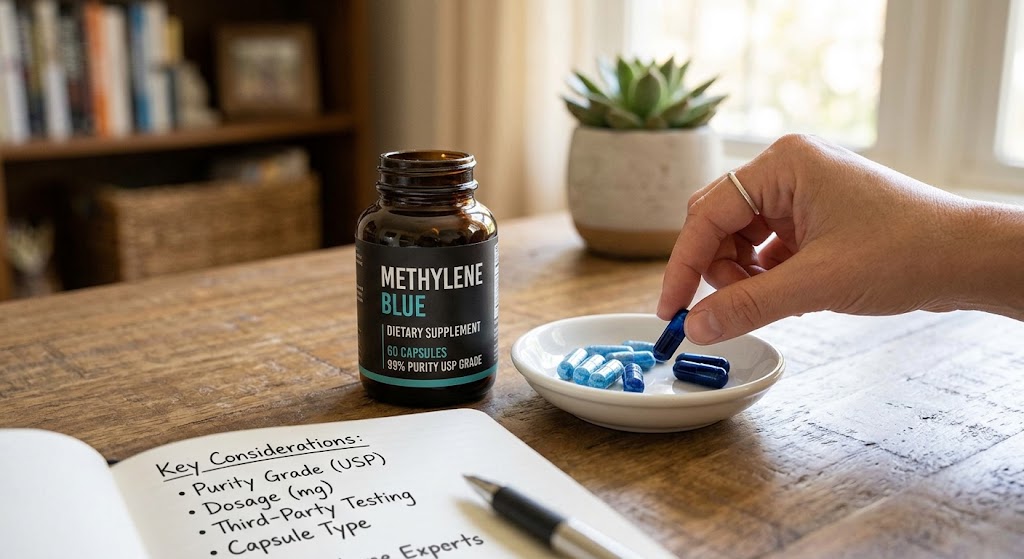
Methylene blue is an unusual compound to shop for. Unlike familiar supplements such as vitamin D, magnesium or creatine, it has a long history spanning medicine, laboratory research and industrial applications. As a result, products sold under the same name can differ considerably in formulation, concentration, quality documentation and intended use.
The growing availability of capsule products can make the buying decision even more confusing. A bottle containing 60 capsules may appear to offer better value than one containing 30, while a product described as “pharmaceutical grade” may provide little information to support the claim.
For consumers researching methylene blue products, it makes more sense to look beyond packaging. Capsule strength, ingredient transparency, testing documentation, intended use and overall cost are more useful factors when comparing products.
What Should You Look For in a Methylene Blue Supplement?
There is no single feature that automatically makes one methylene blue product better than another.
A sensible comparison should begin with several basic questions:
- What grade of methylene blue does the product contain?
- How much methylene blue is present in each capsule?
- Does the manufacturer provide meaningful quality documentation?
- Is batch-specific testing available?
- What does the product cost relative to its total amount?
- Is the formulation appropriate for the intended use?
A detailed comparison of the best methylene blue supplement options can help illustrate why these factors should be considered together.
For example, one product might offer a lower price per milligram but use a capsule strength that provides little flexibility. Another may cost more while offering clearer information about manufacturing and testing.
The right choice therefore depends on more than price alone.
Why Capsule Strength Matters
Bottle count is one of the easiest numbers to compare, but it isn’t necessarily the most useful.
A bottle containing 90 capsules could represent 90 servings or considerably fewer, depending on the manufacturer’s serving instructions. More importantly, the amount of methylene blue in each capsule can vary significantly between products.
A 5 mg capsule and a 20 mg capsule are not simply different package sizes. They provide different levels of dosing flexibility.
Someone looking for a smaller amount cannot automatically turn a 20 mg capsule into a precisely measured 5 mg dose. This makes capsule strength an important consideration when comparing products.
A formulation with a lower individual capsule strength may provide more flexibility because users can combine capsules to reach a higher labelled amount. With higher-strength capsules, achieving smaller amounts can be considerably less straightforward.
Best Methylene Blue Capsules: Why Flexibility Matters
When comparing the best methylene blue capsules, one useful detail to check is the smallest amount provided by a single capsule.
For illustration, a 5 mg capsule provides 5 mg per capsule, while a 10 mg capsule starts at 10 mg. A 20 mg capsule provides an even larger fixed amount.
This difference can matter for consumers who want greater control over how much they take.
However, methylene blue should not be treated like an ordinary nutritional supplement. There is no universally established dose for general supplementation, and the appropriate amount can depend on the specific purpose, formulation and individual circumstances.
For that reason, choosing the highest-strength capsule simply because it appears to offer more active ingredient is not necessarily a sensible approach.
Consumers should follow the product’s instructions and seek professional medical advice when appropriate rather than attempting to establish their own dosing strategy based solely on capsule strength.
Purity Claims Need Evidence
Terms such as “USP grade” and “pharmaceutical grade” can sound reassuring, but a statement on a product label does not by itself establish quality.
A more useful approach is to look for supporting documentation.
One important document is a Certificate of Analysis, commonly referred to as a COA. Depending on the testing performed, a COA can provide information about the identity, potency and certain quality characteristics of a batch.
The source and relevance of the document also matter.
A generic laboratory report that cannot be connected to the specific product being sold provides less useful information than a batch-specific certificate that identifies the relevant lot or batch.
This is particularly important with methylene blue because the compound is used for different purposes across medicine, laboratories and other industries.
A product intended for laboratory or aquarium use should not automatically be considered appropriate for human consumption simply because it contains methylene blue.
Is “Pharmaceutical Grade” Enough?
Consumers sometimes use product grade as a shortcut when comparing supplements.
If one bottle says “pharmaceutical grade” while another does not, it may be tempting to assume that the first product is automatically superior. However, the claim still deserves context.
Consider asking:
Who manufactured the product?
What standards were followed?
Was the material independently tested?
Can the manufacturer provide batch-specific documentation?
Is the product specifically intended for human use?
These questions provide a more useful assessment than relying on a quality term printed prominently on a label.
Transparency is particularly valuable when purchasing unusual compounds. A manufacturer that provides meaningful information about testing and manufacturing gives consumers a stronger basis for making an informed decision.
How to Compare the Cost
Price comparisons become easier when you calculate how much methylene blue is actually contained in a bottle.
A simple calculation is:
Capsule strength × number of capsules = total amount of methylene blue.
You can then calculate:
Product price ÷ total amount = approximate cost per milligram.
This makes it easier to compare products with different capsule strengths and bottle sizes.
However, cost per milligram should not be the only consideration.
For example, a product could have a low cost per milligram but come exclusively in large-strength capsules. If that format does not suit the intended use, the apparent saving may not represent good value.
The more practical comparison can sometimes be the cost of the labelled serving rather than the cost per milligram alone.
Check the Complete Ingredient List
A methylene blue capsule may contain more than the active ingredient.
Depending on the formulation, manufacturers may include capsule materials, fillers or other ingredients. Some products may also combine methylene blue with additional compounds as part of a broader supplement formula.
Neither approach is automatically better.
The important consideration is transparency. Consumers should be able to see what ingredients are included and, where relevant, the quantity of each ingredient.
Single-ingredient formulations may appeal to people who prefer a simpler supplement routine. Combination products may be convenient for people who want several ingredients in one product.
Proprietary blends require additional attention because they can make it difficult to determine exactly how much of each active ingredient is present.
Capsules and Liquid Products Are Different
Capsules have one obvious advantage: the contents are pre-measured.
They are portable, convenient and generally easier to store than liquids. They also avoid some of the practical issues associated with handling methylene blue solutions.
Liquid products offer a different potential advantage: flexibility.
Depending on the formulation and measuring method, liquid products may allow smaller adjustments than fixed-dose capsules.
Neither format is universally superior.
Capsules can be convenient when the available strengths match the intended use. A liquid formulation may be more suitable when greater measurement flexibility is required.
Consumers should also follow the manufacturer’s storage and handling instructions because formulation and stability can vary between products.
What Does the Research Say?
Methylene blue has attracted scientific interest because of its involvement in redox chemistry and its effects on biological processes.
Research has explored areas including mitochondrial function, cellular metabolism, memory and neurological processes. Some findings are interesting, but laboratory or early-stage research should not automatically be interpreted as proof of a specific health benefit from taking a supplement.
The difference between a biological mechanism and a demonstrated clinical outcome is important.
A compound can influence a particular pathway without being an established treatment for a medical condition. Similarly, results from laboratory experiments or limited human research do not necessarily establish the long-term effects of regular supplementation.
Anyone considering methylene blue for a medical condition should speak with an appropriately qualified healthcare professional rather than relying on an online supplement comparison as a substitute for diagnosis or treatment.
Safety Should Influence the Buying Decision
Methylene blue is not risk-free and should not be approached in exactly the same way as a conventional nutritional supplement.
It can have clinically important interactions with serotonergic medicines, including certain antidepressants. It can also be inappropriate in some circumstances, including for people with G6PD deficiency. Pregnant or breastfeeding individuals and anyone taking prescription medication should seek qualified medical advice before considering use.
The product’s intended use is also important. Consumers should not assume that methylene blue sold for laboratory, industrial or aquarium purposes is suitable for human consumption.
Following the manufacturer’s instructions and obtaining professional advice where appropriate is particularly important when a compound has meaningful pharmacological activity.
A Practical Checklist for Choosing a Product
Instead of judging a methylene blue product by its bottle design or marketing language, consider the following checklist:
1. Check the intended use.
Make sure the product is actually manufactured and marketed for the use you are considering.
2. Check the capsule strength.
Determine how much methylene blue is provided in each capsule.
3. Look for quality documentation.
Batch-specific testing and a traceable COA can provide more useful information than generic purity claims.
4. Review every ingredient.
Check whether the product contains fillers, capsule materials or additional active ingredients.
5. Compare total value.
Calculate the total amount in the bottle and compare the cost rather than relying only on capsule count.
6. Consider dosing flexibility.
A lower capsule strength may offer greater flexibility than a high-strength product, depending on the intended use.
7. Consider safety first.
Check potential medication interactions and individual contraindications before use.
The Bottom Line
Choosing a methylene blue product requires more attention than simply finding the bottle with the highest number of capsules or the lowest advertised price.
Capsule strength, ingredient transparency, quality documentation, intended use and cost all deserve consideration. A product with a clear label and traceable testing information can give consumers a better basis for comparison than one relying primarily on marketing claims.
It is also important to remember that methylene blue is a pharmacologically active compound rather than a conventional vitamin. Research into its potential applications continues, but evidence for one particular supplement routine should not be assumed simply because a product makes broad health claims.
The most sensible approach is therefore to evaluate the ingredient, formulation, dose, documentation, intended use and safety considerations together. That gives consumers a more reliable framework for navigating the growing range of methylene blue products available online.