Bold letters are widely used in digital communication to improve clarity, structure, and emphasis. From websites and blogs to social media and messaging platforms, bold text helps readers quickly identify important information. Tools like Bold ai Generator simplify the process of generating bold letters by converting standard text into bold Unicode characters that can be used across platforms.
This article explains how bold font works, what technology it uses, and why it enables users to create bold letters in seconds, from an informational perspective.
Understanding Bold Letters in Digital Text
Bold letters are visually heavier versions of standard characters. Traditionally, bold formatting depends on software features such as word processors, HTML tags, or rich text editors. However, many platforms—especially social media apps and messaging services—do not support traditional formatting.
To solve this limitation, bold text generators use Unicode character sets. Unicode includes alternative character styles that visually appear bold while remaining plain text. These characters can be copied and pasted and still retain their bold appearance across most platforms.
What Is Boldify?
bold italic font generator is an online tool designed to convert normal text into bold Unicode characters. It functions directly in the browser and does not rely on platform-specific formatting rules.
Instead of applying styling like <b> or <strong> tags, Bold Text Generator replaces standard characters with their bold Unicode equivalents. This allows bold text to appear consistently even on platforms that do not support formatting.
How Boldify Works at a Technical Level
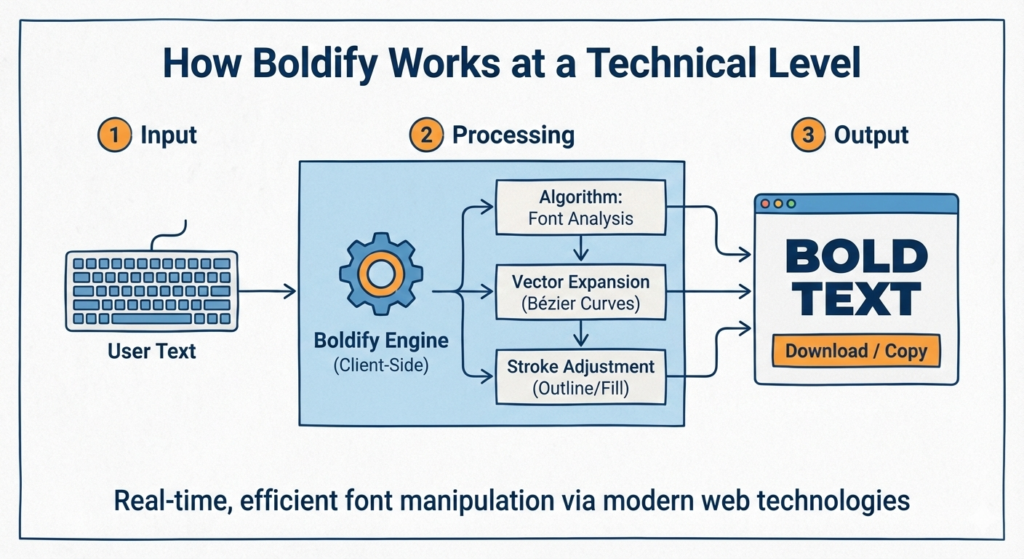
Boldify operates through a simple but effective process:
- Text Input
The user enters plain text into the input field. - Character Mapping
Each standard letter is mapped to a corresponding bold Unicode character. - Real-Time Transformation
The converted bold text appears instantly without page reloads. - Copy Output
The transformed text can be copied and reused anywhere.
This automated mapping system enables near-instant results, which is why bold letters can be generated in seconds.
Why Boldify Produces Results Instantly
Several factors contribute to Boldify’s speed:
- No server-side processing delays
- No file uploads or downloads
- Lightweight client-side logic
- Direct character substitution
Because the tool does not require authentication, formatting engines, or rendering layers, the transformation happens immediately as the user types or pastes text.
Unicode and Cross-Platform Compatibility
One of the main reasons Boldify is effective is its reliance on Unicode.
Unicode is a global standard that ensures text consistency across:
- Browsers
- Operating systems
- Social platforms
- Messaging apps
Since Unicode bold characters are treated as standard text, they remain bold even when pasted into environments that do not support traditional formatting options.
Use Cases for Bold Letters Generated
Boldify’s output can be used in many contexts where traditional bold formatting is unavailable or limited.
Social Media Content
Many social platforms restrict formatting options. Unicode bold letters allow users to highlight names, headings, or key phrases.
Messaging Applications
Messaging apps often remove formatting when text is copied. Bold Unicode characters maintain visual emphasis.
Website Drafting
Bold text can be used during drafting or prototyping stages without modifying CSS or HTML.
Notes and Documents
Users can organize information by emphasizing headings and key terms.
Difference Between Formatting and Character Conversion
It is important to understand the distinction:
- Formatting applies visual styles to text using software rules
- Character conversion replaces characters with visually styled equivalents
Boldify uses character conversion, which is why the output works in more places than traditional formatting.
Accessibility and Readability Considerations
Bold text improves scannability but should be used carefully. Excessive bolding can reduce readability, especially for long-form content.
Tools like Boldify are most effective when used to:
- Highlight headings
- Emphasize keywords
- Separate sections
Used correctly, bold letters support better comprehension and content structure.
Performance and Usability
Boldify is designed to be:
- Lightweight
- Browser-based
- Device-independent
Because it does not rely on external libraries or heavy processing, it performs consistently across desktops, tablets, and mobile devices.
Limitations of Bold Unicode Text
While Unicode bold text is widely supported, there are some limitations:
- Some older devices may not display all characters correctly
- Screen readers may interpret Unicode text differently
- Excessive use can affect visual balance
Understanding these limitations helps users apply bold text appropriately.
Why Tools Like Boldify Exist
Modern digital platforms prioritize simplicity, often removing advanced formatting options. Tools like letter ai generator fill this gap by enabling visual emphasis without relying on built-in formatting controls.
They provide a practical solution for users who need consistent bold text across platforms.
Summary
letter ai generator helps users create bold letters in seconds by converting standard text into Unicode bold characters. Its speed comes from a lightweight, browser-based approach that avoids traditional formatting dependencies.
By using character substitution instead of styling, Boldify ensures cross-platform compatibility and instant results. When used correctly, bold letters enhance readability, organization, and visual clarity in digital content.