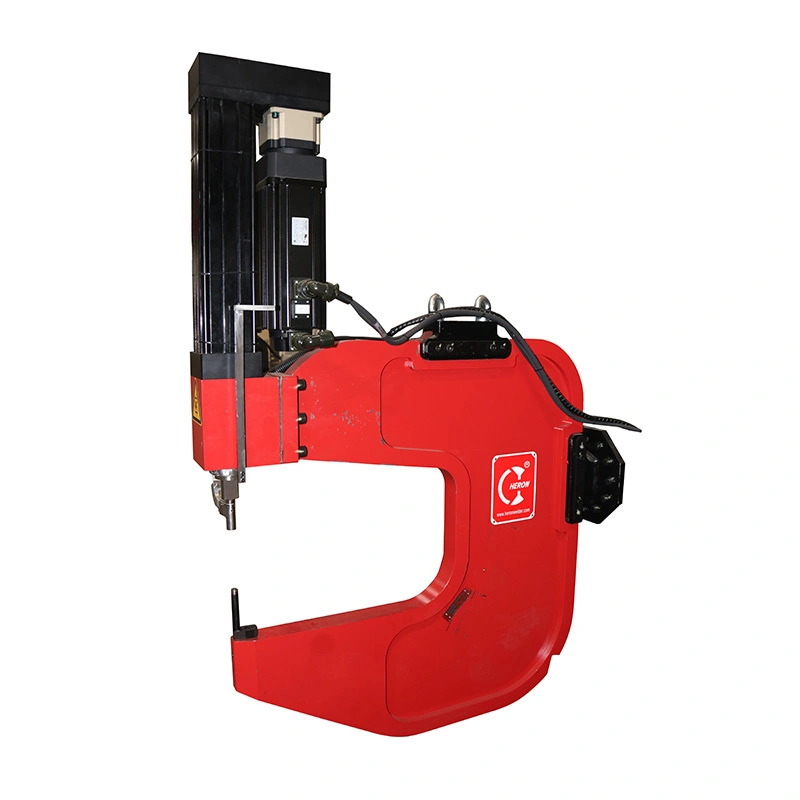
In today’s fast-paced manufacturing landscape, efficiency, precision, and reliability are essential. One technology that plays a critical role in joining metal components is the riveting machine. From automotive assembly to electronics manufacturing, riveting machines provide a high-speed, consistent, and cost-effective method of fastening parts together, often outperforming traditional welding or mechanical fastening methods.
At Heron Welder, we specialize in a comprehensive range of industrial riveting solutions, including self-pierce riveting (FSPR) systems and automated production lines designed for high-volume, high-precision manufacturing.
What is a Riveting Machine?
A riveting machine is industrial equipment designed to permanently join two or more components by deforming a rivet or creating a mechanical interlock. Unlike conventional mechanical fasteners, modern riveting machines, especially self-pierce riveting systems, allow for rapid assembly without pre-drilled holes or additional hardware.
Key Components of a Riveting Machine
- Rivet feeding system: Automatically supplies rivets for continuous operation.
- Press mechanism: Delivers precise force to deform or set the rivet.
- Clamping unit: Holds components securely during riveting to ensure accurate alignment.
- Control system: Typically PLC- or CNC-based for automation, repeatability, and monitoring.
Types of Riveting Machines
Understanding the types of riveting machines is critical for selecting the right solution for your production needs.
1. Self-Pierce Riveting (FSPR) Machines
Self-pierce riveting machines are widely used in automotive and light metal applications. They join layered materials without pre-drilling by piercing the top sheet and flaring it into the lower sheet, forming a secure mechanical joint.
Advantages:
- Ideal for aluminum or mixed-metal assemblies.
- High-speed production capability.
- Minimal heat impact on materials, unlike welding.
2. Manual and Pneumatic Riveting Machines
These are more common in smaller workshops or maintenance operations. They rely on human operation or compressed air to set rivets. While less automated, they are flexible for low-volume or complex assemblies.
3. Hydraulic Riveting Machines
Hydraulic systems provide high force for joining thick or multiple metal layers. They are typically used in heavy industrial applications where precision and strength are paramount.
Applications of Riveting Machines
Riveting machines are versatile and can be found across a wide range of industries:
- Automotive Manufacturing: For joining aluminum panels, body frames, and structural components.
- Electronics Assembly: Securing enclosures and structural parts without heat-sensitive processes.
- Aerospace Industry: Lightweight aluminum and composite assemblies where traditional welding is impractical.
- Appliances and Furniture: Fast, consistent joining of metal components with minimal deformation.
Heron Welder’s riveting systems are designed for these applications, offering customized automation solutions to meet specific production volumes, part geometries, and material types.
Riveting vs. Traditional Welding
Manufacturers often weigh riveting against traditional welding methods. Here’s how they compare:
| Feature | Riveting Machine | Welding |
|---|---|---|
| Heat Impact | Minimal | High (can distort material) |
| Material Compatibility | Metals, composites, mixed layers | Metals only |
| Automation | High-speed production lines | Requires setup, slower for thin materials |
| Maintenance | Low, less wear on parts | Electrode wear, consumables required |
| Joint Inspection | Simple visual or mechanical check | May require X-ray or ultrasonic testing |
Riveting machines, especially FSPR systems, are ideal where high precision, minimal material distortion, and mixed-material joining are essential.
Best Practices for Riveting Machine Operation
To maximize efficiency and joint quality, manufacturers should follow these best practices:
- Proper Rivet Selection: Choose rivets compatible with your material type and thickness.
- Precision Alignment: Ensure clamping units hold materials firmly to avoid misalignment.
- Regular Maintenance: Keep press mechanisms and feeding systems lubricated and free of debris.
- Automated Monitoring: Use integrated control systems to track cycle counts, joint quality, and detect errors early.
- Training Operators: Skilled personnel reduce setup errors and improve production uptime.
Why Choose Heron Welder’s Riveting Solutions?
Heron Welder has over two decades of experience delivering industrial metal-joining solutions. Our self-pierce riveting machines and automated lines provide:
- High-speed production for OEMs and industrial manufacturers.
- Customizable automation for unique part geometries and production layouts.
- Precision controls ensuring consistent, high-quality joints.
- Global support and service for installation, maintenance, and upgrades.
Whether integrating into an existing production line or designing a fully automated assembly cell, Heron’s engineers work with manufacturers to optimize output, reduce downtime, and maintain product quality.
Frequently Asked Questions (FAQs)
1. Can riveting machines join dissimilar metals?
Yes. Self-pierce riveting can join aluminum to steel or other metal combinations without the heat-related issues of welding.
2. How fast can a riveting machine operate?
Automated FSPR systems can achieve up to 60–80 cycles per minute, depending on part size and rivet type.
3. Do riveting machines require pre-drilled holes?
Self-pierce riveters do not. The rivet pierces the top layer during the joining process.
4. Are riveting machines suitable for high-volume production?
Absolutely. Automated riveting lines are designed for continuous operation and high throughput in OEM and industrial applications.
5. How does Heron support customers after purchase?
Heron offers installation, operator training, preventive maintenance, and global technical support to ensure long-term performance.
Conclusion: Invest in Precision with Heron Riveting Machines
For manufacturers seeking reliable, efficient, and high-precision metal joining, a riveting machine is a strategic investment. Whether you operate in automotive, aerospace, electronics, or general industrial manufacturing, Heron Welder provides the expertise, equipment, and automation solutions to elevate your production processes.
Request a quote today or consult with our engineers to explore customized riveting and welding automation solutions that meet your exact production requirements.