An air diffuser for STP (Sewage Treatment Plant) is an essential aeration component used to introduce air into wastewater and supply dissolved oxygen to microorganisms responsible for biological treatment. In an activated sludge or other aerobic biological treatment process, the diffuser distributes air throughout the aeration tank, helping microorganisms break down organic pollutants and supporting processes such as nitrification.
A properly designed STP air diffuser system can improve oxygen transfer, maintain suitable dissolved oxygen levels, support biological activity, and help control aeration energy consumption. Fine bubble diffusers are particularly important because their smaller bubbles provide a greater gas-liquid contact area than larger bubbles. The U.S. Environmental Protection Agency notes that fine-pore aeration can provide high oxygen transfer efficiency, although actual performance depends on wastewater characteristics, diffuser condition, airflow, basin geometry, and operating conditions.
1. Fine Bubble Air Diffuser for STP
A fine bubble air diffuser for STP releases air through numerous small perforations or pores in a membrane or porous media. As the bubbles rise through the aeration tank, oxygen transfers from the air into the wastewater.
Fine bubble diffusion is widely used in biological wastewater treatment because it can provide efficient oxygen transfer. The EPA describes fine-pore diffusers as including discs, tubes, domes, plates, and flexible membrane systems.
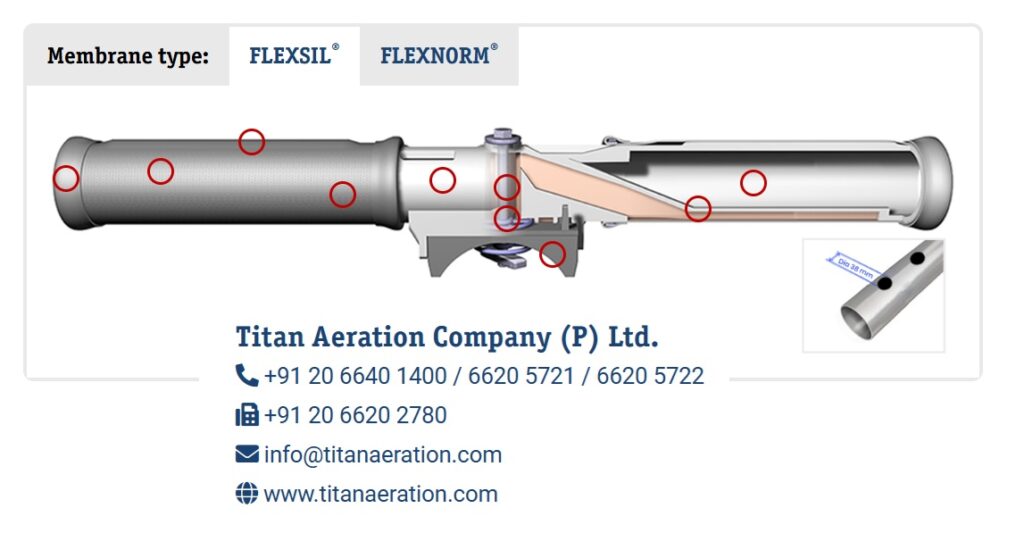
The primary components generally include:
- Diffuser membrane or porous media
- Diffuser body or support tube
- Air connection
- Air distribution piping
- Aeration grid
- Blower and air-control system
- Valves and flow-control equipment
The diffuser should be selected as part of the complete aeration system rather than as an isolated component. Airflow capacity, tank depth, oxygen demand, diffuser density, wastewater characteristics, and required dissolved oxygen levels all influence the final design.
How Fine Bubble Diffusers Work?
Compressed air supplied by a blower enters the diffuser through the air header and connection assembly. The air then passes through small openings in the membrane, producing bubbles that move upward through the mixed liquor.
The objective is to maximize useful oxygen transfer while maintaining adequate mixing. Smaller bubbles generally provide greater surface area for gas-liquid contact, which is one reason fine-pore aeration can achieve higher oxygen transfer efficiency than many coarse-bubble systems.
However, bubble size alone does not determine actual STP performance. Fouling, airflow distribution, wastewater composition, operating pressure, diffuser submergence, and maintenance can substantially affect performance.
2. Disc, Tube and Other Air Diffuser Types for STP
Different air diffuser types for STP are available to match different aeration tank configurations and operating requirements.
Disc Air Diffuser
A disc diffuser uses a circular membrane mounted on a supporting structure. It can be installed in large numbers across an aeration basin to provide distributed oxygen transfer.
Disc diffusers are commonly considered where the basin requires a flexible diffuser layout. The number and spacing of diffusers can be adjusted according to the required airflow and oxygen demand.
Tube Air Diffuser
A tube diffuser consists of an elongated membrane or porous tube mounted along a support body. Tube diffusers provide a relatively large active diffusion area and can be installed in rows along aeration grids.
A fine bubble tube diffuser for STP can be useful when the aeration system requires long, distributed diffusion zones. Tube systems are also available with replaceable membranes, depending on the product design.
Strip and Panel Diffusers
Strip and panel configurations can provide a large diffusion surface over the floor of an aeration basin. Modern membrane systems may be designed for efficient airflow distribution, lower pressure losses, and easier maintenance. Commercial systems also use specialized membrane perforations and replaceable membranes to maintain operating flexibility.
Coarse Bubble Diffusers
Coarse bubble diffusers generate larger bubbles and are often selected when mixing is a major requirement or where wastewater conditions make fine-pore systems less suitable.
Fine bubble and coarse bubble systems therefore serve different process requirements. The correct choice depends on the required oxygen transfer, mixing requirement, fouling potential, maintenance strategy, and overall aeration design.
3. Benefits of Using an Air Diffuser in STP
The use of a properly designed air diffuser system in an STP offers several operational advantages.
Higher Oxygen Transfer Efficiency
Fine bubbles provide a comparatively large gas-liquid contact area. This allows more effective transfer of oxygen from the air into the wastewater when the system is correctly designed and operated.
The EPA identifies high oxygen transfer efficiency and aeration efficiency among the principal advantages of fine-pore aeration.
Improved Biological Treatment
Aerobic microorganisms require oxygen to metabolize biodegradable organic matter. Maintaining appropriate dissolved oxygen conditions allows the biological treatment process to operate effectively.
Adequate aeration can therefore contribute to the treatment of BOD, COD and ammonia-containing wastewater, depending on the biological process and treatment configuration.
Better Air Distribution
A correctly designed diffuser grid distributes air throughout the aeration tank rather than concentrating aeration at a limited number of points.
Uniform air distribution helps avoid areas with insufficient oxygen and supports consistent biological activity across the treatment zone.
Potential Energy Savings
Aeration is an important energy consumer in wastewater treatment. Improving oxygen transfer can reduce the amount of air or blower energy required for a particular oxygen-transfer duty.
EPA documentation has reported that fine-bubble diffusion can reduce aeration energy compared with less efficient aeration arrangements, although actual savings vary considerably according to plant design and operating conditions.
Flexible Aeration Control
Modern membrane diffuser systems can be operated over a range of airflow conditions. With appropriate blower control, valves, and instrumentation, operators can adjust aeration according to changing wastewater loads.
This is particularly useful because oxygen demand is not necessarily constant throughout the day.
4. How to Select the Right Air Diffuser for STP?
Selecting the right air diffuser for sewage treatment plant applications requires consideration of the complete process rather than simply selecting a diffuser based on price or bubble appearance.
Wastewater Characteristics
The wastewater composition affects diffuser performance and membrane life. Industrial wastewater may contain chemicals, oils, surfactants, suspended solids, or other substances that influence oxygen transfer and fouling.
EPA guidance identifies wastewater characteristics, process type, loading conditions, basin geometry, diffuser characteristics, airflow rate, dissolved oxygen control, mechanical integrity, and maintenance as important factors affecting fine-pore aeration performance.
Required Airflow
Each diffuser has an appropriate operating airflow range. The diffuser should be selected according to the total oxygen demand and the number of diffusers installed.
Running too many diffusers at very low airflow or too few diffusers at excessive airflow can affect air distribution and oxygen-transfer performance.
Tank Depth
Aeration tank depth affects hydrostatic pressure, bubble residence time, and oxygen-transfer conditions. Deeper tanks generally provide greater bubble contact time, but the blower must overcome the corresponding water pressure and diffuser losses.
Membrane Material
Membrane selection should consider wastewater chemistry, operating temperature, expected service life, fouling characteristics, and maintenance requirements.
Common membrane materials used in wastewater aeration include elastomeric materials such as EPDM and silicone, depending on the application and manufacturer specifications.
Diffuser Layout
Diffuser spacing and arrangement are critical. The system should provide appropriate air distribution across the aeration basin while maintaining sufficient mixing.
A diffuser layout should account for:
- Tank dimensions
- Water depth
- Oxygen demand
- Airflow requirements
- Biological process configuration
- Inlet loading
- Return activated sludge flow
- Required dissolved oxygen
- Blower capacity
- Maintenance access
The EPA specifically identifies diffuser type, size, shape, density, and airflow rate as factors affecting fine-pore aeration performance.
5. Maintenance and Performance of STP Air Diffusers
Even a high-quality STP air diffuser requires appropriate operation and maintenance. Fine-pore diffusers can experience fouling that increases pressure loss and reduces oxygen-transfer performance. EPA guidance identifies both air-side and wastewater-side fouling as important concerns.
Monitor Airflow and Pressure
Operators should monitor diffuser-zone airflow and pressure. A gradual increase in pressure at similar operating conditions can indicate fouling, blockage, membrane deterioration, or another restriction.
Maintain Clean Blower Air
The quality of air supplied to the diffuser is important. Proper filtration and blower maintenance help reduce the risk of air-side contamination.
Inspect Diffuser Membranes
Membranes should be periodically inspected for:
- Cracks
- Tears
- Hardening
- Excessive fouling
- Uneven bubble distribution
- Damaged connections
- Mechanical deterioration
Check Bubble Distribution
Uneven bubbling can indicate blocked diffuser sections, damaged membranes, poor air balancing, or problems within the distribution network.
A healthy diffuser system should provide consistent air release across the intended operating area.
Control Dissolved Oxygen
Dissolved oxygen monitoring can help operators determine whether the aeration system is supplying sufficient oxygen without unnecessary over-aeration.
Proper control can improve process stability while avoiding excessive blower operation.
Why Fine Bubble Air Diffusers Are Important for Modern STPs?
A modern wastewater treatment plant requires more than simply introducing air into an aeration tank. The aeration system must deliver the required oxygen efficiently, maintain adequate mixing, respond to changing loads, and remain reliable throughout its operating life.
A fine bubble air diffuser for STP can provide an effective solution when the diffuser type, membrane material, airflow, tank configuration, and maintenance program are correctly matched to the treatment process.
Fine-pore aeration has been extensively used in wastewater treatment, and its principal advantage is the ability to achieve efficient oxygen transfer through small bubbles. At the same time, fouling and wastewater-specific effects must be considered during system design and operation.
For STPs treating municipal or industrial wastewater, the best diffuser configuration should therefore be established from the actual oxygen demand, airflow requirement, tank geometry, wastewater characteristics, operating depth, blower capacity, and maintenance strategy.
Conclusion
An air diffuser for STP plays a central role in biological wastewater treatment by transferring oxygen from compressed air into the aeration tank. Among the available options, fine bubble disc, tube, strip, and panel diffusers can provide efficient oxygen transfer when appropriately designed and operated.
The selection process should consider diffuser type, membrane material, airflow rate, oxygen demand, tank depth, wastewater characteristics, diffuser density, pressure loss, fouling potential, and maintenance requirements. Proper diffuser selection and system design can support stable biological treatment, effective oxygen distribution, and efficient aeration operation.
For wastewater treatment plants seeking dependable aeration, fine bubble air diffusers andmembrane tube diffusers can be integrated into properly engineered aeration grids to meet the specific requirements of municipal STPs, industrial ETPs, and other aerobic treatment systems.