As a food business grows, packaging can quickly become more than a basic operating expense. Restaurants, food trucks, cafes, catering companies, fast-casual brands, stadium concessions, and other foodservice businesses need packaging that protects food, supports efficient service, and represents the brand.
For a small business serving a limited number of customers each day, purchasing packaging in small quantities may seem convenient. However, as order volume increases, buying individual packages repeatedly can become inefficient. This is where wholesale purchasing can become a practical option.
Custom food paper trays can provide a useful combination of food presentation, portion organization, branding, and convenience. Buying them in larger quantities may also help a growing business maintain a consistent packaging supply while planning its costs more effectively.
The right time to move toward wholesale packaging depends on factors such as order volume, storage capacity, menu size, branding goals, cash flow, and expected growth. A business should not choose wholesale simply because it sounds cheaper. It should make sense operationally and financially.
When Should a Growing Business Start Buying Food Packaging in Wholesale Quantities?
A growing food business should consider wholesale packaging when its regular order volume becomes high enough that frequent small purchases create unnecessary cost, work, or supply risk. The packaging should also meet appropriate food-contact requirements, which is why businesses should carefully evaluate food grade paper when selecting trays for serving meals.
There is no single sales number that determines when wholesale purchasing becomes appropriate. A restaurant selling 100 meals per day may have different needs from a food truck selling 300 meals during weekend events.
Several signs can indicate that it is time to consider larger packaging orders.
First, the business may be reordering trays frequently. If employees regularly have to check inventory and place packaging orders, purchasing larger quantities can simplify procurement.
Second, packaging costs may become more noticeable as sales increase. Even a small difference in the per-unit price can have an impact when thousands of trays are used every month.
Third, the business may have established menu items that require the same packaging consistently. If the same tray size is being used every day, wholesale purchasing becomes easier to plan.
Finally, a growing business may want more control over its brand presentation. Standard generic trays may not provide the same visual consistency as custom packaging.
Wholesale purchasing makes the most sense when demand is predictable and the business has enough storage space to hold the inventory.
Why Can Custom Packaging Become More Valuable as a Food Business Grows?
As a food company becomes more established, packaging often becomes part of its customer-facing identity.
A customer may recognize a restaurant from its logo, colors, typography, packaging patterns, or signature presentation. This can be particularly important for businesses that serve food outside their physical location.
A branded tray can help create consistency between dine-in, takeout, catering, and event service.
For example, a burger restaurant in Texas may use the same logo and color scheme on trays, wrappers, bags, and menu boards. A food truck in California might use custom packaging to make its meals more recognizable at festivals and community events.
Packaging does not replace good food or customer service, but it can reinforce the overall experience.
For growing brands, this consistency becomes increasingly important because customers may encounter the business in multiple places.
How Does Wholesale Purchasing Help Control Packaging Costs?
Wholesale purchasing can reduce the unit cost of packaging when compared with buying small quantities repeatedly, although actual savings depend on the supplier, order size, material, printing requirements, shipping, and other factors.
A restaurant should evaluate the complete cost rather than focusing only on the price per tray.
For example, a lower-cost tray may not be the best choice if it is too weak for the food, difficult to stack, or poorly sized. Similarly, a very large order may create unnecessary storage costs if the packaging takes years to use.
Businesses should consider:
- Unit price
- Printing cost
- Shipping charges
- Storage requirements
- Minimum order quantity
- Expected usage
- Reordering frequency
- Product quality
- Waste or damaged units
- Production lead time
The goal is to find the right balance between price, quality, and inventory.
How Can Custom Trays Improve Food Presentation?
Food presentation matters even in fast-casual and takeaway environments.
A well-designed tray can help organize burgers, fries, sandwiches, chicken, seafood, desserts, or combination meals. The tray can create a defined serving area while giving the food a more consistent appearance.
For dine-in service, presentation can influence how customers perceive the meal. For takeaway orders, packaging may be the main visual element surrounding the food.
A custom design can include:
- Business logo
- Brand colors
- Simple patterns
- Illustrations
- Short brand messages
- Website information
- Social media handles
- Seasonal artwork
However, effective packaging design should remain readable and practical. Too many graphics can make a package look cluttered.
A simple logo and recognizable color palette are often enough to create a strong visual identity.
Why Is Printed Food Paper Useful Alongside Custom Trays?
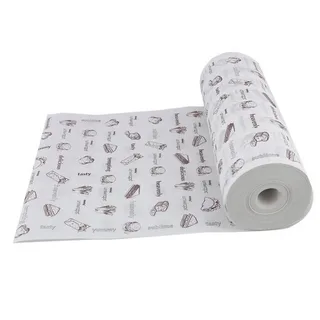
Custom trays do not have to work alone. Restaurants can combine them with other paper packaging to create a coordinated serving system. For example, printed wax paper for food can complement a custom tray by adding another branded surface around sandwiches, burgers, fries, or other menu items.
Using coordinated packaging can make the complete meal look more intentional.
A restaurant might use a printed liner inside a tray, a matching wrapper around a sandwich, and a branded paper bag for takeaway. When the colors and graphics are consistent, customers can immediately connect the packaging with the business.
This approach is particularly useful for businesses that want to create a recognizable experience without changing their entire packaging range at once.
How Can Wholesale Trays Support a Growing Menu?
Growing food businesses often add new menu items.
A cafe may expand from sandwiches into breakfast bowls and pastries. A burger restaurant may add chicken sandwiches and loaded fries. A food truck may introduce seasonal specials.
Packaging needs can change with menu expansion.
Instead of purchasing a completely different package for every food item, businesses can sometimes use a few versatile tray sizes.
Before ordering, businesses should map each major menu category to an appropriate package.
For example:
| Menu Item | Packaging Consideration |
|---|---|
| Burgers | Width and height for the burger |
| Fries | Tray depth and portion size |
| Chicken tenders | Surface area and grease management |
| Sandwiches | Space for wrapping or liners |
| Seafood | Moisture and grease considerations |
| Desserts | Protection from crushing |
| Combo meals | Capacity for multiple components |
The goal is to avoid unnecessary packaging variety while still giving important menu categories suitable presentation.
How Much Custom Packaging Should a Growing Business Order?
The correct order quantity depends on actual usage and expected growth.
A business should review historical packaging consumption before placing a wholesale order. If a restaurant uses 500 trays per week, ordering enough for several months may be reasonable if it has adequate storage and stable demand.
However, businesses should avoid purchasing excessive quantities simply to receive a lower unit price.
Demand can change because of:
- Seasonal sales
- Menu changes
- New locations
- Events
- Promotions
- Local competition
- Weather
- Delivery trends
- Business expansion
A useful approach is to estimate average monthly usage and add a reasonable safety stock rather than buying an excessive amount.
Businesses should also ask suppliers about production times. If custom trays require several weeks to manufacture, the reorder point should be established well before inventory becomes critically low.
What Should You Check Before Ordering Custom Wholesale Trays?
Before committing to a large order, businesses should evaluate both the product and the supplier.
Start with the tray dimensions. A tray that looks attractive but does not fit the food correctly will create problems during service.
Next, consider material strength. The tray should be appropriate for the type and weight of food being served.
Printing quality is also important. Logos should appear clear, colors should be consistent, and important text should remain readable.
Businesses should also ask about:
- Material specifications
- Intended food-contact applications
- Grease resistance
- Moisture performance
- Printing options
- Available sizes
- Minimum order quantities
- Sample availability
- Production time
- Shipping options
- Artwork requirements
- Reordering procedures
A reliable supplier should provide clear answers rather than making vague promises.
Is Wholesale Packaging Suitable for Food Trucks?
Yes, wholesale packaging can be especially useful for food trucks with predictable sales.
Food trucks often operate in compact environments, so packaging needs to be easy to store, stack, and access quickly.
Custom trays can also support food truck branding because the package travels with the customer. A branded meal may be seen at parks, offices, festivals, sports events, and other public locations.
However, food truck operators should pay close attention to storage space. A large wholesale order may save money per unit but create operational problems if the vehicle or storage facility cannot accommodate the inventory.
Many food truck businesses may benefit from storing bulk packaging at a separate facility and keeping only the required working inventory on the truck.
How Can Wholesale Packaging Help Multi-Location Restaurants?
For restaurant groups with multiple locations, packaging consistency can become even more important.
A standardized custom tray design can help different locations present food in a similar way. Customers visiting two branches should still recognize the same brand.
Centralized purchasing may also make inventory management easier.
A multi-location business can establish:
- Standard tray sizes
- Approved artwork
- Packaging specifications
- Minimum stock levels
- Reordering schedules
- Approved suppliers
This creates greater control over packaging quality and branding.
Before standardizing a package across locations, businesses should test it in different environments. A package that works well in one restaurant may behave differently when used by another location with different menu items or service conditions.
When Is It Better to Wait Before Buying Wholesale?
Wholesale is not automatically the best choice for every growing business.
A company may want to wait if its menu is changing rapidly, sales are unpredictable, storage space is limited, or it is still testing its brand identity.
A startup that expects major changes to its logo or packaging design may not want thousands of units carrying an outdated design.
Similarly, a restaurant preparing to open a second location may want to understand its combined demand before placing a large order.
In these situations, smaller quantities or standard packaging may be more practical until demand becomes clearer.
The important point is to match the purchasing strategy with the business stage.
Can Wholesale Custom Trays Support Catering and Events?
Catering businesses can benefit from bulk packaging because order volumes can increase significantly during events.
Corporate lunches, weddings, festivals, sports events, school functions, and private parties may require hundreds or thousands of servings.
Custom trays can help maintain a consistent presentation across large orders. They can also make portion organization easier for catering staff.
For event-based businesses, forecasting is particularly important. Ordering too much packaging after a short-term event can create excess inventory.
Caterers should consider their annual event calendar and recurring clients when estimating packaging requirements.
How Should a Business Test Custom Trays Before a Large Order?
Testing is one of the most practical steps before placing a wholesale order.
Businesses should request samples where available and use them with actual menu items.
Test the trays during normal service rather than simply looking at them on a table.
Check whether:
- Food fits comfortably
- Portions remain organized
- The tray holds its shape
- Staff can handle it quickly
- Customers can carry it easily
- Printing looks professional
- Storage is practical
- The package works with sauces and sides
- The design matches the brand
Testing can reveal problems that are difficult to identify from photographs or product specifications alone.
Frequently Asked Questions
When should a restaurant switch to wholesale packaging?
A restaurant should consider wholesale purchasing when packaging demand becomes predictable, recurring orders become frequent, and the business has sufficient storage for bulk inventory.
Is wholesale packaging always cheaper?
Not necessarily. The unit price may be lower, but businesses should consider shipping, storage, minimum order quantities, quality, and potential waste before calculating the true cost.
Are custom trays useful for small restaurants?
Yes, but small restaurants should balance branding goals with order quantities and storage capacity. A smaller custom order may be more appropriate during the early stages of growth.
What food businesses can use custom paper trays?
Restaurants, food trucks, cafes, catering companies, concession stands, bakeries, delis, sandwich shops, and fast-casual businesses can use trays when the format fits their menu and service model.
How many custom trays should a restaurant order?
The quantity should be based on average usage, expected growth, storage capacity, lead time, and safety stock. Businesses should avoid ordering significantly more than they can reasonably use.
Should a restaurant order different tray sizes?
It depends on the menu. A business with several substantially different food portions may need multiple sizes, while a focused menu may be served efficiently with one or two versatile formats.
What should businesses ask a packaging supplier?
Businesses should ask about material specifications, food-contact suitability, dimensions, printing, minimum quantities, samples, production times, shipping, storage, and reordering.
Can custom trays improve brand recognition?
Yes. Consistent logos, colors, patterns, and packaging designs can help customers recognize a restaurant across dine-in, takeaway, catering, and delivery experiences.
Is custom packaging a good investment for a growing food business?
It can be when packaging is already being purchased regularly and the business has a clear brand identity and predictable demand. The investment should be evaluated based on operational and marketing value rather than appearance alone.
Final Words
Choosing wholesale custom food trays is an important step for a growing food business, but timing matters. The best time to make the switch is usually when packaging demand has become predictable, the business has enough storage capacity, and repeated small orders are becoming inefficient.
Wholesale purchasing can help simplify inventory management, support consistent food presentation, and potentially reduce the per-unit packaging cost. Custom printing can also turn an everyday serving item into part of the restaurant’s brand identity.
However, businesses should avoid choosing packaging based on price alone. Tray dimensions, material quality, food-contact suitability, grease and moisture performance, printing quality, storage, production time, and supplier reliability all deserve attention.
For restaurants, food trucks, cafes, caterers, and other food businesses in the United States, a well-planned packaging strategy can support both daily operations and long-term growth. Start with actual usage data, test samples with real menu items, calculate the total cost, and choose quantities that match realistic demand.
When the timing is right, wholesale custom trays can become a practical part of a growing food business’s purchasing, branding, and customer experience strategy.