Japanese uses three scripts. Hiragana and katakana are sound-based alphabets with 46 basic characters each, and most beginners can learn them in a few weeks. Kanji are meaning-based characters borrowed from Chinese, learned gradually over years. Start with hiragana, then katakana, then add kanji, and practise every sound with native audio.
Is There Really a “Japanese Alphabet”?
Strictly speaking, no. Japanese has no single alphabet like English. It uses three writing systems together, and often all three appear in one sentence. People searching for the “beginner Japanese alphabet” usually want the two syllabaries, hiragana and katakana, and then want to know where kanji fit in.
| Script | Type | Basic size | Main use | Learn it |
|---|---|---|---|---|
| Hiragana (ひらがな) | Syllabary (sounds) | 46 characters | Native words, grammar endings, particles | First |
| Katakana (カタカナ) | Syllabary (sounds) | 46 characters | Foreign loanwords, names, emphasis, sound effects | Second |
| Kanji (漢字) | Logograms (meaning + sound) | 2,136 in the official everyday list (jōyō kanji) | Nouns, verb and adjective stems | Gradually, from early on |
Each kana represents a sound (mostly one consonant plus one vowel). Once you know them, you can read aloud almost any Japanese text, even before you understand it.
Step 1: Learn Hiragana First
Hiragana is the foundation. Textbooks, children’s books, and learner apps all build on it. It is used for grammar particles (は, を, の), verb endings, and many everyday words such as ありがとう (arigatō, “thank you”).
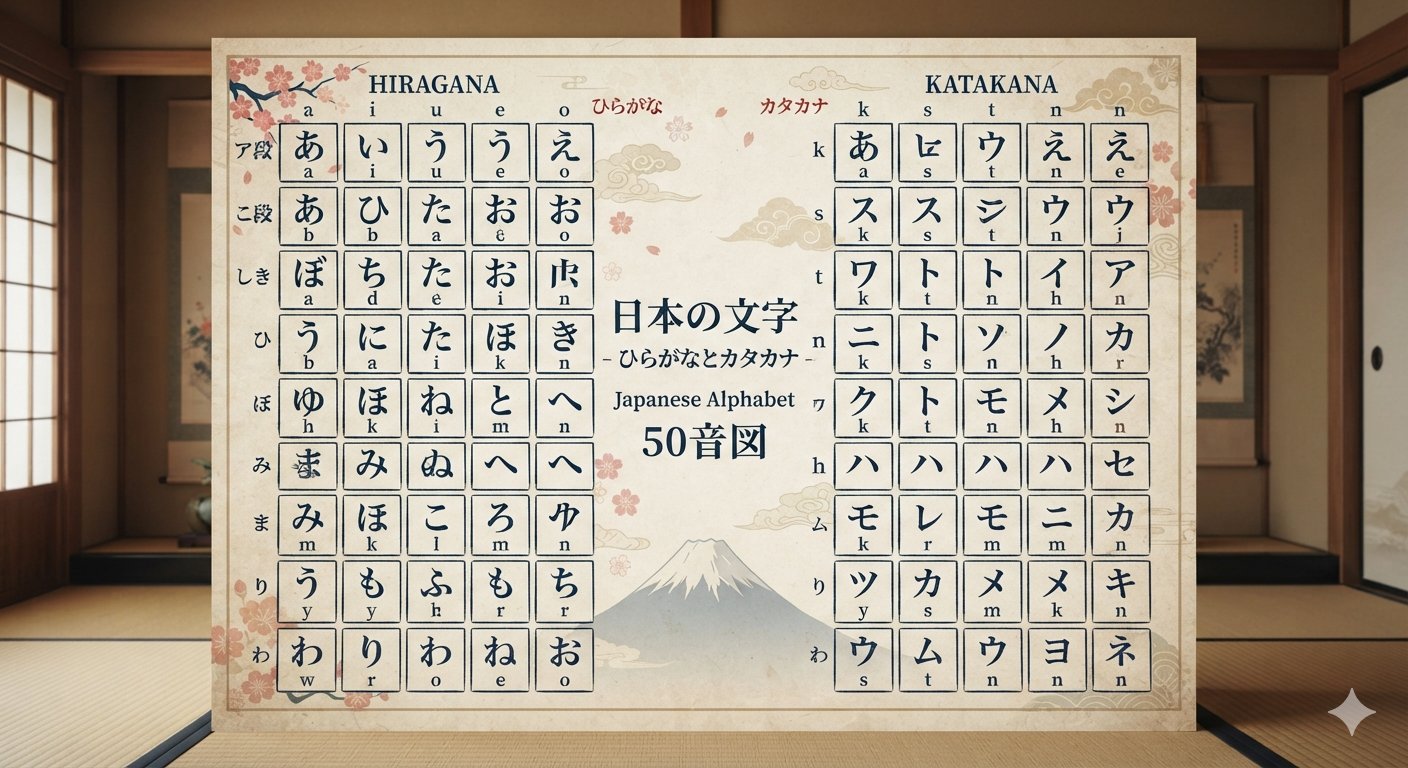
The Basic Hiragana and Katakana Chart
Read each row aloud. The vowels are always a, i, u, e, o, and they don’t change from word to word.
| Row | Romaji | Hiragana | Katakana |
|---|---|---|---|
| Vowels | a i u e o | あ い う え お | ア イ ウ エ オ |
| K | ka ki ku ke ko | か き く け こ | カ キ ク ケ コ |
| S | sa shi su se so | さ し す せ そ | サ シ ス セ ソ |
| T | ta chi tsu te to | た ち つ て と | タ チ ツ テ ト |
| N | na ni nu ne no | な に ぬ ね の | ナ ニ ヌ ネ ノ |
| H | ha hi fu he ho | は ひ ふ へ ほ | ハ ヒ フ ヘ ホ |
| M | ma mi mu me mo | ま み む め も | マ ミ ム メ モ |
| Y | ya yu yo | や ゆ よ | ヤ ユ ヨ |
| R | ra ri ru re ro | ら り る れ ろ | ラ リ ル レ ロ |
| W + N | wa wo n | わ を ん | ワ ヲ ン |
Adding Audio to Your Practice
Japanese has pitch accent and short-versus-long vowel differences that you can’t absorb from romaji alone. Use audio like this:
- Listen first. Play each row from a native speaker before looking at the romaji.
- Repeat out loud. Say each sound right after the recording.
- Write while you speak. Follow correct stroke order and say the sound as you write.
- Test by ear. Play a random sound and write the character without looking.
(Editor’s note: embed your own native-speaker audio files beside the chart. I can’t generate or host audio here.)
Sound Marks and Combinations
After the basic 46, add these:
- Dakuten (゛): turns か into が (ga), さ into ざ (za), た into だ (da), は into ば (ba).
- Handakuten (゜): turns は into ぱ (pa).
- Small や, ゆ, よ (yōon): combine with other characters, e.g. き + ゃ = きゃ (kya).
- Small っ (sokuon): doubles the next consonant, as in きって (kitte, “stamp”).
- Long vowels: hold the sound twice as long. おばさん (obasan, “aunt”) and おばあさん (obāsan, “grandmother”) are different words.
Step 2: Learn Katakana Second
Katakana covers the same sounds as hiragana, but the shapes are more angular and the uses differ:
- Foreign loanwords: コーヒー (kōhī, “coffee”), テレビ (terebi, “television”), パソコン (pasokon, “personal computer”)
- Foreign names, including many people’s own names when written in Japanese
- Emphasis and sound effects, similar to italics in English
- Many animal, plant, and food names in scientific or menu contexts
Loanwords are a good way to practise: you read the word and often understand it immediately.
Look-Alike Characters to Watch
| Pair | Sounds | Tip |
|---|---|---|
| シ vs ツ | shi vs tsu | シ strokes are more horizontal; ツ strokes point more downward |
| ソ vs ン | so vs n | ソ’s short stroke sits on top; ン’s sits at the lower left |
| ぬ vs め | nu vs me | ぬ has a loop at the end; め does not |
| わ vs れ vs ね | wa vs re vs ne | Check the final curve and the tail |
Step 3: Add Kanji Gradually
Kanji carry meaning. They can feel overwhelming, but you don’t need to finish the kana before starting. Begin with a few high-frequency kanji while you practise reading.
| Kanji | Meaning | Example word |
|---|---|---|
| 日 | sun, day | 日本 (Nihon, Japan) |
| 本 | book, origin | 本 (hon, book) |
| 人 | person | 日本人 (Nihonjin, Japanese person) |
| 水 | water | 水 (mizu, water) |
| 山 | mountain | 山 (yama, mountain) |
Why Kanji Have More Than One Reading
Most Live Japanese Alphabet Kanji have an on’yomi (a reading derived from Chinese) and a kun’yomi (a native Japanese reading). For example, 日 is read にち or じつ in compounds, and ひ on its own. Learn kanji inside real words, not as isolated characters, so you pick up the right reading automatically.
How the Three Scripts Work Together
Take this sentence: 私はコーヒーを飲みます。 (Watashi wa kōhī o nomimasu: “I drink coffee.”)
- 私 and 飲 are kanji (the meaning-carrying words)
- は, を, み, ま, す are hiragana (particles and verb endings)
- コーヒー is katakana (a loanword)
Once you see this pattern, Japanese text stops looking like a wall of symbols.
A Realistic 4-Week Study Plan
People learn at different speeds, so treat this as a framework, not a guarantee.
- Week 1: Hiragana vowels through the N-row, with audio, 15 to 20 minutes daily.
- Week 2: Finish hiragana, including dakuten and small characters. Read simple words aloud.
- Week 3: Katakana basics. Read loanwords and menus. Focus on look-alike pairs.
- Week 4: Review both scripts, then add 10 to 20 starter kanji inside common words.
Short daily sessions beat long weekly ones, because the goal is fast recognition.
Common Beginner Mistakes to Avoid
- Relying on romaji too long. It slows reading and hides real pronunciation.
- Skipping stroke order. Correct order makes handwriting faster and neater.
- Learning kanji in isolation. Always attach a word and a reading.
- Ignoring long vowels and small っ. They change meaning.
- Not reviewing. Use spaced repetition, which revisits items just before you’d forget them.
Frequently Asked Questions
1. How long does it take to learn hiragana and katakana?
Many beginners learn the basics of each in a few weeks with daily practice. Reading them quickly takes longer and improves with real reading.
2. Should I learn hiragana or katakana first?
Hiragana. It appears in every sentence, while katakana is more specialised.
3. Do I need kanji to speak Japanese?
No. You need them to read and write real-world Japanese, not to speak.
4. How many kanji do I need to know?
The official jōyō list has 2,136 kanji for general use. A few hundred already let you read a surprising amount, and most learners build up gradually.
5. Is romaji good enough for beginners?
Only as a short bridge. Moving to kana early improves reading and pronunciation.
6. Why does Japanese have three scripts?
Kanji came from Chinese writing, and kana developed from simplified kanji to write Japanese sounds. The scripts kept distinct roles.
7. Why is audio important when learning kana?
It shows real pronunciation, rhythm, and vowel length, which charts can’t.
8. What’s the difference between hiragana and katakana?
They represent the same sounds. Hiragana is for native words and grammar; katakana is for loanwords, names, and emphasis.
9. What’s the best way to remember the characters?
Combine audio, handwriting, and spaced-repetition review. Picture-based mnemonics can help at first.
10. Can I learn all three scripts at once?
You can introduce kanji early, but master hiragana first so you always have a base to read from.
Conclusion
The “Japanese alphabet” is really three scripts working as a team. Begin with hiragana, move to katakana, and bring in kanji gradually inside real words. Add audio from day one so your eyes and ears learn together. Keep sessions short and consistent, and you’ll soon read your first full sentence.