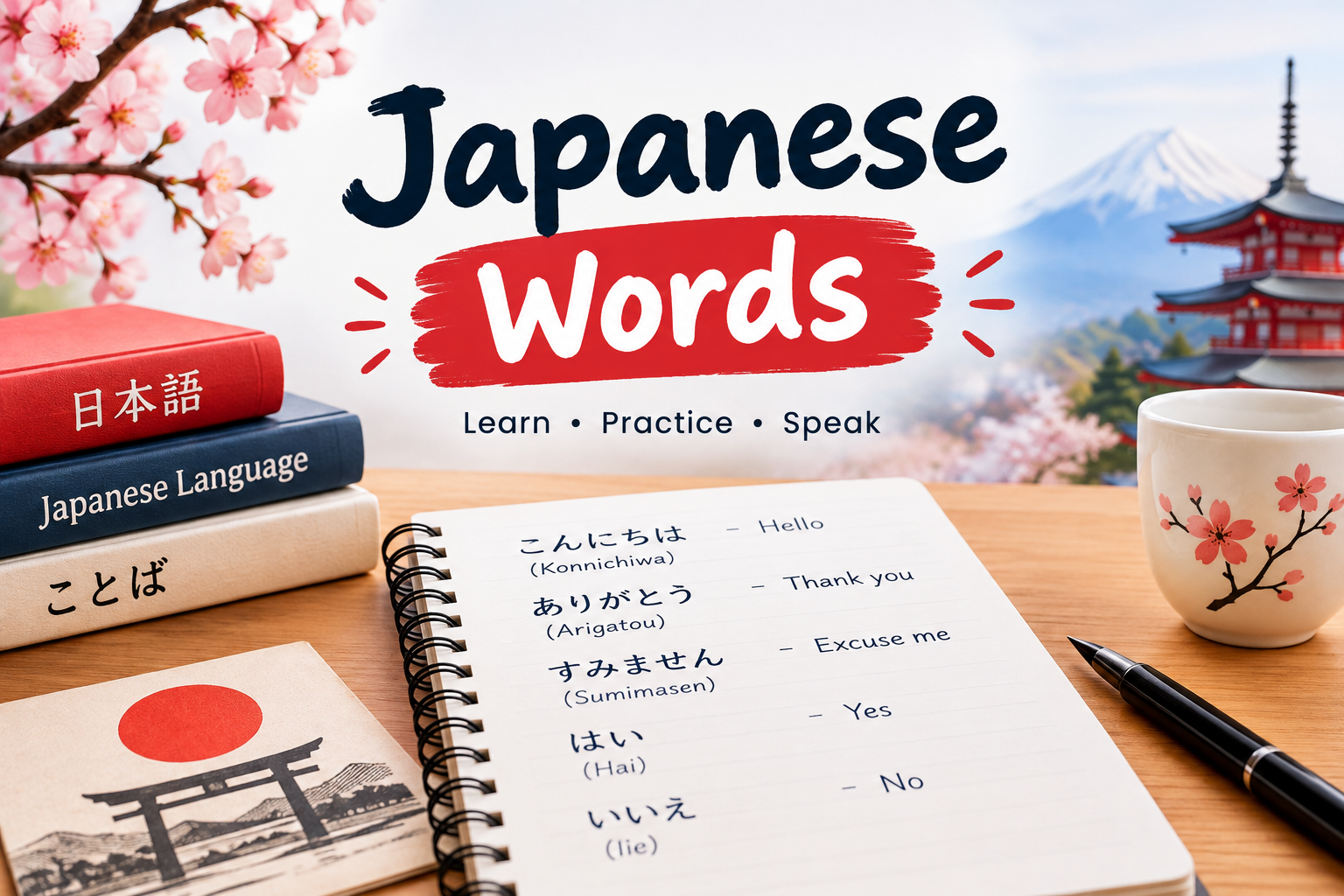
Learn Japanese words with 105 beginner-friendly vocabulary picks, hiragana basics, and simple sentences. Start speaking Japanese with confidence today.
To learn Japanese words as a beginner, start with about 100 high-frequency words: greetings, numbers, family, food, common verbs, and question words. Learn the 46 basic hiragana first, since Japanese has no A to Z alphabet. Use romaji as a temporary guide, then practice each word in a short sentence every day.
What Beginners Are Really Looking For
Most people searching “Learn Japanese Words” or “Japanese letters A to Z” want the same thing: a simple place to begin. They want words they can use this week, and they want to know how Japanese writing compares to the English alphabet.
This guide covers both. You’ll get the writing-system basics, 105 beginner words in tables, practice sentences, a study routine, and answers to common questions.
Is There a Japanese A to Z? Understanding the Writing Systems
Japanese does not have an A to Z alphabet. It uses three scripts together, plus a Latin-letter system for learners.
| Script | What it is | Typical use |
|---|---|---|
| Hiragana (ひらがな) | 46 basic sound characters | Native words, grammar endings |
| Katakana (カタカナ) | 46 basic sound characters | Foreign loanwords, names, emphasis |
| Kanji (漢字) | Characters borrowed from Chinese | Core meaning in most words |
| Romaji | Japanese written in Latin letters | Learner support, typing |
The closest thing to “A to Z” is the gojūon (五十音) chart, the traditional hiragana order that starts with the five vowels.
The Five Vowels
Every Japanese syllable builds on these sounds. They are short and consistent, unlike English vowels.
- あ (a): as in “father”
- い (i): as in “machine”
- う (u): like “oo” in “food,” but with relaxed lips
- え (e): as in “bed”
- お (o): as in “or”
From there, consonants attach in rows: か (ka), さ (sa), た (ta), な (na), は (ha), and so on. Learning one row per day is a realistic pace for most beginners.
105 Basic Japanese Words by Category
Each table pairs the word with its romaji and English meaning. Hiragana or katakana is shown first because that is what beginners meet earliest.
1. Greetings and Polite Phrases (12)
| Japanese | Romaji | Meaning |
|---|---|---|
| こんにちは | konnichiwa | Hello / good afternoon |
| おはようございます | ohayō gozaimasu | Good morning |
| こんばんは | konbanwa | Good evening |
| おやすみなさい | oyasumi nasai | Good night |
| ありがとう | arigatō | Thank you |
| すみません | sumimasen | Excuse me / sorry |
| ごめんなさい | gomen nasai | I’m sorry |
| はい | hai | Yes |
| いいえ | iie | No |
| おねがいします | onegai shimasu | Please |
| さようなら | sayōnara | Goodbye |
| はじめまして | hajimemashite | Nice to meet you |
2. Numbers 1 to 10 (10)
| Japanese | Romaji | Number |
|---|---|---|
| いち | ichi | 1 |
| に | ni | 2 |
| さん | san | 3 |
| よん / し | yon / shi | 4 |
| ご | go | 5 |
| ろく | roku | 6 |
| なな / しち | nana / shichi | 7 |
| はち | hachi | 8 |
| きゅう / く | kyū / ku | 9 |
| じゅう | jū | 10 |
3. People and Family (10)
| Japanese | Romaji | Meaning |
|---|---|---|
| わたし | watashi | I / me |
| あなた | anata | You |
| ともだち | tomodachi | Friend |
| せんせい | sensei | Teacher |
| がくせい | gakusei | Student |
| かぞく | kazoku | Family |
| おかあさん | okāsan | Mother |
| おとうさん | otōsan | Father |
| こども | kodomo | Child |
| ひと | hito | Person |
4. Food and Drink (12)
| Japanese | Romaji | Meaning |
|---|---|---|
| みず | mizu | Water |
| おちゃ | ocha | Tea |
| ごはん | gohan | Rice / meal |
| パン | pan | Bread |
| にく | niku | Meat |
| さかな | sakana | Fish |
| やさい | yasai | Vegetables |
| たまご | tamago | Egg |
| くだもの | kudamono | Fruit |
| コーヒー | kōhī | Coffee |
| りんご | ringo | Apple |
| ぎゅうにゅう | gyūnyū | Milk |
5. Everyday Verbs (14)
These are in dictionary form, which is what you’ll see in word lists and dictionaries.
| Japanese | Romaji | Meaning |
|---|---|---|
| たべる | taberu | To eat |
| のむ | nomu | To drink |
| いく | iku | To go |
| くる | kuru | To come |
| みる | miru | To see / watch |
| きく | kiku | To listen / ask |
| はなす | hanasu | To speak |
| よむ | yomu | To read |
| かく | kaku | To write |
| かう | kau | To buy |
| する | suru | To do |
| ある | aru | To exist (things) |
| いる | iru | To exist (people, animals) |
| べんきょうする | benkyō suru | To study |
6. Common Adjectives (12)
| Japanese | Romaji | Meaning |
|---|---|---|
| おおきい | ōkii | Big |
| ちいさい | chiisai | Small |
| あたらしい | atarashii | New |
| ふるい | furui | Old (things) |
| たかい | takai | Expensive / tall |
| やすい | yasui | Cheap |
| おいしい | oishii | Delicious |
| たのしい | tanoshii | Fun |
| むずかしい | muzukashii | Difficult |
| やさしい | yasashii | Easy / kind |
| いい | ii | Good |
| わるい | warui | Bad |
7. Places and Everyday Objects (12)
| Japanese | Romaji | Meaning |
|---|---|---|
| うち | uchi | Home |
| がっこう | gakkō | School |
| えき | eki | Station |
| みせ | mise | Shop |
| びょういん | byōin | Hospital |
| くるま | kuruma | Car |
| でんしゃ | densha | Train |
| ほん | hon | Book |
| かばん | kaban | Bag |
| でんわ | denwa | Phone |
| おかね | okane | Money |
| トイレ | toire | Toilet |
8. Time and Days (10)
| Japanese | Romaji | Meaning |
|---|---|---|
| きょう | kyō | Today |
| あした | ashita | Tomorrow |
| きのう | kinō | Yesterday |
| いま | ima | Now |
| あさ | asa | Morning |
| よる | yoru | Night |
| まいにち | mainichi | Every day |
| しゅうまつ | shūmatsu | Weekend |
| げつようび | getsuyōbi | Monday |
| にちようび | nichiyōbi | Sunday |
9. Question Words (7)
| Japanese | Romaji | Meaning |
|---|---|---|
| なに | nani | What |
| だれ | dare | Who |
| どこ | doko | Where |
| いつ | itsu | When |
| なぜ | naze | Why |
| いくら | ikura | How much |
| どれ | dore | Which |
10. Basic Colors (6)
| Japanese | Romaji | Meaning |
|---|---|---|
| あか | aka | Red |
| あお | ao | Blue |
| しろ | shiro | White |
| くろ | kuro | Black |
| みどり | midori | Green |
| きいろ | kiiro | Yellow |
That’s 105 words across ten everyday topics.
Put the Words to Work: Beginner Japanese Letters A to Z
Words stick better in context. Beginner Japanese Letters A to Z sentences usually end with the verb or です (desu), and small particles mark each word’s role.
- わたしは がくせいです。 (Watashi wa gakusei desu.) I am a student.
- みずを のみます。 (Mizu o nomimasu.) I drink water.
- えきは どこですか。 (Eki wa doko desu ka?) Where is the station?
- これは いくらですか。 (Kore wa ikura desu ka?) How much is this?
- きょうは たのしいです。 (Kyō wa tanoshii desu.) Today is fun.
Note that は is read “wa” and を is read “o” when used as particles. Adding か (ka) at the end turns a statement into a question.
A Simple Study Routine That Works
Consistency matters more than speed. Try this five-step routine:
- Learn hiragana first. Aim for one or two rows per day until you can read all 46.
- Study 5 to 7 words a day. One category per week keeps topics connected.
- Say every word aloud. Japanese pronunciation is regular, so speaking early builds good habits.
- Make one sentence per word. Even a rough sentence helps memory more than a flashcard alone.
- Review at spaced intervals. Revisit words after one day, three days, and a week.
A spaced-repetition app or a paper flashcard set both work. Choose the one you’ll actually open every day.
Common Beginner Mistakes to Avoid
- Relying on romaji too long. It’s a useful bridge, but it hides how Japanese is really written and encourages English-style pronunciation. Move to hiragana quickly.
- Ignoring long vowels. obasan (aunt) and obāsan (grandmother) are different words, as are ojisan (uncle) and ojīsan (grandfather).
- Mixing up similar sounds. Practice telling apart pairs like さ/ざ and つ/づ with a native audio source.
- Memorizing without sentences. Isolated words fade quickly.
- Skipping polite forms. Learn ます (masu) and です (desu) early; they’re safe in almost any situation.
Frequently Asked Questions
1. Is there a Japanese alphabet from A to Z?
No. Japanese uses hiragana, katakana, and kanji. Romaji uses Latin letters, but only as a learner tool.
2. How many Japanese words should a beginner learn first?
Around 100 well-chosen words is a solid start. They cover greetings, numbers, and daily needs, and give you enough vocabulary to build basic sentences.
3. Should I learn hiragana or katakana first?
Hiragana first. It’s used for grammar and native words. Learn katakana next for loanwords like コーヒー (coffee).
4. Do I need to learn kanji as a beginner?
Not immediately. Start with kana, then add simple kanji such as numbers and days of the week once you’re comfortable.
5. Is Japanese hard for English speakers?
The writing system and sentence order take adjustment. Pronunciation is comparatively simple because the vowel sounds are consistent.
6. What’s the difference between konnichiwa and konbanwa?
Konnichiwa is used in the daytime, konbanwa in the evening. Both are polite and widely understood.
7. Why do some numbers have two readings?
Four, seven, and nine each have two readings (yon/shi, nana/shichi, kyū/ku). In everyday counting, yon, nana, and kyū are the most common choices.
8. Can I learn Japanese words without a teacher?
Yes, with structured resources and regular speaking practice. A tutor or language partner can speed up pronunciation correction.
9. How long does it take to learn 100 Japanese words?
It depends on your pace. At five to seven new words a day with review, many learners can work through a list like this in a few weeks.
10. What’s the best way to remember Japanese vocabulary?
Combine spaced repetition, speaking aloud, and using each word in a short sentence. Varying how you practice helps retention.
Conclusion
Learning Japanese doesn’t require mastering an “A to Z” alphabet. It requires a clear starting point: the five vowels, the hiragana chart, and a compact set of useful words. The 105 words above give you that foundation.
Pick one category, learn a handful of words today, and say them out loud in a sentence. Small, steady practice is what turns a word list into real communication.