
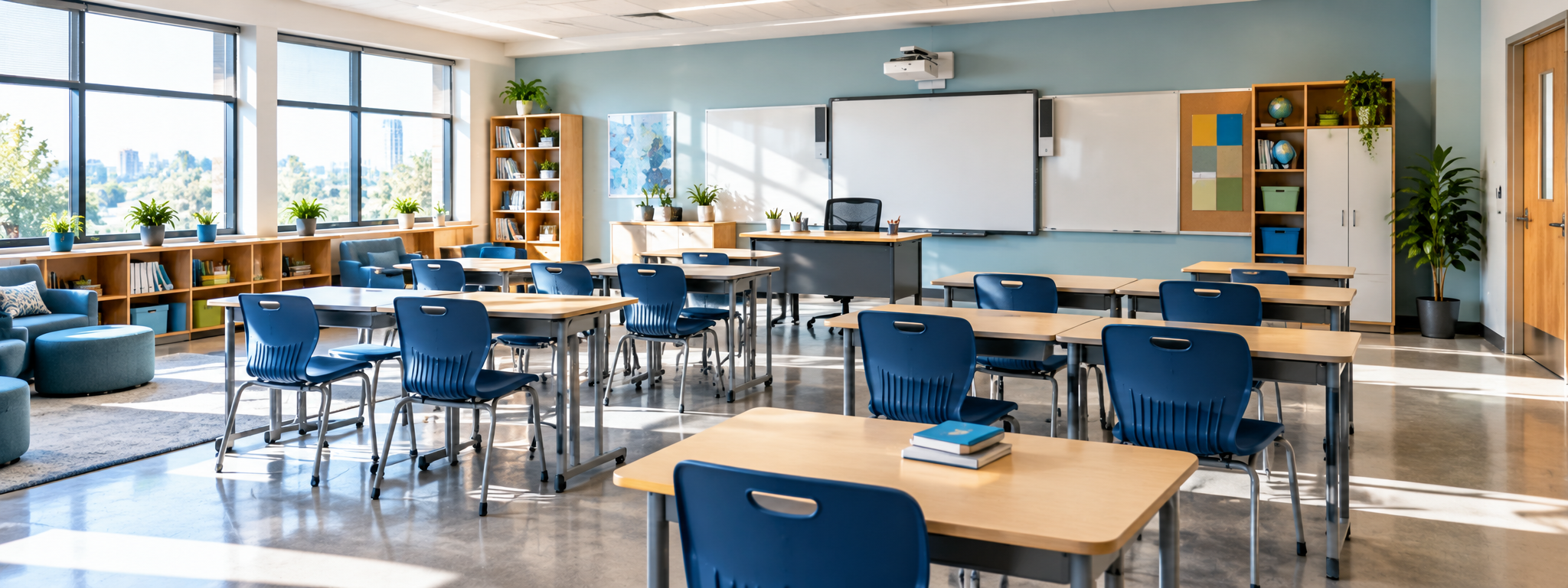
Educational spaces across Louisiana are evolving rapidly to support new teaching methods, interactive group learning, and diverse student needs. Traditional rows of heavy wooden desks and static seating are giving way to dynamic learning environments that foster creativity, engagement, and focus.
Achieving a high performing educational layout requires a thoughtful balance between interior space planning, physical ergonomics, durability, and practical utility. When school administrators and interior design teams invest in versatile commercial grade solutions.
Optimizing Ergonomics and Room Functionality
Creating a productive learning environment begins with understanding how students and teachers interact within a physical room throughout the day. Furniture selection directly influences posture, concentration levels, and overall classroom dynamics. When chairs and tables are designed with ergonomics and flexibility in mind, students experience fewer physical distractions and maintain higher levels of focus.
Furthermore, educational facilities must invest in commercial grade products capable of withstanding heavy daily use while maintaining a clean, professional appearance. Thoughtful space planning also incorporates technology integration, ensuring that power sources and digital tools remain easily accessible without creating tripping hazards or cluttered walkways.
Why Classroom Furniture Has Become More Important
Furniture affects more than the appearance of a classroom. It influences movement, interaction, visibility, storage, and the amount of usable floor space available for activities. A classroom with carefully selected furniture can accommodate several teaching methods without requiring a major redesign.
Traditional fixed arrangements can work for certain lessons, but they become restrictive when students need to collaborate. Moving individual desks can create unnecessary noise and take valuable time away from teaching. Modular tables and lightweight seating provide greater flexibility because teachers can change the layout according to the activity.
There are several practical factors worth considering:
- The age and size of students
- Available classroom floor area
- Number of students using the room
- Storage requirements
- Technology and power access
- Teacher movement
- Cleaning and maintenance requirements
The goal is not to fill every available area with furniture. A successful classroom uses furniture strategically so that students have enough working space and teachers can move easily between learning zones.
Designing Around Different Learning Activities
A modern classroom may need to support several activities during a single school day. Students might begin with a teacher led explanation, move into group work, complete an individual assignment, and finish with a presentation. The furniture arrangement should make these transitions practical.
For example, tables that can be separated and regrouped allow teachers to create collaborative areas without permanently dedicating part of the classroom to group work. Individual chairs can also make it easier for students to face different directions when the activity changes.
This approach makes classroom furniture design an important part of creating adaptable educational environments. Furniture should respond to the teaching strategy instead of forcing every lesson into the same physical arrangement.
Supporting Collaborative Learning
Group learning requires students to communicate easily with one another. Large rectangular rows can make conversation awkward because students may have to turn around or lean across desks. Smaller tables arranged for four or six students can encourage face to face interaction.
However, collaboration does not mean every classroom should use one large table. Different activities require different levels of interaction. A flexible room can include individual work positions alongside collaborative tables, giving teachers more choices.
Creating Space for Independent Work
Furniture can help establish these areas without building permanent walls. Individual desks, separated seating positions, or small study stations can create visual and physical boundaries while preserving flexibility.
Choosing Furniture for Student Comfort
Comfort should be considered alongside flexibility. Students spend a significant amount of time sitting, writing, reading, and using digital devices. Furniture that does not suit their physical requirements can become uncomfortable and may make it harder for them to focus.
Comfort also includes movement. Chairs should allow reasonable freedom of movement without creating instability or safety problems. Tables should provide enough legroom and working space for the expected activities.
Making Better Use of Limited Classroom Space
Not every school has large classrooms. In many buildings, teachers have to work with relatively compact rooms while accommodating a full class. Efficient furniture planning can make a noticeable difference.
Instead of concentrating furniture in one fixed arrangement, planners can use the room’s perimeter for storage and teaching resources while keeping central areas adaptable. Furniture with efficient proportions can provide sufficient workspace without consuming unnecessary floor area.
Storage should also be considered carefully. When teaching materials are left on desks or floors, the classroom quickly becomes crowded. Cabinets, shelves, and mobile storage units can help keep frequently used resources accessible while maintaining clear circulation routes.
Technology and the Modern Classroom
Technology has changed the physical requirements of classrooms. Students may use laptops, tablets, interactive displays, charging equipment, and other digital tools. Furniture therefore needs to accommodate technology without creating cable clutter or restricting movement.
Power access should be planned before furniture is finalized. If students regularly use devices, charging points need to be positioned conveniently and safely. Tables may also need sufficient surface area for both digital devices and traditional notebooks.
Storage Should Be Part of the Design
Storage is sometimes treated as an afterthought, but it has a direct effect on classroom organization. Books, art supplies, science equipment, teaching aids, stationery, and student projects all require appropriate places.
A good storage system makes frequently used items easy to access while keeping less frequently used materials out of the main working area. Mobile storage can be especially useful when classrooms need to change layouts regularly.
Storage also supports classroom management. When everything has an assigned location, students can participate in putting materials away. This reduces clutter and helps maintain a more organized environment throughout the day.
Durability and Maintenance Matter
Educational furniture experiences heavy daily use. Students move chairs, place bags under tables, write on surfaces, and sometimes use furniture in ways that manufacturers did not anticipate. For this reason, durability should be considered alongside design.
Materials should be appropriate for regular cleaning and maintenance. Surfaces that are easy to wipe down can save staff time and help maintain hygiene. Components should also be strong enough for the expected level of use.
Schools should think about the long term cost rather than simply the initial purchase price. A cheaper product that requires frequent replacement may ultimately cost more than durable furniture that remains functional for many years.
Designing a Classroom That Can Change
Furniture that can be moved, combined, separated, or rearranged gives schools more options. A classroom designed today may support different teaching approaches several years from now without requiring a complete furniture replacement.
Teachers should also have a voice in furniture decisions. They understand daily classroom routines and can identify practical problems that may not be obvious during a design presentation.
Safety and Accessibility
Safety should remain a fundamental part of classroom planning. Circulation routes should remain clear, furniture should be stable, and sharp or hazardous features should be avoided wherever possible.
Accessibility also requires thoughtful planning. Students with different mobility or physical requirements should be able to enter, move through, and participate in classroom activities comfortably.
Furniture arrangements should provide sufficient space for movement rather than creating narrow pathways. Adjustable or appropriately sized furniture may also help accommodate different student needs.
A More Practical Approach to Classroom Planning
The best classroom furniture strategy does not necessarily involve buying the most fashionable products. It starts with understanding how the space is used and then selecting furniture that solves real problems.
Schools can begin by observing existing classrooms. Where do students gather which areas become congested? Where do teachers struggle to move? Which storage areas are constantly overflowing? These observations provide useful information before purchasing decisions are made.
A practical planning process can include:
- Measuring the room accurately
- Identifying fixed architectural elements
- Mapping circulation routes
- Listing teaching activities
- Assessing storage needs
- Considering technology requirements
- Testing possible furniture layouts
This approach reduces the risk of choosing furniture simply because it looks attractive in a catalogue.
Conclusion
Classroom furniture has become an important component of effective educational design. The right choices can support collaboration, independent learning, movement, technology use, organization, and student comfort without making the room complicated.
The strongest classroom environments are flexible enough to change with different lessons while remaining safe, comfortable, durable, and easy to maintain. Schools that approach furniture as part of the overall learning environment can create spaces that work better for both students and teachers.

