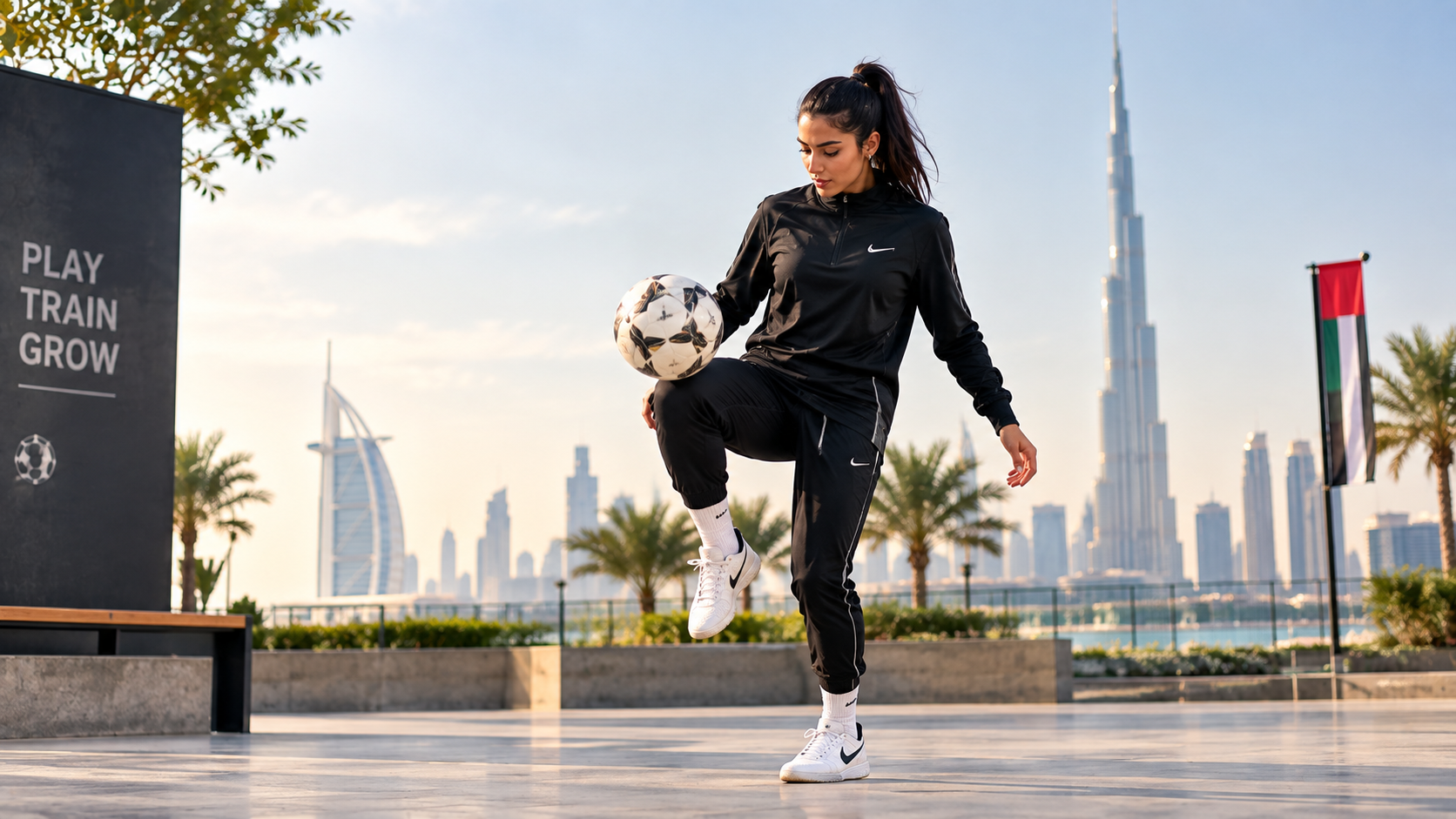
maymi asgari has built a public career that combines freestyle football, digital content, coaching, public speaking, and academic work. Her story has attracted attention well beyond football because her career connects sporting skill with questions around representation, access, identity, and opportunities for girls in sport.
Born and raised in Denmark, Asgari became known for football freestyle videos and later developed a substantial social-media audience. Her public work has included appearances around major football events, coaching girls, speaking at schools, and creating online content connected with football and social issues.
Her career also has a strong connection with the UAE. In a 2025 LinkedIn post, she said she spent the first half of that year in Dubai researching how football influences girls’ personal and social skills for her master’s thesis in sociology.
Who Is Maymi Asgari?
Maymi Asgari is a Danish-Iranian football freestyler and digital creator whose work has developed across sport, social media, education, and community engagement. The University of Copenhagen describes her in academic research as a football influencer whose online storytelling addresses experiences involving women’s football, gender, ethnicity, and identity.
Her football journey is particularly notable because freestyle football differs from conventional competitive football. Rather than focusing primarily on match tactics, freestyle involves technical ball control, creativity, coordination, and the performance of individual tricks.
That format proved well suited to short-form video platforms. Asgari used digital media to present football skills while also talking about her experiences and the barriers she encountered as a girl playing the sport.
Her public profile subsequently expanded beyond football demonstrations. She has worked as a coach, public speaker, and content creator, giving her career several connected dimensions rather than a single sporting role.
For readers following the wider growth of sport and digital culture in the UAE, her journey also fits naturally alongside coverage of the country’s expanding sports and entertainment scene. MAGNAV’s Sports section provides a broader place to follow related stories.
7 Important Facts About Her Career
1. Football freestyle became a major part of her identity
Asgari’s public career is closely associated with freestyle football. Her performances focus on technical control and creative tricks, skills that can be communicated effectively through short-form video.
A 2022 report during the FIFA World Cup in Qatar highlighted her performances outside stadiums in Doha. The coverage described how her football tricks attracted attention from fans while her social-media videos expanded her reach internationally.
This illustrates an important change in modern sports media. Athletes and performers no longer need to depend exclusively on traditional broadcasters to reach audiences. A distinctive skill can be recorded, edited, published, and shared directly with viewers around the world.
2. Her social-media career became an important part of her work
Digital platforms played a significant role in turning Asgari’s football skills into a wider public profile. Her content has combined football performances with personal storytelling and commentary.
Reuters reporting from the 2022 World Cup period noted that one of her TikTok posts had received millions of views, demonstrating the scale that individual sports content can reach when it connects with an online audience.
Her later professional profile shows how this digital presence developed alongside other activities. In 2025, she described herself as having built a community of more than one million followers across social media while completing her master’s degree and working on football-related activities.
For modern creators, this model is significant because social media can function as both a publishing channel and a professional portfolio.
3. She has used football to support girls’ participation
A recurring theme in Asgari’s public work is increasing opportunities for girls in football.
GAME Denmark previously identified her as a Playmaker involved in girls’ football activities. The organization described her role as part of a wider effort to create accessible sporting communities for young people.
Her work included weekly street-football activities for girls. That type of local participation matters because access to sport often begins with a supportive environment where young people feel comfortable learning without excessive pressure.
Asgari has also spoken publicly about wanting to become the kind of role model she did not have when she was younger. Her experience gives her an unusual combination of personal perspective and practical involvement in youth football.
4. Her story has attracted academic interest
Asgari’s career is not only covered through sports and entertainment media. Researchers have also examined how she uses social media.
The University of Copenhagen Research Portal lists a research chapter titled “Breaking barriers with a football: the activist TikTok narratives of Maymi Asgari.” The research examines her use of short-form video, personal storytelling, and counterstorytelling in discussions surrounding gender, ethnicity, and football.
This academic attention is useful because it places influencer culture within a broader discussion about how sporting personalities communicate with audiences.
Instead of viewing social media simply as a promotional tool, the research considers how creators can use digital platforms to present experiences, challenge stereotypes, and build forms of authority with their audiences.
5. She has received recognition from the football industry
In a 2024 LinkedIn post discussing her 2023 achievement, Asgari said she won the “Best Video Creator 2023” award at the Globe Soccer Awards in Dubai. She described appearing at the event alongside major football figures and teams.
The recognition is relevant to her career because it reflects the growing connection between football and creator culture.
Football audiences increasingly consume skills, commentary, behind-the-scenes material, interviews, fan content, and short-form entertainment alongside traditional match coverage. A creator whose work combines football ability with digital storytelling can therefore operate across several parts of the sports-media ecosystem.
Readers interested in the wider business side of this development can also follow MAGNAV’s UAE Business News coverage, where sports, media, technology, and commercial trends can intersect.
6. Her academic background adds another dimension
In 2025, Asgari publicly shared that she had completed a master’s degree in sociology. She said her thesis research focused on how football influences girls’ personal and social skills and how those effects appear in everyday life. She also described spending several months in Dubai conducting research.
This is particularly relevant because it connects her professional experience with academic research.
Someone who has participated in football, coached girls, created sports content, and then studied the social effects of football can approach the subject from several perspectives. Her academic work does not replace broader research on girls’ participation in sport, but it adds a personal connection to the subject she studied.
7. Dubai has become part of her recent professional story
Dubai has appeared repeatedly in Asgari’s recent public career. Her 2025 account described spending six months in the city while researching football and girls’ social development. She also built professional and social-media connections through football-related activities.
The UAE’s international position in sports, events, tourism, media, and digital content provides a useful setting for creators with global audiences
MAGNAV’s UAE Lifestyle Magazine coverage can provide additional context for readers interested in how sport, culture, travel, entertainment, and modern professional life intersect in the UAE.
How Her Story Connects Football and Digital Media
One of the most interesting elements of Asgari’s career is the relationship between physical skill and digital communication.
Freestyle football is highly visual. A successful trick can be understood quickly, even by viewers who do not speak the creator’s language. Short videos can therefore make a technical sporting skill accessible to a global audience.
But the performance itself is only part of the formula. Consistent digital publishing requires communication, audience awareness, editing, storytelling, and an understanding of how different platforms work.
Asgari’s career demonstrates how these abilities can operate together. Her content has allowed football to become more than a sporting activity; it has also become a medium through which she communicates personal experiences and social themes.
The University of Copenhagen research specifically identifies personal storytelling and counterstorytelling as important elements in her digital communication.
The Importance of Representation in Women’s Football
Women’s football has grown significantly in visibility, but participation and representation remain important subjects in many communities.
Asgari has spoken publicly about experiencing prejudice while playing football as a hijab-wearing girl. Her own accounts describe questions and assumptions she encountered and explain why she wanted to continue playing rather than allow those experiences to determine her path.
Her experience should not be treated as representative of every Muslim, Iranian, Danish, or female football player. It is one individual’s account.
However, individual stories can help audiences understand why representation matters. A young player who sees someone with a similar background participating successfully in sport may gain a practical example of what a possible sporting pathway can look like.
GAME Denmark’s previous work with Asgari also reflects this role-model approach, particularly through community football activities for girls.
Maymi Asgari and the Changing Sports Creator Economy
The modern sports industry extends well beyond stadiums and television.
Creators can build audiences through training videos, football challenges, educational material, live appearances, sponsorships, coaching services, and event participation. Their value can come from the combination of sporting ability and direct audience access.
Asgari’s career provides an example of this broader model. Her public work has included football performance, coaching, speaking, social-media creation, and commercial collaborations.
This trend also matters for businesses. Sports creators can provide brands with access to communities that traditional advertising may not reach as effectively. At the same time, creators need to protect audience trust by maintaining clear relationships with sponsors and keeping their content authentic.
For a UAE audience, this connects with wider developments in the country’s creator economy and digital sector. Readers interested in technology and digital transformation can find related coverage through MAGNAV’s UAE Technology News section.
What Her Dubai Research Adds to the Story
Asgari’s 2025 research in Dubai gives her recent career an additional academic dimension. Rather than simply visiting the UAE for a football event, she described spending several months researching the social impact of football on girls.
That distinction matters.
Sport can contribute to physical activity, teamwork, communication, confidence, and social connection, but its effects depend heavily on the environment in which participation occurs. Coaching quality, access to facilities, family support, community attitudes, and opportunities for regular participation can all shape a young person’s experience.
Research into these issues can help move discussions about girls’ football beyond simple participation figures and toward questions about what participants actually gain from sport.
Challenges and Considerations
Public careers built around social media also have challenges.
A creator’s audience can change rapidly as platforms adjust algorithms, formats, and recommendation systems. Maintaining a professional identity across multiple platforms requires continuous work, while public visibility can also bring criticism and unwanted attention.
There is another consideration when discussing people with large online audiences: follower counts can change quickly. Numbers reported in older articles or social posts should therefore be treated as time-specific rather than permanent measurements.
The same principle applies to career descriptions. Asgari’s work has developed over time, moving across football, content creation, coaching, speaking, and academic research. A current profile should distinguish earlier activities from more recent ones.
What the Future Could Hold for Her Career
Asgari’s combination of football, sociology, coaching, and digital media creates several possible professional directions.
She could continue developing football education and coaching initiatives, produce more sports content, participate in campaigns supporting girls’ participation, or combine academic research with community projects.
Her experience in Dubai may also create further opportunities within the UAE’s sports and media environment. However, future projects should be discussed only when publicly confirmed rather than assumed.
What is already clear is that her career has moved beyond the traditional definition of a football performer. She has built a profile in which sporting ability, digital communication, education, and community work overlap.
Conclusion
maymi asgari represents a modern type of sports creator whose career has developed across freestyle football, social media, coaching, public speaking, and sociology. Her journey from football participation in Denmark to international digital recognition and academic research in Dubai shows how a sporting skill can become part of a much broader professional identity.
Her work with girls’ football, her public discussions of representation, and her use of short-form video have also contributed to conversations about access and visibility in sport.
For audiences in the UAE and beyond, her story offers a useful case study in how sports, digital media, education, and community engagement can intersect. It also shows why contemporary sports personalities are increasingly becoming educators, creators, coaches, and communicators alongside their roles on the pitch.
Frequently Asked Questions
Who is Maymi Asgari?
Maymi Asgari is a Danish-Iranian football freestyler, digital creator, coach, and public speaker. Her work has focused on football, social media, girls’ participation in sport, and representation.
What is Maymi Asgari known for?
She is widely known for freestyle football videos and digital content. Her profile grew through social-media platforms, while her public work has also included coaching, speaking engagements, and football-related appearances.
Did Maymi Asgari study sociology?
Yes. In a 2025 public post, Asgari said she had completed a master’s degree in sociology. She also said her thesis examined how football influences girls’ personal and social skills.
What connection does Maymi Asgari have with Dubai?
Asgari said she spent the first half of 2025 in Dubai conducting research for her master’s thesis. Her public professional profile also identifies Dubai as part of her recent professional activity.
Has Maymi Asgari worked with girls in football?
Yes. GAME Denmark previously identified her as a Playmaker involved in football activities for girls, including community-based sessions.
Why is her social-media work significant?
Her career illustrates how short-form digital content can connect sporting performance with personal storytelling and wider discussions about representation. Academic research from the University of Copenhagen has specifically examined this aspect of her online work.