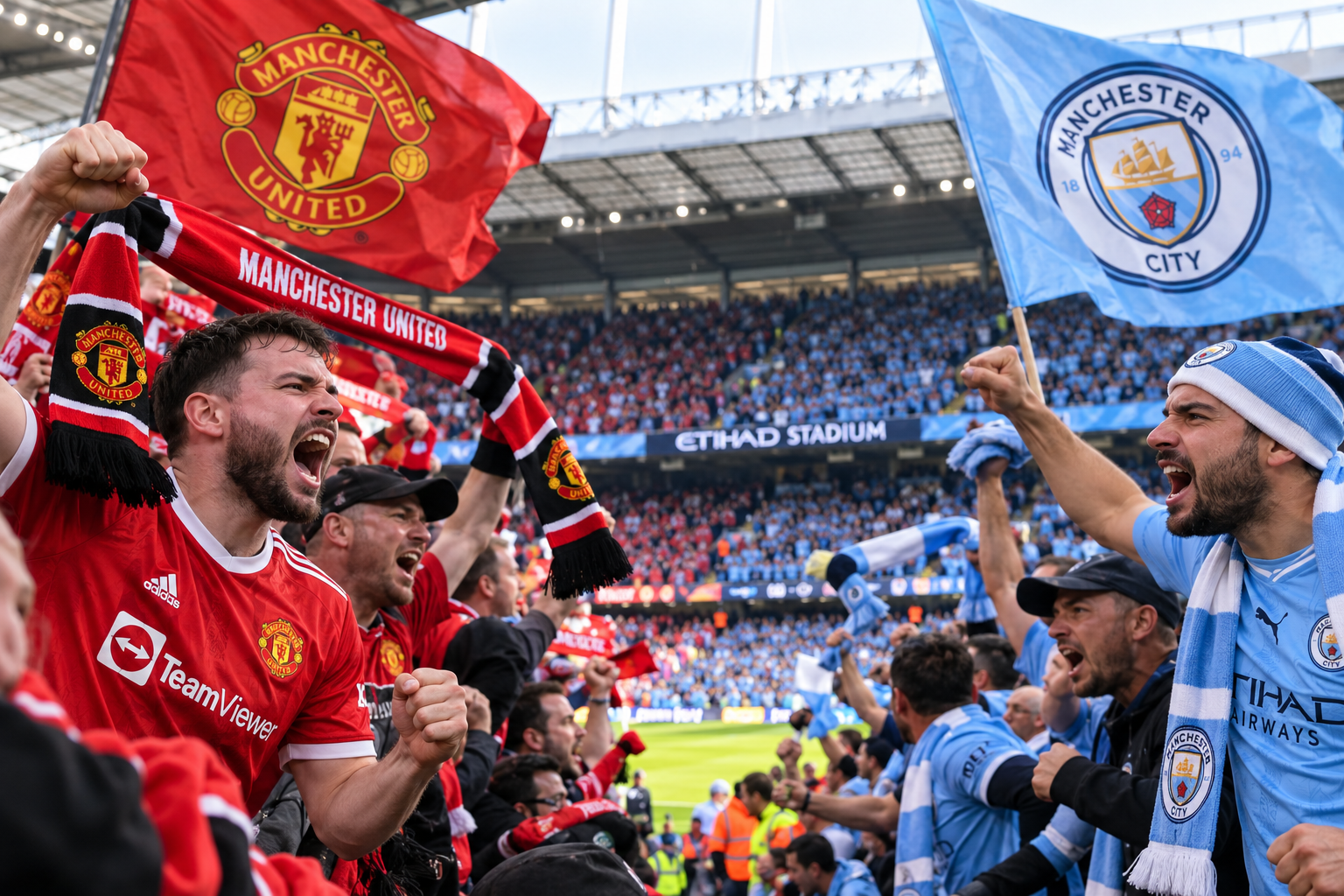
A friend of mine from Liverpool once told me he could forgive almost anything except losing to Everton. Not a bad season. Not a missed penalty in a cup final. Just losing to the team across the park. He wasn’t joking, and I’ve met plenty of fans in Manchester and north London who feel exactly the same way about their own neighbours.
That’s what makes Premier League derbies different from normal fixtures. The points are the same. Everything else isn’t. Bragging rights, family arguments, the mood at work on Monday morning, all of it rides on ninety minutes.
Here are the biggest rivalries in the league, where they came from, and why they still matter so much, both emotionally and in the table.
The Manchester derby
For a long time, this wasn’t really a rivalry at all. United were the giants, City were the noisy neighbours, a phrase Sir Alex Ferguson used in 2009 that City fans have never let anyone forget. Then the money arrived at City, and the balance of power in Manchester flipped almost overnight.
If you want one match that captures the change, it’s October 2011. City went to Old Trafford and won by six goals to one. United fans still wince at the scoreline. City won the league that season on goal difference, and those extra goals at Old Trafford turned out to matter enormously.
Since then, City have dominated most of the meetings, but United have landed some memorable blows. Their FA Cup final win over City in 2024 was a genuine shock, a year after City had beaten them in the same final on the way to the treble.
This season adds a new twist. Both clubs have new permanent bosses, Enzo Maresca at City and Michael Carrick at United, and the first derby of the season went City’s way, a narrow win at Old Trafford in September. The return fixture comes at the Etihad on 20 March, and depending on how the title race looks by then, it could be enormous.
The North London derby
Arsenal against Tottenham might be the most bitter rivalry of the lot, and it goes back more than a century.
Arsenal weren’t originally a north London club at all. They started in Woolwich, south of the river, and moved to Highbury in 1913, just a few miles from Tottenham. Spurs fans saw it as an invasion. Then, in 1919, Arsenal were elected into the First Division in controversial circumstances while Tottenham were left out. Some Spurs fans still bring it up. Over a hundred years later.
For most of the Premier League era, Arsenal have had the upper hand. Their fans even invented St Totteringham’s Day, the point in the season when Spurs can no longer mathematically finish above them. Tottenham had their own moment of glory in 2025, winning the Europa League, but the league table has mostly belonged to Arsenal.
This season, the gap is about as wide as it has ever been. Arsenal are the reigning champions. Tottenham are bottom of the table after five games without a win. When the first derby of the season comes around at the Tottenham Hotspur Stadium on 5 December, Spurs will be desperate for a result that saves their season, and Arsenal will be desperate not to be the team that gives it to them. The latest team news and ticket information will be on the official Tottenham Hotspur website closer to the date. The return game at the Emirates is on 1 May, right in the thick of the run in.
The Merseyside derby
People used to call this the friendly derby, because families in Liverpool are so often split down the middle. Brothers support different clubs. Parents wear different colours to the same match. The two grounds sat less than a mile apart across Stanley Park for most of their history.
Friendly isn’t quite the word anymore, though. The Merseyside derby has produced more red cards than any other fixture in Premier League history.
The origin story is wonderfully messy. Everton actually played at Anfield first. After a row over rent with the ground’s owner, John Houlding, they left in 1892, and Houlding formed a new club to play there. That club was Liverpool. So one of the fiercest rivalries in English football started, essentially, as a landlord dispute.
The last derby at Goodison Park, in February 2025, summed it up perfectly. Everton equalised deep into stoppage time, and two players, Liverpool’s manager and his assistant were all sent off after the final whistle. Everton have since moved to their new stadium at Bramley Moore Dock, and Liverpool now travel to the Hill Dickinson Stadium instead. The venue has changed. The feeling hasn’t.
This season, Liverpool face Everton and Manchester United on back to back weekends in late November, and the same thing happens again in January. It’s a brutal stretch for Andoni Iraola in his first season, and you can keep up with how he’s approaching it on the official Liverpool website.
Liverpool vs Manchester United
It’s not technically a derby, since the clubs are about 35 miles apart. But ask most English fans which rivalry is the biggest in the country, and this is the one they’ll name.
The tension between the two cities goes back to the 19th century. When the Manchester Ship Canal opened in 1894, it allowed ships to bypass Liverpool’s docks entirely, and there was real economic resentment between the two places. Football came later and inherited all of it.
On the pitch, it’s a rivalry of eras. Liverpool dominated the 1970s and 1980s. United dominated the Premier League years under Ferguson and overtook Liverpool’s league title total in 2011. Liverpool fought back, and after winning the league in 2024/25, the two clubs are now level on 20 English titles each. You couldn’t script it better.
There are moments every fan remembers. Steven Gerrard coming off the bench against United in 2015 and being sent off after about 38 seconds. Liverpool beating United by seven goals to nil at Anfield in 2023. Years of heated, sometimes ugly clashes in between.
Neither club is quite where it wants to be right now. Liverpool finished fifth last season, 25 points behind champions Arsenal, while United finished third under Carrick but have started this season slowly. That won’t make these games any less intense. If anything, it makes them feel even more important.
Why rivalries affect the table
It’s easy to treat derbies as purely emotional. They’re not. They have a real effect on the standings.
First, form tends to go out of the window. A team in the bottom half can raise itself for a derby and take points off a title contender. We’ve seen it countless times, and it can decide who wins the league or who goes down.
Second, derbies drain players. The intensity, the crowd and the fear of losing make these matches exhausting. It’s no coincidence that clubs often drop points in the game immediately after a big derby.
Third, the results can swing goal difference in a way ordinary games don’t. Derbies are often either tight and cagey or completely wild, and one thumping win can give a club a cushion that lasts all season. City’s six goal win at Old Trafford in 2011 is the perfect example, since the title that year came down to goal difference.
If you want to see the knock on effect for yourself, keep an eye on the live standings on Valioliiga after a derby weekend. It’s remarkable how often a single local rivalry reshuffles the top four or the bottom three, and how often the team that wins the derby carries that momentum into the next few games.
For the stories behind those results, The Guardian’s Premier League coverage is full of good reporting and sharp opinion, especially in the days after a big derby when every fan wants to relive it, or forget it.
A few more worth watching
The big four rivalries get most of the headlines, but the league has plenty of others. Newcastle against Sunderland is back as a Premier League fixture and has lost none of its fire. Brighton against Crystal Palace has turned into a surprisingly spiky south coast rivalry. Chelsea and Fulham share west London, and Aston Villa against Coventry City returns this season with Coventry’s promotion.
More than three points
Premier League derbies are where football stops being just a sport and becomes something closer to local identity. They’re about history, geography, family and pride, and sometimes about a rent dispute from 1892.
This season has all the ingredients for a memorable run of them: a North London derby with the champions against the bottom club, a Manchester derby between two new managers, and a November double header for Liverpool that could shape their whole season. Whatever happens, one thing is guaranteed. Somebody’s Monday morning is going to be very uncomfortable.