
Protein is often talked about in connection with gyms, muscle gain, and protein shakes. But protein is not only for people who work out.
You need protein every day. Your body uses it to build and maintain muscles and to make important molecules such as enzymes and hormones. WHO notes that protein generally provides around 10–15% of daily energy intake for healthy adults, though individual needs can vary.
For an Indian diet, getting enough protein does not mean you have to completely change what you eat.
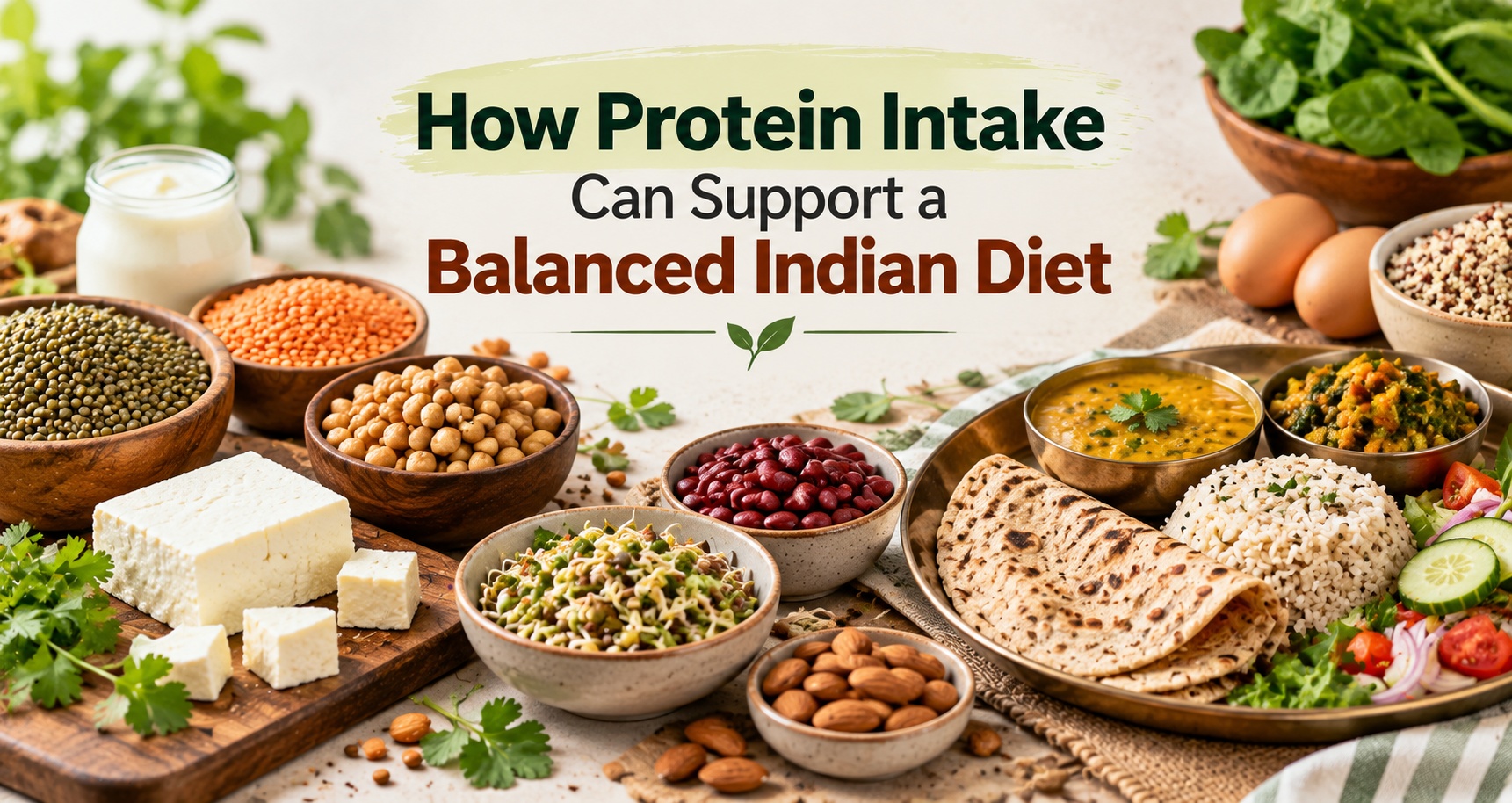
Dal, chana, rajma, curd, paneer, milk, soy, eggs, fish, chicken, nuts, and seeds can all fit into a balanced eating pattern.
The real question is this: are you getting enough protein across your meals?
Why Protein Matters in a Balanced Diet
Protein provides amino acids that your body needs for several functions. It supports the maintenance of body tissues and contributes to the production of enzymes, hormones, and other functional molecules.
This is why protein should not be treated as a separate “fitness food.”
It can be part of a normal Indian breakfast, lunch, snack or dinner.
For example:
- Idli with sambar
- Roti with dal
- Rice with rajma
- Curd with a meal
- Paneer with vegetables
- Egg bhurji with roti
- Chana salad
- Moong dal khichdi
- Fish with rice and vegetables
These combinations can make everyday meals more balanced.
The Indian Council of Medical Research’s National Institute of Nutrition also points out that pulses are important protein sources in vegetarian Indian diets. It notes that combining pulses with cereals can improve the protein quality of the overall diet.
How Much Protein Do You Need?
There is no single protein target that works for everyone.
Your needs can change based on factors such as:
- Age
- Body size
- Physical activity
- Pregnancy or breastfeeding
- Overall health
- Fitness goals
- Dietary pattern
WHO gives a general adult range of about 10–15% of total daily energy from protein. For a healthy adult eating around 2,000 calories, this can work out to roughly 50–75 grams of protein per day, although individual requirements can differ.
This is why copying a friend’s protein target may not make sense.
Someone who exercises regularly may have different needs from someone who spends most of the day sitting at a desk. Children, older adults and people with specific health conditions may also require different dietary planning.
A personalised approach is more useful than chasing a number from social media.
Protein Sources That Fit an Indian Diet
One good thing about Indian food is the variety.
You don’t have to depend on expensive foods or supplements to include protein.
1. Dal and Pulses
Dal is one of the easiest ways to add protein to an Indian meal.
Common options include:
- Moong dal
- Masoor dal
- Toor dal
- Chana dal
- Urad dal
Pulses also provide fibre and several micronutrients. ICMR-NIN describes pulses as low-fat, high-fibre foods that provide nutrients such as iron, potassium, zinc and magnesium.
Try adding dal to lunch or dinner instead of treating it as an occasional side dish.
2. Beans and Legumes
Rajma, chickpeas, black chana, lobia, and other beans can make a filling part of your meal.
For example, you could have:
- Rajma with brown or regular rice
- Chole with roti
- Black chana with vegetables
- Lobia with rice
- Chickpea salad with curd
The meal does not need to look like a fitness meal.
It can simply look like lunch at home.
3. Dairy Foods
Milk, curd, and paneer can contribute protein to the diet.
Curd is particularly easy to add. You can have it with lunch, use it as the base for raita or include it in a simple snack.
Paneer can also be used in dishes with vegetables, roti or rice.
The portion still matters, especially when you’re watching your overall calorie intake.
4. Eggs
If you eat eggs, they can be a convenient protein source.
You can keep things simple:
- Boiled eggs
- Egg bhurji
- Vegetable omelette
- Egg curry
- Eggs with whole-grain toast
Adding vegetables to an egg-based meal can make it more balanced.
5. Fish and Chicken
For people who eat non-vegetarian foods, fish and chicken can provide protein as part of a varied diet.
Try pairing them with vegetables and a suitable portion of rice, roti or another whole-grain food.
The idea is not to replace everything else with meat.
A balanced diet still needs vegetables, fruits, whole grains, pulses and other foods.
WHO recommends variety across food groups, including legumes, whole grains, vegetables, fruits, nuts and suitable animal-source foods.
6. Soy Foods
Soybeans, tofu and other minimally processed soy foods can be useful options, especially for vegetarians.
Tofu can be added to:
- Stir-fried vegetables
- Curries
- Wraps
- Salads
- Rice dishes
It gives you another option when you don’t want dal or paneer every day.
7. Nuts and Seeds
Almonds, peanuts, pumpkin seeds, sesame seeds, and other nuts and seeds can contribute protein.
But remember that they are also energy-dense foods.
A small portion can work well as part of a snack or meal.
Eating a large handful several times a day simply because something is “healthy” can still add a lot of calories.
Combining Foods Can Make Your Meals More Balanced
Indian meals often naturally combine different food groups.
Think about dal and rice.
Or rajma and rice.
Or roti with dal and vegetables.
ICMR-NIN specifically notes that combining pulses with cereals can improve the protein quality of a vegetarian Indian diet.
This is useful because you don’t need to search for one magical “complete protein food.”
Instead, focus on variety across the day.
For example:
Breakfast: Vegetable poha with curd
Lunch: Roti, dal, vegetables and salad
Snack: Roasted chana with fruit
Dinner: Rice, rajma and vegetables
This gives you protein along with carbohydrates, fibre, vitamins and minerals.
How to Add More Protein to Your Everyday Meals
You don’t have to make dramatic changes.
Start with small adjustments.
Upgrade Your Breakfast
Many traditional breakfasts can be carbohydrate-heavy.
For example, instead of having only toast and tea, you could add eggs, curd or paneer.
If you prefer vegetarian food, try:
- Besan chilla with curd
- Moong dal chilla
- Vegetable poha with peanuts and curd
- Idli with sambar
The goal is simple. Add a protein source rather than removing foods unnecessarily.
Add Protein to Lunch
A simple Indian lunch can already provide a good foundation.
Try building your plate around:
- One protein source
- Vegetables
- A suitable portion of rice or roti
- Salad or other fibre-rich foods
- Curd when appropriate
Dal doesn’t have to be the only protein source.
You can combine dal with curd, paneer, beans or another suitable food depending on your preferences.
Make Snacks More Filling
Biscuits and tea are convenient, but they may not keep you satisfied for long.
Try alternatives such as:
- Roasted chana
- Curd with fruit
- Boiled eggs
- Sprouts
- Peanut chaat
- Paneer cubes
- A small portion of nuts and seeds
You don’t need to turn every snack into a high-protein meal.
Just choose more nutrient-dense options more often.
Protein and Weight Management
Protein is often discussed in weight-loss diets because it can contribute to satiety and help support lean tissue when combined with an appropriate eating pattern and physical activity.
But protein alone does not cause weight loss.
A person can eat large quantities of high-protein foods and still consume more calories than their body needs.
A better approach is to look at the complete meal.
For example:
Instead of eating a very large portion of paneer and skipping vegetables, you could have a moderate portion of paneer with vegetables and roti.
Instead of drinking a protein shake in place of every meal, you could first look at whether your regular meals are providing enough protein.
This is where personalised nutrition can be useful.
If you’re searching for the Best Nutritionist in Bangalore, look for someone who considers your complete eating pattern rather than simply giving you a protein number.
Do Vegetarians Get Enough Protein?
They can.
A vegetarian Indian diet can include protein from pulses, beans, soy foods, dairy, nuts and seeds.
The bigger issue is often variety and meal planning.
If most meals consist mainly of rice, roti or other cereal-based foods with very little dal, beans, dairy or other protein-rich foods, your overall protein intake may be lower than you expect.
ICMR-NIN notes that pulses are particularly important protein sources in vegetarian Indian diets and that cereal-pulse combinations can improve protein quality.
So you don’t necessarily need meat to build a protein-rich diet.
You need variety.
Do You Need Protein Powder?
Not necessarily.
Protein powders can be convenient in certain situations, but they are not automatically better than whole foods.
ICMR-NIN notes that protein powders can come from sources such as milk, whey, eggs, soy, peas, and rice. It also points out that some products contain added sugars, sweeteners, and other additives.
For many people, it makes sense to first improve their regular meals.
Ask yourself:
- Do I include a protein source at most meals?
- Do I eat enough variety?
- Am I relying heavily on processed snacks?
- Are my portions suitable for my needs?
- Am I getting enough vegetables and fibre?
If your regular diet is already balanced, you may not need a supplement.
Common Protein Mistakes to Avoid
Eating Protein Only at Dinner
If almost all your protein comes from dinner, your meals earlier in the day may lack balance.
Try distributing protein sources across breakfast, lunch, and dinner.
Depending Only on Protein Shakes
A shake can be convenient, but whole foods offer more than protein.
Pulses, dairy, eggs, fish, vegetables, fruits, nuts, and whole grains also contribute other nutrients.
Ignoring Portion Sizes
Healthy foods still contain calories.
Large portions of paneer, nuts, cheese or other energy-dense foods can add up quickly.
Removing Carbohydrates
Protein doesn’t need to replace carbohydrates.
Rice, roti, oats, millets and other carbohydrate sources can remain part of a balanced diet. WHO recommends that carbohydrates mainly come from foods such as whole grains, vegetables, fruits and pulses.
Following Someone Else’s Diet
Your friend’s protein requirement may not be your requirement.
A diet should fit your body, lifestyle, food preferences, and health needs.
A Simple Indian High-Protein Meal Pattern
Here’s an example of how you could spread protein-rich foods through the day.
Breakfast
Moong dal chilla with curd and vegetables
Mid-Morning
Fruit with a small portion of nuts
Lunch
Roti or rice with dal, vegetables, salad, and curd
Evening Snack
Roasted chana or sprouts chaat
Dinner
Paneer or tofu with vegetables and roti
For a non-vegetarian option, you could replace paneer or tofu with eggs, fish, or chicken.
This is only an example, not a fixed diet plan.
Your actual portions and food choices should depend on your individual requirements.
How a Nutritionist Can Help You Build a Balanced Diet
Sometimes the problem isn’t knowing which foods contain protein.
You already know that dal, eggs, paneer, and chicken contain protein.
The difficult part is fitting them into your actual routine.
You may work long hours.
You may eat at the office.
You may be vegetarian.
You may dislike certain foods.
You may have a specific health goal.
A nutrition professional can look at these factors when planning your diet.
When looking for the Best Nutritionist in Bangalore, consider whether the professional takes your food preferences, lifestyle, health goals, and existing eating habits into account.
A useful nutrition plan should be something you can actually follow.
Not something that looks perfect on paper but becomes impossible after a week.
Building a Balanced Indian Plate
A protein-rich meal is still not automatically a balanced meal.
Think beyond protein.
Your meals can include a combination of:
- Protein-rich foods
- Whole grains or other carbohydrate sources
- Vegetables
- Fruits
- Healthy sources of fat
- Adequate fluids
WHO describes healthy diets around four core principles: adequacy, balance, moderation, and diversity.
That makes sense for Indian eating habits too.
You don’t have to stop eating rice.
You don’t have to avoid roti.
You don’t have to eat salads at every meal.
You need a varied diet that provides the nutrients your body needs while fitting your lifestyle.
FAQs
Is protein important for everyone?
Yes. Protein is an essential nutrient needed by the body for maintaining tissues and producing functional molecules such as enzymes and hormones. Individual protein needs vary based on age, body size, activity, and other factors.
What are the best vegetarian protein sources in an Indian diet?
Dal, chickpeas, rajma, beans, soy foods, paneer, curd, milk, nuts and seeds are some options. Combining pulses with cereals can also improve the overall protein quality of vegetarian meals.
Can I get enough protein without eating meat?
Yes. A well-planned vegetarian diet can provide protein through pulses, beans, dairy, soy, nuts and seeds. Variety matters.
Is dal enough for protein?
Dal is a useful protein source, but relying on only one food is not ideal. Include different protein sources across your meals to improve dietary variety.
Should I take protein powder every day?
Not everyone needs protein powder. Whole foods can provide protein for many people. Supplements may be useful in specific situations, but your overall diet should be assessed first.
Final Takeaway
Protein does not have to mean protein shakes, expensive foods, or a strict fitness diet.
Your regular Indian meals already offer many useful options.
Dal with rice.
Chana with roti.
Curd with your meal.
Paneer with vegetables.
Eggs with breakfast.
Tofu with a simple stir-fry.
Small changes like these can help you build meals that are more balanced and satisfying.
The bigger goal is not to eat as much protein as possible. It is to get an appropriate amount while also eating enough vegetables, fruits, whole grains, pulses and other nutrient-rich foods.
A balanced Indian diet can include protein without becoming complicated.
For personalised nutrition planning, especially when you have a specific health goal or dietary restriction, working with a qualified nutrition professional can help you create a plan that fits your everyday routine.
