
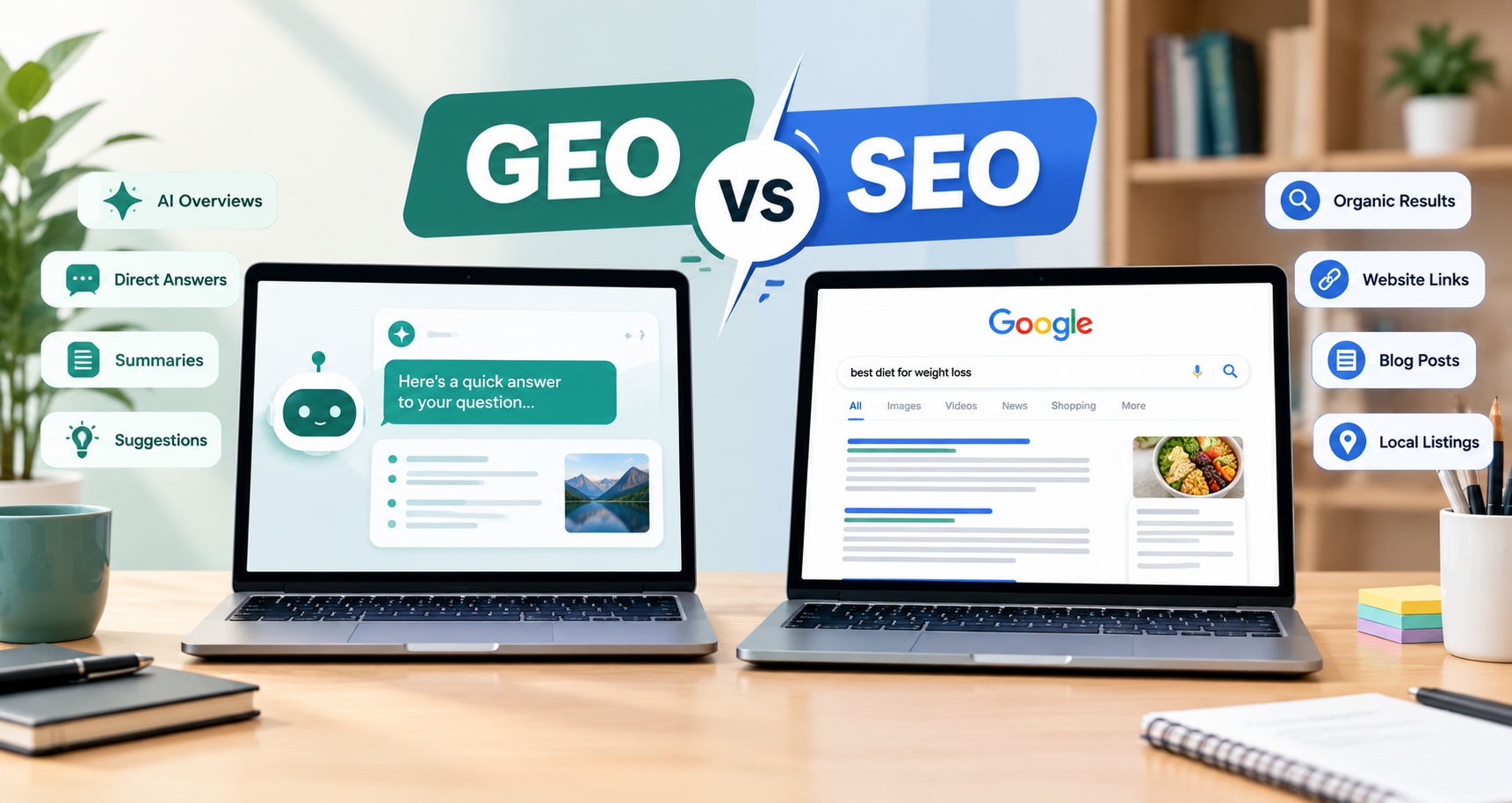
Search has changed a lot.
A few years ago, most SEO conversations were about getting a webpage into the top 10 Google results. Digital marketers focused on keywords, backlinks, technical SEO, content length, and rankings.
In 2026, that is still relevant.
But there is another layer now.
People are asking longer questions, using AI search features, comparing several options in one query, and looking for direct answers instead of visiting multiple websites.
This is where GEO comes into the discussion.
GEO stands for Generative Engine Optimization. It refers to the work of improving a brand or website’s chances of being surfaced or referenced in generative AI search experiences.
SEO stands for Search Engine Optimization. It focuses on improving a website’s visibility in search engines.
So, GEO vs SEO is not really about choosing one and forgetting the other.
For digital marketers, the bigger question is this:
What skills should you learn so that your content can perform in both traditional search and AI-powered search?
If you are considering the Best Digital Marketing classes in Nagpur, this is one topic you should understand before choosing a course.
What Is SEO in 2026?
SEO is the process of improving a website so search engines can understand, discover, index, and rank its content for relevant searches.
The basic idea has not disappeared.
You still need to understand:
- Keyword research
- Search intent
- On-page SEO
- Technical SEO
- Internal linking
- Content structure
- Local SEO
- Link building
- Website performance
- Google Search Console
- Analytics
- Structured data
- Content quality
Google’s own documentation says that traditional SEO practices remain relevant for AI-powered search features such as AI Overviews and AI Mode. Google also says there are no special technical requirements that guarantee inclusion in these AI experiences. That is an important point for anyone learning SEO in 2026.
You do not need to throw away everything you learned about SEO just because AI search is growing.
The foundation is still SEO.
What Is GEO?
GEO means Generative Engine Optimization.
The term is generally used for strategies aimed at improving how content appears in generative AI experiences.
Think about a traditional search.
You type:
“Best digital marketing courses in Nagpur”
You may receive a list of webpages.
Now imagine asking an AI-powered search experience:
“I am a beginner in Nagpur and want to learn SEO, Google Ads, social media marketing, and analytics. What should I look for in a digital marketing course?”
The system may generate an answer by using information gathered from multiple sources.
This changes how content can be discovered.
Google explains that AI search experiences can use techniques such as retrieval-augmented generation and query fan-out to retrieve information from multiple related searches and sources.
This is one reason digital marketers are paying attention to GEO.
GEO vs SEO: What Is the Main Difference?
The easiest way to understand the difference is to look at the search experience.
| SEO | GEO |
| Focuses on search engine visibility | Focuses on visibility in generative AI experiences |
| Targets keywords and search intent | Targets questions, context and concepts |
| Aims for strong search rankings | Aims to become useful source material for AI-generated answers |
| Measures rankings, impressions and clicks | Can also involve mentions, citations and AI visibility |
| Strong technical foundation | Depends heavily on strong content and clear information |
| Uses traditional search data | May require monitoring AI search visibility as well |
Google itself describes GEO and AEO as terms used to describe workarounds for generative AI search, while stating that from Google’s perspective this work is still part of SEO and the broader search experience.
So, treating GEO and SEO as completely separate disciplines can create confusion.
Why GEO Matters to Digital Marketers in 2026
Search behaviour is becoming more conversational.
A person may no longer search for:
“SEO course Nagpur”
They might ask:
“What should a beginner learn first to get an SEO job in Nagpur?”
That second query contains more context.
It tells you about:
- The person’s experience level
- Their location
- Their goal
- Their career intent
- The type of information they need
AI-powered search experiences are designed to handle more complex questions and follow-up exploration. Google’s documentation says AI Mode can help with nuanced questions, comparisons,ons and deeper exploration.
For marketers, this means content needs to answer real questions instead of simply repeating keywords.
Does GEO Replace SEO?
No.
This is probably the biggest misunderstanding around GEO.
A marketer who says, “SEO is dead because GEO is here,” is missing the bigger picture.
Google states that AI search features are rooted in its existing search systems and that SEO best practices remain relevant. Pages still need to be accessible, crawlable, and eligible for search.
Imagine you create an amazing article.
But Google cannot crawl the page.
Or the important information exists only inside an inaccessible element.
Or your website has serious technical problems.
Your content may struggle to be discovered in the first place.
That is why technical SEO still matters.
GEO builds on a strong search foundation. It does not remove the need for one.
What Changes When You Think Beyond Keywords?
Keyword research remains useful.
But your thinking needs to become broader.
Suppose you are targeting:
“Best Digital Marketing classes in Nagpur”
You should not create a page that repeats that phrase twenty times.
Instead, think about the questions someone might ask before joining a course.
For example:
- What does a digital marketing course teach?
- Is SEO included?
- Will I learn Google Ads?
- Does the course include practical projects?
- What tools should beginners learn?
- How long does it take to learn digital marketing?
- Can a fresher get an SEO job after completing a course?
- What should I check before joining a digital marketing class in Nagpur?
Now your content covers the topic from different angles.
That gives search engines and AI systems more useful information to work with.
Search Intent Matters More Than Exact Keyword Matching
Search intent has always been part of SEO.
In 2026, it becomes even more useful when creating content for AI-assisted search.
Consider these three searches:
“SEO”
“SEO course in Nagpur”
“How can I learn SEO from scratch and get an entry-level job?”
All three contain different intentions.
The first is broad.
The second has commercial and local intent.
The third is informational with a career goal.
A good marketer needs to recognise this difference.
If you create one generic page for every query, the content may not answer what the searcher actually wants.
Ask yourself:
“What would this person want to know next?”
That simple question can improve your content planning.
What Type of Content Works Well for GEO?
There is no official Google formula called a “GEO score.”
No guaranteed format makes a page appear in an AI-generated answer.
Google’s current guidance focuses on valuable, unique, people-first content rather than special GEO tricks.
Still, some content practices make sense.
1. Answer Questions Clearly
Do not hide the answer under five paragraphs of introduction.
If someone asks:
“What is technical SEO?”
Give a clear definition near the beginning.
Then explain it.
This makes the page easier for people to read and easier for systems to understand.
2. Add Original Information
This is where many websites struggle.
You can find hundreds of articles explaining “what is SEO.”
If your article says the same thing as 200 other websites, why would someone need yours?
Try adding:
- Your own examples
- Original research
- Case studies
- Screenshots
- First-hand experiences
- Expert quotes
- Local examples
- Practical processes
- Data from your own campaigns
Google’s 2026 guidance specifically encourages valuable, unique, non-commodity content and first-hand perspectives.
3. Build Topic Depth
Instead of publishing dozens of unrelated articles, build useful topic groups.
For an SEO training website, one topic cluster could include:
- SEO basics
- Keyword research
- Technical SEO
- On-page SEO
- Link building
- Local SEO
- Google Search Console
- SEO reporting
- AI search
- GEO
- SEO careers
Each page can answer a specific need while connecting to related pages.
4. Use Clear Headings
Good headings help readers scan content.
They also make the relationship between different sections easier to understand.
For example:
H2: What Is GEO?
H2: How GEO Differs From SEO
H2: GEO Strategies for Digital Marketers
H2: SEO Skills You Still Need in 2026
This is much clearer than one long block of text.
What Is E-E-A-T and Why Does It Matter?
E-E-A-T stands for:
- Experience
- Expertise
- Authoritativeness
- Trustworthiness
Google uses E-E-A-T as a concept for assessing qualities associated with helpful content.
One correction is useful here.
E-E-A-T is not a standalone Google algorithm or a single ranking factor. Google says its automated systems use many signals and factors that can identify aspects of E-E-A-T. Google also gives greater weight to strong E-E-A-T for topics that can affect people’s health, finances, safety,afety or wellbeing.
So instead of saying “E-E-A-T algorithm,” digital marketers should understand it as a quality framework and set of concepts connected to how Google evaluates helpful content.
Experience
Show real experience where appropriate.
For example, a digital marketing trainer could discuss:
- A real SEO project
- A website audit
- A Google Ads campaign
- A keyword research process
- A reporting workflow
Expertise
Show that the author understands the subject.
An article about Google Ads should not be written as if the writer has never worked with advertising platforms.
Authoritativeness
Build recognition around the subject.
This can come from:
- Expert authors
- Industry mentions
- Relevant links
- Strong references
- Consistent topic coverage
Trustworthiness
Be clear about who created the content.
Add:
- Author information
- Contact details
- Business information
- Sources where needed
- Accurate claims
- Updated information
For a digital marketing training website, these details can make the website feel more credible to prospective students.
GEO Strategies Digital Marketers Should Learn in 2026
If you are learning digital marketing today, focus on practical skills rather than collecting GEO-related terms.
Learn Entity and Topic Understanding
Do not think only about individual keywords.
Understand the broader subject.
For example, “SEO” connects with:
- Crawling
- Indexing
- Search intent
- Content
- Links
- Search Console
- Rankings
- Structured data
- User experience
This helps you create more complete content.
Learn Question-Based Content Planning
Use real questions from:
- Google Search
- People Also Ask
- Reddit discussions
- Customer conversations
- Sales calls
- Forums
- Search Console
- Keyword research tools
Questions often reveal what people actually need.
Learn Local SEO
Local businesses still need strong location signals.
For a digital marketing institute in Nagpur, relevant information may include:
- Location
- Course details
- Contact information
- Business Profile
- Reviews
- Local landing pages
- Student experiences
- Training details
Google’s AI search guidance also highlights the importance of local content and keeping Business Profile information up to date.
Learn Content Measurement
Do not measure everything through keyword rankings.
Look at:
- Organic impressions
- Organic clicks
- Engagement
- Leads
- Form submissions
- Course enquiries
- Conversions
- Search visibility
- Brand searches
- AI search visibility where measurable
Google introduced dedicated Search Console reporting for visibility within generative AI features, including AI Overviews and AI Mode, and announced that these insights had rolled out worldwide by August 31, 2026.
This gives SEO professionals another data point when analysing search performance.
What SEO Skills Should You Learn First?
If you are a beginner, do not jump directly into GEO.
Start with the basics.
Step 1: Learn How Search Engines Work
Understand:
- Crawling
- Indexing
- Ranking
- Search results
- Search intent
Step 2: Learn Keyword Research
Learn how to identify:
- Search volume
- Competition
- Search intent
- Long-tail keywords
- Commercial keywords
- Local keywords
Step 3: Learn On-Page SEO
Practice:
- Title tags
- Meta descriptions
- Headings
- Internal links
- URLs
- Image alt text
- Content structure
Step 4: Learn Technical SEO
Understand:
- XML sitemaps
- Robots.txt
- Canonical tags
- Indexing
- Page speed
- Mobile usability
- Redirects
- Structured data
Step 5: Learn Content Strategy
Learn how to turn keyword research into useful pages.
Do not just create content because a keyword has search volume.
Ask what the searcher actually needs.
Step 6: Learn Analytics and Reporting
Get comfortable with:
- Google Search Console
- Google Analytics
- Keyword tracking
- Conversion tracking
- SEO reporting
Step 7: Learn AI Search and GEO
Once your SEO foundation is strong, learn:
- Generative search
- AI Overviews
- AI Mode
- AI citations
- Entity-based content
- Question-based content
- AI visibility measurement
- Content designed for deeper search journeys
That order makes more sense than trying to learn GEO as a completely separate subject.
GEO vs SEO: What Should a Digital Marketer Choose?
The answer depends on your role.
If you are an SEO executive, SEO should remain a core skill.
If you are a content marketer, learn how AI search changes content discovery.
If you work in local SEO, understand how location, business information,mation and reputation can support search visibility.
If you work in paid advertising, learn how changing search behaviour affects the relationship between organic, paid and AI-assisted discovery.
If you are a beginner, learn SEO first and add GEO knowledge to it.
This combination gives you a broader understanding of modern search.
Common GEO Mistakes to Avoid
Creating Content Only for AI
Your first audience is still the person reading the page.
Google’s guidance repeatedly focuses on helpful, people-first content.
Publishing Hundreds of Similar Pages
Creating many pages with tiny keyword variations can create thin content.
Google specifically warns against producing large amounts of content mainly to manipulate search or generative AI results.
Believing Every GEO Hack
You may see claims about special files, secret prompts, or guaranteed AI citations.
Be careful.
Google’s current guidance says there are no special technical requirements or special schema needed to appear in AI Overviews or AI Mode.
Ignoring Traditional SEO
A page still needs to be discoverable and indexable.
If your technical foundation is weak, adding GEO tactics will not solve the core problem.
How Digital Marketing Courses Should Change in 2026
A modern digital marketing course should go beyond social media posting and basic SEO definitions.
Students should get practical exposure to:
- SEO
- Keyword research
- Content writing
- Technical SEO
- Local SEO
- Google Search Console
- Google Analytics
- Google Ads
- Social media marketing
- Email marketing
- Conversion tracking
- AI-assisted content workflows
- Generative search
- GEO concepts
- SEO reporting
This is especially useful for students searching for the Best Digital Marketing classes in Nagpur because the industry is moving toward a broader search skill set.
Learning one platform or one technique is not enough.
You need to understand how different parts of digital marketing connect.
A Simple GEO + SEO Learning Plan for Beginners
If you are starting from zero, try this six-month approach.
Month 1
Learn digital marketing basics and search engine fundamentals.
Month 2
Focus on keyword research, on-page SEO and content writing.
Month 3
Learn technical SEO, Search Console, and basic analytics.
Month 4
Practice local SEO, link building, and content planning.
Month 5
Learn Google Ads, social media marketing, and conversion tracking.
Month 6
Study AI search, GEO, AI Overviews, AI Mode, and modern content strategies.
Work on real projects throughout the process.
For example, build a small website and optimise it.
Research keywords.
Write pages.
Submit the sitemap.
Monitor Search Console.
Improve pages based on data.
Then study how AI search experiences interpret and surface information.
That practical process will teach you much more than memorising definitions.
The Future of SEO Is Not SEO vs GEO
The discussion around GEO vs SEO makes it sound like one will replace the other.
The current evidence does not support that idea.
Google says its generative AI search experiences are connected to its existing search systems, and traditional SEO remains foundational.
The bigger change is how people search.
Queries can be longer.
Questions can be more detailed.
People can ask follow-up questions.
Search can involve text, images, and other forms of information.
That means digital marketers need to become better at understanding people, topics, search intent,t and useful content.
The technical side of SEO still matters.
Content still matters.
Trust still matters.
Data still matters.
And now, understanding AI-powered search should be part of the skill set too.
If you are choosing the Best Digital Marketing classes in Nagpur in 2026, look beyond a course that only teaches definitions. Check whether you will get hands-on SEO work, analytics practice, real projects, content strategy,gy and exposure to current AI search developments.
That combination is much closer to the skills modern digital marketing teams need.
FAQs
1. What is the difference between GEO and SEO?
SEO focuses on improving visibility in search engines. GEO refers to strategies aimed at improving visibility or inclusion in generative AI search experiences. The two overlap because AI search systems can rely on search indexes and existing search systems.
2. Is GEO replacing SEO in 2026?
No. Google says SEO best practices remain relevant for generative AI search features. Technical accessibility, crawlability, indexing, and helpful content still matter.
3. Is GEO a Google ranking factor?
GEO is not described by Google as a separate ranking factor. Google refers to GEO as a term used for workarounds for generative AI search. Its guidance says the same foundational SEO practices remain relevant.
4. Is E-E-A-T a Google algorithm?
No. E-E-A-T is not a standalone ranking factor or algorithm. Google describes it as a set of qualities that its systems can identify through different signals.
5. What does E-E-A-T stand for? E-E-A-T stands for Experience, Expertise, Authoritativeness, and Trustworthiness
