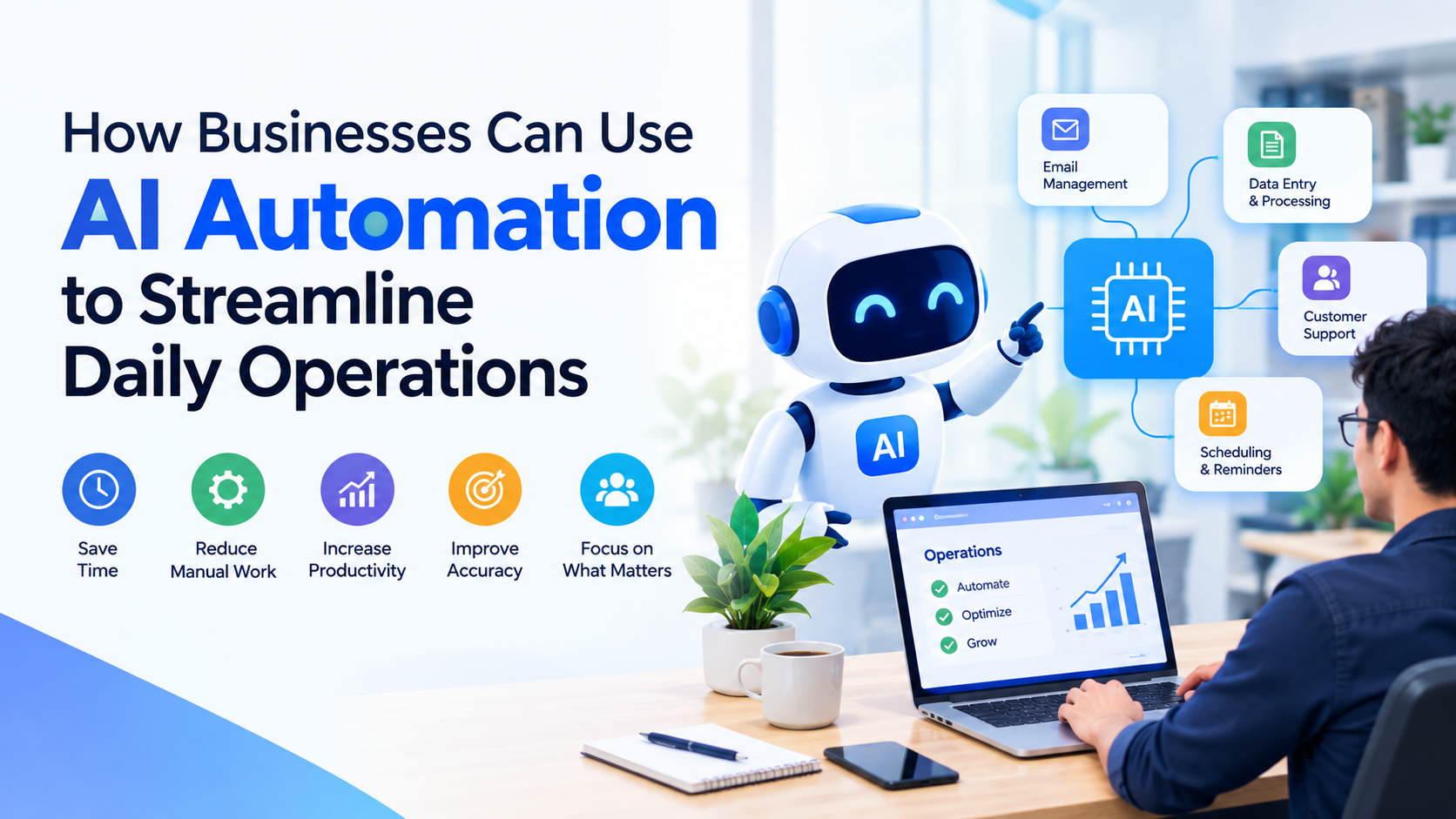
Businesses today are managing more data, customer interactions, and operational tasks than ever before. While technology has improved many processes, employees still spend considerable time handling repetitive activities such as data entry, email management, reporting, document processing, and customer inquiries.
AI Automation can help businesses streamline these activities by combining artificial intelligence with automated workflows. Instead of relying entirely on manual processes, organizations can use intelligent systems to analyze information, trigger actions, and support employees across different departments.
What Is AI Automation?
AI Automation refers to the use of artificial intelligence to perform or support tasks within automated business workflows.
Traditional automation generally follows predefined rules. AI-powered automation can work with more complex information, understand natural language, identify patterns, classify data, and generate responses.
For example, a traditional workflow might send an automated email after a customer submits a form. An AI-powered workflow can analyze the customer’s message, understand their intent, categorize the inquiry, update the CRM, and route it to the appropriate team.
Why Are Businesses Adopting AI Automation?
AI automation can help organizations improve how everyday processes are managed.
Some common benefits include:
- Reducing repetitive manual tasks
- Improving workflow efficiency
- Processing information faster
- Supporting employees with intelligent tools
- Improving consistency across processes
- Connecting different business applications
- Creating scalable workflows
The objective is not necessarily to automate every task. Instead, businesses can identify processes where AI can provide practical value.
Common AI Automation Use Cases
1. Customer Support
Customer service teams often receive similar questions repeatedly. AI-powered chatbots and virtual assistants can handle common inquiries, provide basic information, summarize conversations, and route complex requests to human representatives.
This allows support teams to spend more time on issues that require human judgment.
2. Sales and Lead Management
AI can support sales teams by analyzing incoming leads and organizing customer information.
An automated workflow can capture a lead, analyze available information, categorize the prospect, update the CRM, and notify the appropriate sales representative.
This can reduce administrative work and help create a more structured follow-up process.
3. Document Processing
Businesses work with invoices, applications, contracts, forms, reports, and other documents.
AI can extract relevant information from these documents and transfer it into business systems, reducing repetitive data-entry activities.
4. Marketing Operations
Marketing teams can use AI automation for activities such as:
- Customer segmentation
- Email personalization
- Campaign analysis
- Content organization
- Lead nurturing
- Reporting
Human oversight remains important for strategy, accuracy, and brand consistency.
5. Internal Workflows
AI automation can also support internal operations, including employee onboarding, approvals, notifications, task assignments, and information management.
For example, an employee onboarding workflow can automatically trigger document requests, assign tasks, notify departments, and update the status of the onboarding process.
AI Automation and Software Integration
One of the biggest opportunities for AI automation is connecting existing business systems.
Companies may use different platforms for CRM, accounting, project management, customer support, communication, and internal operations.
An AI Automation Agency can help connect these systems through APIs and automation workflows.
A typical process might look like:
Website Form → AI Analysis → CRM Update → Lead Assignment → Notification → Follow-Up
This reduces the need for employees to manually move information between different systems.
How AI Automation Can Improve Productivity
AI automation can help employees spend less time on repetitive processes and more time on activities requiring creativity, communication, and decision-making.
For example, instead of manually reviewing hundreds of incoming emails, an AI-powered system can categorize them and route them to the appropriate departments.
Similarly, automated reporting can collect information from multiple systems and prepare recurring reports, reducing the time required for manual data gathering.
How to Implement AI Automation Successfully
Businesses should take a structured approach when introducing AI automation.
Identify Repetitive Processes
Start by identifying tasks that consume significant time and follow a repeatable workflow.
Define Business Objectives
Determine what you want to improve, such as processing time, response speed, productivity, or workflow consistency.
Select the Right Technology
Choose AI models, automation platforms, integrations, and infrastructure based on the specific business requirement.
Start With a Focused Use Case
Instead of attempting to automate multiple departments simultaneously, begin with one well-defined workflow.
Test the Solution
Test the automation using different scenarios and ensure that appropriate human review is available where necessary.
Monitor and Optimize
Track performance after deployment and make improvements based on real-world results.
Choosing an AI Automation Agency
Businesses looking for an AI Automation Agency in USA should evaluate more than just the available AI tools.
Important factors include:
- AI development expertise
- Workflow automation experience
- API integration capabilities
- Software development knowledge
- Data security practices
- Testing and quality assurance
- Scalability
- Technical support
A technology partner should understand the business problem before recommending an automation solution.
AI Automation Services in USA
Businesses searching for AI Automation Services in USA can work with technology providers to develop solutions around their existing processes and systems.
Devstringx Technologies provides AI and software development capabilities including:
- AI Consulting
- AI Development
- AI Automation
- Custom Software Development
- Mobile App Development
- Software Testing & QA
- API Integration
- SaaS Development
- OTT Platform Development
As an AI Automation Agency, Devstringx Technologies helps businesses identify suitable automation opportunities and develop practical technology solutions aligned with their business requirements.
Conclusion
AI Automation can help businesses streamline everyday operations, reduce repetitive work, and improve the efficiency of existing workflows. From customer support and sales to document processing, marketing, and internal operations, AI can be integrated into many areas of modern business.
The most effective approach is to start with a clearly defined business problem, select the right use case, test the solution, and gradually expand automation as the organization gains experience.
Devstringx Technologies helps businesses turn AI ideas into practical solutions through AI consulting, AI development, automation, custom software development, and technology integration.