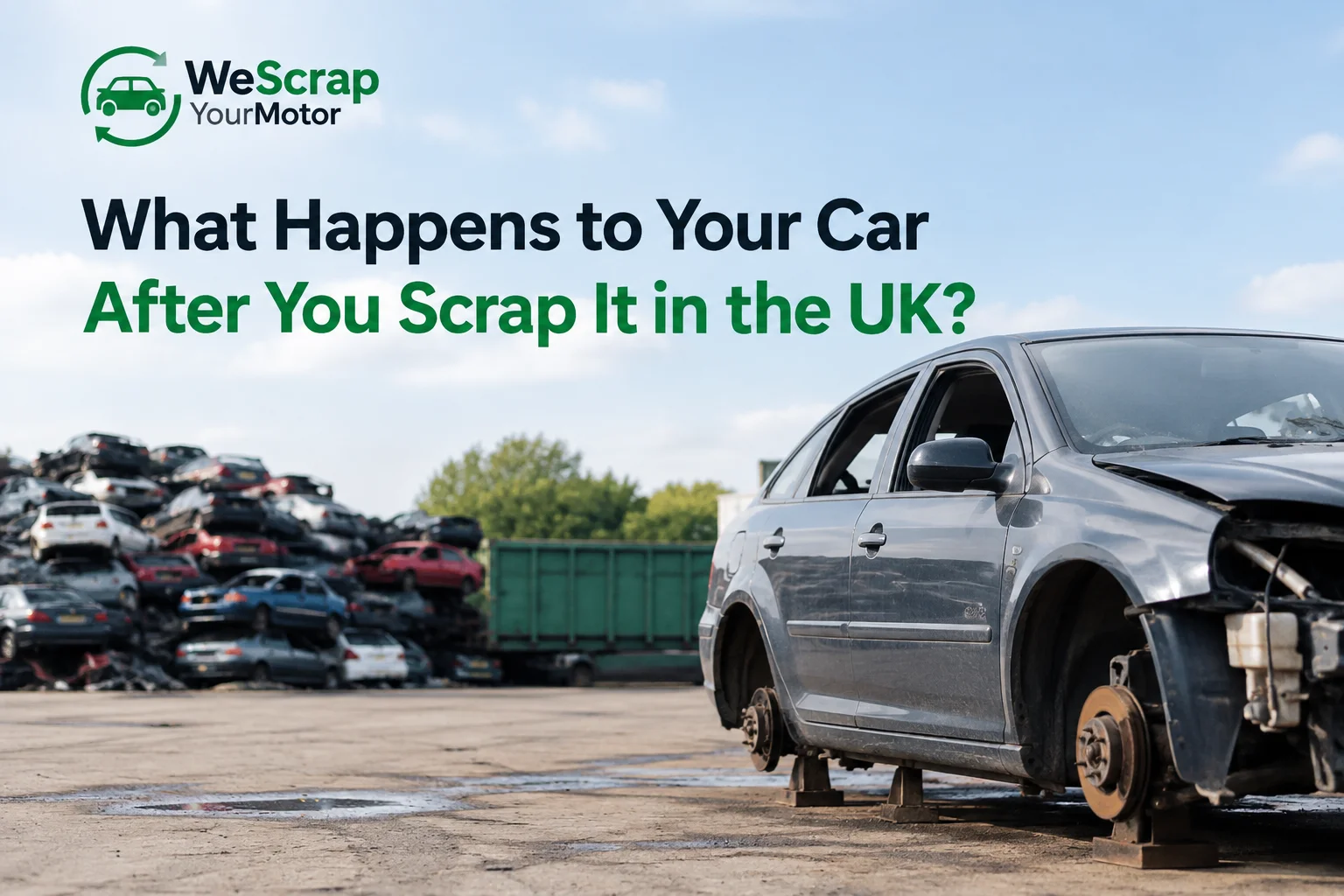
When an old car reaches the end of its useful life, many owners think the process ends as soon as a recovery truck takes it away. In reality, that is only the beginning of a carefully managed process involving collection, depollution, dismantling, parts recovery and metal recycling.
For motorists across the UK, understanding what happens after a vehicle is collected can make the decision to scrap a car much easier. It can also help vehicle owners choose a responsible scrap car company rather than simply accepting the first offer they see online.
Whether your vehicle has failed its MOT, suffered major mechanical damage, been involved in an accident or simply become too expensive to maintain, there are several stages between collection and final recycling.
Why Do People Scrap Their Cars?
Cars can reach the end of their useful life for many different reasons. An older vehicle may need increasingly expensive repairs, while a newer car might become uneconomical to repair after an accident.
Common reasons for scrapping a vehicle include:
- Expensive MOT repairs
- Engine or gearbox failure
- Serious rust or corrosion
- Accident damage
- Flood or fire damage
- Insurance write-off
- High mileage
- Repeated mechanical faults
- Expensive replacement parts
- A vehicle that has been sitting unused for a long period
The fact that a car is no longer suitable for the road does not mean it has no value. A vehicle contains metals and components that can potentially be recovered and reused.
This is one reason many UK motorists choose a professional scrap my car in the UK service rather than leaving an unwanted vehicle sitting on a driveway.
What Happens When the Car Is Collected?
The first stage is vehicle collection.
Once you have accepted a quotation, the collection company arranges a suitable time and location. The vehicle may be collected from a driveway, workplace, garage or another accessible location.
Before the vehicle is loaded, the collector may confirm the registration number and inspect the vehicle against the information provided during the quotation.
This is important because an accurate description helps avoid disagreements. If the vehicle was described as complete but important components have been removed, the final valuation may be different.
Owners should therefore explain problems such as:
- Missing wheels
- A seized engine
- A missing gearbox
- Missing catalytic converter
- Accident damage
- Locked steering
- Flat tyres
- Missing keys
- Flood or fire damage
Once the vehicle is collected, it can be transported to an appropriate authorised treatment facility or recycling route.
The First Important Stage: Depollution
Modern vehicles contain several materials that should not simply be released into the environment.
Before a vehicle is dismantled, hazardous fluids and materials need to be dealt with correctly.
Depending on the vehicle, this can include:
- Engine oil
- Coolant
- Brake fluid
- Fuel
- Air-conditioning refrigerants
- Batteries
- Other potentially hazardous materials
This process is commonly known as depollution.
Depollution is important because an end-of-life vehicle contains more than just metal. Fluids and certain components can cause environmental harm if they are handled incorrectly.
A professional vehicle recycling process therefore starts by making the vehicle safe for further dismantling.
What Happens to the Usable Parts?
Not every component of a scrap vehicle is automatically waste.
If a vehicle still contains usable components, some parts may be removed and assessed for reuse or further processing.
Depending on the condition and demand, these could include:
- Engines
- Gearboxes
- Alternators
- Starter motors
- Alloy wheels
- Doors
- Mirrors
- Lights
- Body panels
- Electronic components
- Interior components
The exact process depends on the vehicle’s age, condition, make, model and the demand for its components.
For example, a relatively modern vehicle involved in an accident may have many undamaged components even though repairing the entire car is uneconomical.
On the other hand, an older vehicle with severe corrosion may have fewer parts suitable for reuse.
If you are dealing with a vehicle that has already had components removed, it is important to describe the condition accurately when requesting a quote. Missing components can affect both the vehicle’s value and the practicalities of collection.
For more information, vehicle owners can also read this guide about Can You Scrap a Car With Parts Missing?.
What Happens to the Metal?
After useful components and hazardous materials have been dealt with, the remaining vehicle can be processed for material recovery.
Cars contain substantial quantities of steel and other metals. These materials can be separated and prepared for recycling.
Steel is particularly important because it can be recovered and used in the production of new steel products.
Other materials may also be recovered depending on the vehicle and recycling process, including:
- Aluminium
- Copper
- Certain plastics
- Glass
- Rubber
- Other recyclable materials
The exact recovery rate varies between vehicles and facilities. It would be inaccurate to assume that every component of every vehicle is recycled in exactly the same way.
However, modern vehicle recycling is designed to recover useful materials wherever practical.
Why Vehicle Weight Matters
Vehicle weight is one factor that can influence the value of a scrap car.
A larger vehicle generally contains more recoverable metal than a very small vehicle. However, scrap car valuation is not simply a calculation based on weight.
Other factors can influence the final offer, including:
- Make and model
- Age
- Vehicle condition
- Current metal prices
- Completeness
- Reusable parts
- Catalytic converter
- Location
- Collection requirements
- Current demand
This is why two cars that appear similar may receive different quotations.
A complete vehicle with desirable reusable parts can have a different value from a similar vehicle that has already had its engine, gearbox or catalytic converter removed.
What About Cars That Do Not Run?
A car does not necessarily need to start or drive to be considered for scrapping.
Non-running vehicles can still contain valuable metals and reusable components.
However, the collection process can become more complicated if the vehicle cannot roll, steer or brake.
For example, a vehicle with locked wheels may require different recovery equipment from one that can be winched onto a recovery truck.
Owners should therefore provide accurate information before collection.
Tell the company if:
- The engine does not start
- The wheels do not turn
- The steering is locked
- The car has no keys
- The vehicle has missing wheels
- The car is parked in a restricted location
- The vehicle is underground
- Access is limited
Providing this information helps the collector prepare properly.
What Happens to the Vehicle Paperwork?
Scrapping a car also involves administrative responsibilities.
The V5C logbook can help establish the vehicle’s details, although individual circumstances can vary.
When a vehicle is taken for destruction, the owner should make sure DVLA is notified using the correct process.
For vehicles that are completely destroyed through an authorised treatment facility, the relevant destruction documentation may also be issued.
Owners should keep records of:
- The vehicle registration
- Collection details
- Payment
- DVLA notification
- Relevant destruction documentation
Keeping these records provides useful evidence that the vehicle has been handed over correctly.
What About Personal Number Plates?
If a vehicle has a personalised registration that you want to keep, this should be dealt with before the vehicle is scrapped.
Do not assume that the registration can simply be recovered after the car has already been destroyed.
The correct DVLA process should be followed first so that the registration is retained properly.
This is particularly important for owners who have spent significant money purchasing or transferring a private registration.
How Much Is a Scrap Car Worth?
There is no single price for every scrap vehicle.
The amount offered depends on the individual vehicle and market conditions at the time of valuation.
A quotation may take into account:
- Weight
- Make and model
- Age
- Condition
- Missing parts
- Current metal prices
- Salvage demand
- Location
- Collection requirements
A car that has valuable reusable components may be assessed differently from a vehicle that is being valued mainly for its recyclable materials.
This is why obtaining a vehicle-specific quotation is generally more useful than relying on a generic online estimate.
Why Responsible Recycling Matters
Scrapping a vehicle is not simply about getting rid of an unwanted car.
A responsible recycling process helps ensure that hazardous materials are handled correctly while useful components and metals are recovered where possible.
For vehicle owners, this provides an alternative to leaving an old car abandoned or sending it through an unsuitable disposal route.
For the wider environment, recovering materials can reduce the need to produce some new raw materials from scratch.
Vehicle recycling therefore connects the financial decision of scrapping an old car with a broader waste-management process.
How to Choose a Scrap Car Company
Before accepting an offer, look beyond the headline price.
A reliable company should be able to explain:
- How the valuation was calculated
- Whether collection is included
- What happens if the vehicle condition differs
- How payment will be made
- Where the vehicle will be processed
- What paperwork you need
- What your DVLA responsibilities are
You should also provide an accurate description of the vehicle.
If a major component is missing, mention it before accepting the quote. This creates a clearer transaction and reduces the possibility of an unexpected change at collection.
The Journey Does Not End at Collection
When your scrap car disappears on the back of a recovery truck, its useful life may not actually be over.
Its engine, gearbox, wheels, electronics or body panels may still have a second life. Its steel and other metals can potentially return to the manufacturing cycle, while hazardous materials can be handled through controlled processes.
That is the real journey of an end-of-life vehicle.
For motorists, the most important step is choosing a legitimate route, describing the vehicle accurately and keeping the correct paperwork.
Scrapping an old car can therefore be much more than simply disposing of unwanted transport. Done through the correct recycling route, it can turn an otherwise unusable vehicle into a source of recoverable materials and components.