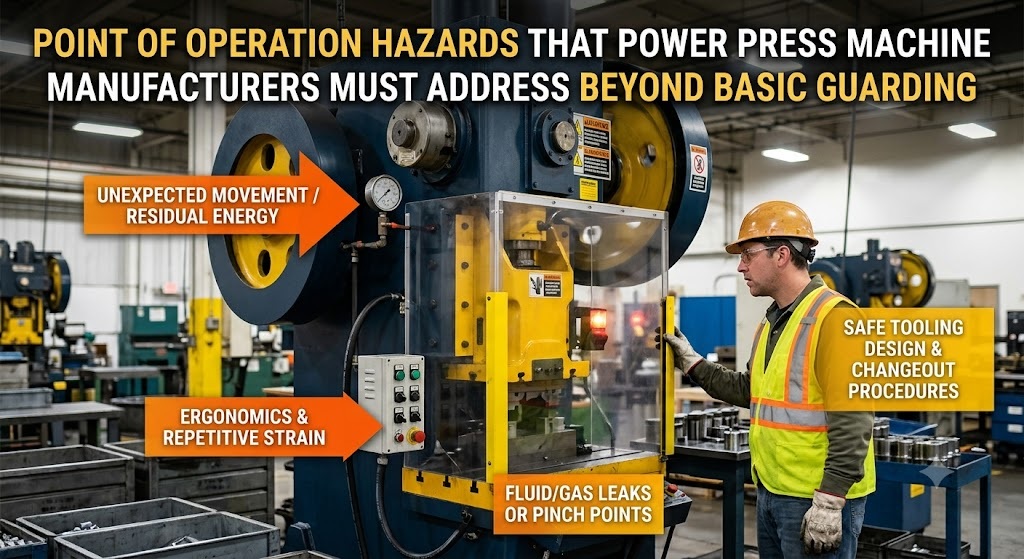
A power press is capable of performing repetitive operations such as forming, punching, blanking, bending, and stamping in a single powerful stroke. The high-speed power of the machine introduces serious potential for creating point of operation hazards that can amputate or severely injure an operator’s hand.
Basic guarding is only one element in a complete press safeguarding plan. An operator’s hand or loose object can enter the point of operation area at any time and be crushed or amputated. A careful analysis of the process performed by the power press machine manufacturer is necessary to determine what safeguards are needed to protect against these and other hazards.
Basic Understanding of Point of Operation
The point of operation is the area of a machine where the workpiece is being processed between the tooling surfaces. There is potential for creating a crushing hazard at the point of operation due to the enormous amount of energy being focused on the relatively small area of the workpiece during the stroke.
This hazard is further increased when the operator is required to frequently feed and unload the workpiece. The placement of the hands close to the die of the Power press machine manufacturer is likely both due to the small size of the workpiece and the need for speed and accuracy.
Therefore, it is necessary to prevent access to the point of operation and not necessarily to warn the operator of the hazard. The OSHA standard requires point of operation guarding or the appropriate application of safeguarding devices on mechanical power presses to the extent necessary to prevent hazards.
Why Fixed Guard is Not Always Applicable
While a fixed guard may be appropriate if the manufacturing process allows the area to be enclosed, not all press processes are the same.
A guard may also restrict the view to the process, create a situation where the guard must be removed or bypassed during the process, or may have oversized openings or additional pinch points.
OSHA requires that guards be provided to prevent hands or fingers from contacting the point of operation through, over, under or around the guard and that the application of the guard not provide additional pinch points.
In addition, the ability to see the workpiece is sometimes sacrificed when a guard is added. If visibility is reduced to the extent that it becomes a production hazard, then operators are likely to make unsafe attempts to get a better view. The choice and application of a good point of operation guarding system must balance the need to prevent access to the hazard with providing adequate visibility and access needed for the process.
Point of Operation Safety Devices Must Suit the Press Process
If a fixed barrier cannot be used safely, other point of operation devices may be required depending on the type and method of operation of the press, the type of clutch used, the stroke parameters of the press, and the type of feeding method.
Some of the common devices are two-hand controls, two-hand trips, interlocked gates, pull-out devices, and presence sensing. While these devices seem to be similar in function, their application differs significantly. Note that OSHA specifically refers to two-hand trips for full-revolution clutch presses and two-hand controls for part-revolution clutch presses.
The power press machine manufacturer must also consider the process performed by the machine during the choice of point of operation devices as a device that seems appropriate visually may not offer the protection needed because of the process performed by the machine.
Distance is a Design Concern
An often-overlooked part of point of operation safeguarding is the distance between the safeguarding device and the point of operation. While it seems intuitive that placing two-hand controls or a sensing device several inches from the die would eliminate the hazard, it does not always do so.
Part of the decision-making process about distance involves knowing the maximum stopping distance of the machine. If the slide continues to move despite the presence of a protective device, the operator could be injured if their hand or body part is pulled into the point of operation as an additional safeguard. OSHA specifies the requirements for some of the most commonly applied safeguarding devices including the relationship between the presence sensing distance and the stopping time.
Thus, determining the stopping time and the performance of the brake is an important part of the machine design process. A power press machine manufacturer should consider the stopping performance characteristics during the design process rather than during the final production stages.
Hazard of Unintended Cycling
In addition to physical guarding, another aspect of a point of operation hazard is the possibility of an unintended cycle of the machine.
While a properly located guard prevents access to the point of operation, there could be a condition in which a malfunction in the control circuitry could cause an unintended cycle of the machine. In addition, there is a potential for human error when accessing or using the point of operation.
Electrical control systems, clutches, brakes, switches, and other components must be used in such a way that a failure in one of these components does not compromise the protection provided by the point of operation safeguarding system.
OSHA specifically calls out control safeguards and those that are used to prevent or stop movement of the press when hazardous conditions exist. In its safety standards, OSHA also refers to unintended cycling as a significant hazard of mechanical power presses.
Safeguarding circuits should be designed in such a way that a failure does not go undetected and, where applicable, the system detects the fault and prevents the next potentially hazardous cycle from occurring.
Guards Must be Resistant to Production Practice
A guard that has been demonstrated to be effective in a sales demonstration may not be effective if the operator must frequently remove the guard or bypass it during the process. The location of the guard and its accessibility during operation are extremely important design considerations.
Operators are likely to try alternative means of feeding or unloading the workpiece if the process becomes disruptive. The guard is designed in such a way that it does not become a production bottleneck or require special tools or training to access. The same goes for the control components; they are not conveniently located for the operator to access. A careful analysis of the process performed during the production run by the Power press machine manufacturer can help in designing an appropriate point of operation safeguarding system.
Feeding and Unloading Require Additional Consideration
Feeding the workpiece into the Power press machine manufacturer is an aspect of the process that deserves special consideration as the operator is likely to be within striking distance of the point of operation. Small workpieces, difficult geometry of the workpiece, the need for speed, and high rates of production all contribute to the likelihood that the operator will be close enough during the feed process to be injured.
Hand feeding can reduce the likelihood of the operator’s hand being caught in the point of operation in some cases. However, hand tools do not replace point of operation guarding or devices. OSHA specifically states that hand tools do not substitute for point of operation guards or devices.
Automatic or semi-automatic feeding methods can further reduce the likelihood of the operator’s hand being caught in the point of operation. However, the method of feeding should not introduce alternative access points to the point of operation.
Design for Maintenance and Die Changes
As important as production processes are, they are not the only activity that takes place around the point of operation. When a Power press machine manufacturer requires maintenance to be performed or the tooling to be changed, there is the potential for creating a hazard.
The same goes for troubleshooting malfunctions and inspecting and testing the components. The design of a point of operation safeguarding system should be considered in such a way as to allow legitimate maintenance and die change activities to take place without creating an opportunity for a shortcut to access the point of operation. Safeguards should also consider how the machine will be isolated, accessed, and controlled during servicing and maintenance.
Tool changes, adjustments, and the like can take place while the machine is in motion in some cases. A power press machine manufacturer should consider whether the point of operation safeguarding system remains effective when the die is changed or the process parameters are adjusted. The application of the point of operation safeguarding system should be determined for similar conditions that may be encountered.
Siddhapura’s Approach to Press Machine Design
Siddhapura offers industrial machinery with an understanding of the challenges that practical production and machine performance can present. The various engineering solutions are available through its official homepage as the design of a machine is considered to be appropriate for the application for controlled forming and performance.
Creating a Safe Point of Operation
While a point of operation hazard is a major safety concern for a power press machine manufacturer, the application of a single safeguarding component such as a guard is rarely enough to prevent the hazard. Understanding the production process performed by the press is essential to the selection of the point of operation safeguarding system.
The design of a press machine with appropriate point of operation safeguards in place anticipates the way that the machine is used throughout the production cycle. It takes into account issues of accessibility and visibility for the operator, the stopping time of the machine, the possibility of unintended cycling, the accessibility of the point of operation during tool changes, and the likelihood that the operator may attempt to defeat the safeguarding system. With these considerations in mind, the point of operation safety becomes part of the design of the machine rather than an after-thought.
Conclusion
Point of operation hazards continue to be a major concern for a Power press machine manufacturer due to the very nature of the process performed by the machine. A basic approach to guarding can prevent most of these hazards. However, an effective combination of physical barriers as well as control and sensing devices are required to ensure that a press machine performs its function without creating a hazard to the operator. A power press machine manufacturer must consider the aspects of a production process involving the point of operation to ensure that the machine provides the intended productivity while minimizing the possibility of an injury.