
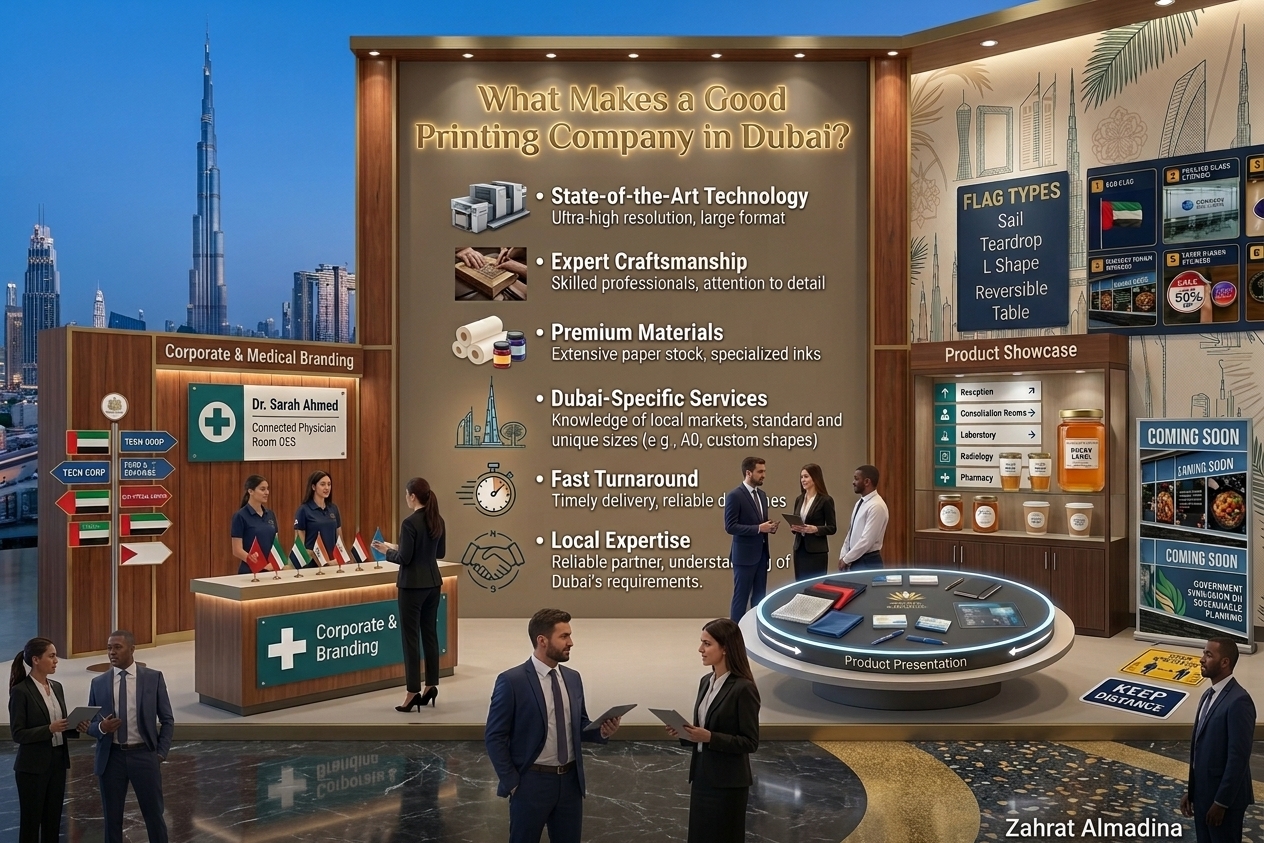
Printing remains an important part of business communication in Dubai. From product labels and packaging to office signage, exhibition displays, brochures, stickers, and promotional materials, businesses depend on printed products to present information clearly and maintain a consistent visual identity.
However, choosing a printing company should involve more than comparing prices. Two providers may offer similar services while delivering very different results in terms of material quality, color accuracy, finishing, turnaround time, and customer support.
Understanding what separates a capable printing provider from an unsuitable one can help businesses make better decisions and avoid problems during production.
A Wide Range of Relevant Services
A good printing company should have the capabilities needed for the type of project being planned. While some businesses only require basic digital printing, others may need several related services from the same provider.
Common requirements include:
- Business cards and stationery
- Flyers and brochures
- Product labels and stickers
- Large-format banners
- Event backdrops
- Promotional flags
- Retail and office signage
- Vehicle graphics
- Exhibition displays
- Custom promotional materials
A broader service range can be particularly useful when several printed elements are part of one campaign. It allows businesses to coordinate different materials while keeping their branding consistent.
Consistent Printing Quality
Printing quality is one of the most important factors to evaluate. A professional-looking design can lose its impact if colors are inaccurate, text is unclear, images appear pixelated, or finishing is poor.
Quality depends on several elements, including the printing equipment, materials, ink or toner technology, file preparation, and production process.
For this reason, businesses should review actual project samples before placing a large order. Looking at similar work can provide a better understanding of what to expect than relying only on promotional descriptions.
Suitable Materials for Different Applications
The right material depends on where and how the printed item will be used.
For example, an indoor promotional poster does not necessarily require the same material as an outdoor banner. Similarly, product labels, window graphics, wall stickers, and vehicle graphics have different requirements.
Material selection can affect:
- Durability
- Appearance
- Flexibility
- Surface adhesion
- Resistance to moisture
- Indoor or outdoor suitability
- Overall cost
A knowledgeable printing provider should be able to explain these differences and help customers select a material based on the actual application.
Strong Finishing Capabilities
Printing is not always the final production stage. Finishing can significantly change the appearance and usability of printed materials.
Depending on the project, finishing may include:
- Lamination
- Die-cutting
- Trimming
- Folding
- Mounting
- Eyelets
- Binding
- Protective coatings
For example, lamination may be useful when additional surface protection is required, while die-cutting can create customized shapes for stickers, packaging, or promotional materials.
The availability of appropriate finishing options gives businesses more control over the final product.
Reliable Turnaround Times
Business printing is often connected to deadlines. A brochure may be needed for a sales meeting, banners may be required before an exhibition, or signage may need to be installed before a store opens.
A printing company should therefore provide a realistic production timeline rather than simply promising the fastest possible delivery.
Turnaround can depend on:
- Quantity
- Material availability
- Printing method
- Artwork readiness
- Finishing requirements
- Installation needs
- Delivery location
Businesses should confirm the complete timeline before approving an order, especially when the printed materials are connected to a fixed event or campaign.
Professional Artwork Handling
The printing process can only produce good results when the artwork is prepared correctly.
Common artwork issues include low-resolution images, incorrect dimensions, missing bleed, unsuitable color settings, and fonts that are not properly embedded.
A capable printing provider should be able to identify technical problems before production. Some providers also offer design assistance or artwork adjustments when required.
This is particularly useful for businesses that do not have an in-house graphic designer.
Clear Pricing and Specifications
A quotation should clearly explain what is included. A low initial price can become expensive if important requirements such as finishing, delivery, installation, or special materials are added later.
When comparing quotations, businesses should check:
- Quantity
- Dimensions
- Material
- Printing method
- Finishing
- Artwork services
- Delivery
- Installation
- Production timeline
Comparing like-for-like specifications provides a much more accurate picture of the actual cost.
Experience With Business Printing Projects
Different printing projects require different production knowledge. A company producing office stationery may have different capabilities from one handling exhibition displays, retail graphics, or large-format branding.
Businesses should therefore look for previous work relevant to their own requirements.
For example, a company preparing for a trade show can review previous exhibition displays, while a retailer may be more interested in storefront signage, window graphics, and promotional materials.
Relevant experience does not necessarily mean choosing the largest provider. It means finding a printing partner familiar with the type of work being requested.
Delivery and Installation Support
Some printed products are simple to collect and use, while others require transportation and installation.
Large banners, signage, backdrops, wall graphics, display systems, and vehicle graphics may need additional handling. If installation is required, it should be discussed before the project begins.
Businesses should confirm:
- Delivery areas
- Expected delivery date
- Installation availability
- Installation charges
- Site requirements
- Responsibility for final setup
Clarifying these details helps prevent last-minute arrangements.
How Businesses Can Compare Printing Providers
There is no single factor that determines whether a printing company is suitable. The best choice depends on the specific requirements of the project.
A practical comparison can include:
| Factor | What to Check |
| Installation | Is professional installation available when needed? |
| Artwork | Is file checking or design support offered? |
| Experience | Has the provider handled similar projects? |
| Turnaround | Does the timeline match the deadline? |
| Services | Does the provider handle the required printing? |
| Quality | Can previous work be reviewed? |
| Finishing | Are the required finishing methods available? |
| Materials | Are suitable options available? |
| Pricing | Are specifications clearly included? |
| Delivery | Are delivery arrangements suitable? |
Businesses researching potential providers can also use an informational guide to printing companies in Dubai to understand the types of services available and the factors worth comparing before making a decision.
Think Beyond a Single Printing Order
A printing company may be needed repeatedly throughout the year rather than for just one project. Businesses may require new promotional materials, updated signage, seasonal campaigns, event displays, packaging, or branded office materials.
For this reason, it can be useful to consider whether a provider can support different types of printing as future requirements change.
A consistent printing partner can also make it easier to maintain similar colors, materials, dimensions, and visual standards across recurring projects.
Conclusion
A good printing company is not simply one that offers a low quotation or a long list of services. Businesses should look at the complete production process, from material selection and artwork preparation to printing, finishing, delivery, and installation.
By comparing providers based on relevant experience, quality, capabilities, timelines, and clear pricing, businesses can choose a printing partner that fits their actual requirements. This approach can also make future printing projects easier to manage and help maintain a consistent brand presentation across different materials.
Frequently Asked Questions
1. How should a business choose a printing company in Dubai?
Businesses should compare service capabilities, material options, printing quality, finishing, turnaround times, pricing, delivery, installation, and previous work. The right choice depends on the specific printing requirements rather than price alone.
2. What should be included in a printing quotation?
A quotation should ideally specify the quantity, dimensions, material, printing method, finishing, artwork services, delivery, installation where applicable, and expected production time. Clear specifications make it easier to compare different quotations.
3. Why is material selection important in printing?
Different materials are designed for different applications. Indoor displays, outdoor banners, product labels, window graphics, and vehicle graphics may require different levels of durability, flexibility, adhesion, or weather resistance.
4. Should businesses request a sample before a large printing order?
For important or high-volume projects, requesting a sample or proof can be useful. It allows the business to check colors, material, size, finishing, and overall appearance before the complete order is produced.
5. Does a higher printing price always mean better quality?
Not necessarily. Price can vary because of material, quantity, printing method, finishing, design work, delivery, and other requirements. The better approach is to compare quotations using the same specifications and evaluate the overall value.

