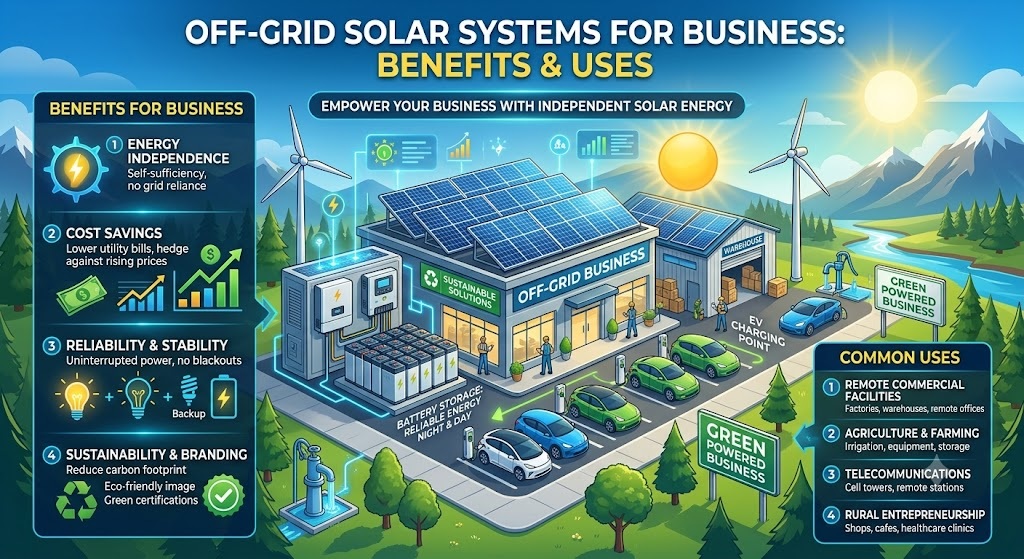
An off-grid solar system is defined as a solar power installation that has no connection to the grid. produces energy using sunlight and saves the electricity in batteries for future consumption. Off-grid solar systems are utilized by businesses and institutions to fulfill their power needs without entirely relying on the grid.
What Are Off-Grid Solar Systems for Business?
Businesses utilize off-grid solar systems to harness the sun’s power in the form of solar panels. The electricity that is produced once it is captured would be used for lighting, running laptops and computers, activating machines and fans, pumping water, operating security devices, and any other business needs. The system consists of batteries to store any excess solar energy that could be utilized when there is no sunlight. Off-grid solar systems are ideal for business establishments located in regions with unreliable power.
The Importance of Off-Grid Solar Systems for Commercial Enterprises
Many commercial enterprises depend on power to function, and any disruption in supply could have repercussions for the efficiency of operations and customer satisfaction. Off-Grid Solar Systems for Business provide companies with an independent source of energy that reduces dependence on the grid for power. Companies that are situated in sunny areas have the ability to produce a lot of power during daytime hours. This set of electricity can be used in office and school buildings, warehouses, farms, workshops, and for other needs. In addition, businesses will have access to stored solar energy instead of using electricity when solar energy is unavailable. Thus, a well-designed system will supply essential electric loads day and in some cases at night.
Benefits of Off-Grid Solar Systems for Business
One primary benefit of the use of off-grid solar systems for businesses is the elimination of the need to use electricity from the grid. Businesses can produce their own electricity and utilize stored energy when needed. Another benefit is better management of long-term energy costs. After installation of solar energy technology, there is no need for fuel in order to produce electricity. However, in order to make smarter savings calculations, companies should still take into account the capital expenditures on equipment, maintenance, replacement of batteries, as well as installing the systems.
Off-grid solar solutions can also lead to more environmentally sustainable operation. The use of solar energy avoids the creation of emissions that typically occurs in fossil fuel energy generation. Hence, companies can be environmentally conscious by taking advantage of renewable energy products. In addition, the use of solar power minimizes downtime caused by unreliable electricity from the power grid in different places. It proves to be very beneficial in case of remote facilities or agricultural, telecom and manufacturing operations.
Who Can Install Off-Grid Solar Systems?
Various businesses can opt for off-grid solar systems. Examples are offices, retail stores, storage facilities, inns, agricultural lands, shipping industries, institutions of learning, healthcare establishments, telecommunication organizations, and isolated commercial locations.
Nonetheless, the system should be tailored to suit the actual electricity consumption of the business. The solar panel capacity, battery storage, inverter capacity, working hours, and backup needs have to be considered prior to the installation process.
How to Install an Off-Grid Solar System for Business
At the first stage of the solar energy process, companies must determine their electric requirements and the critical loads. After that, an expert from the solar energy industry can evaluate the location in order to conclude the best combination of solar panels and batteries. Eventually, the system can be designed, installed, tested, and delivered. The maintenance of the system plays a crucial role in keeping solar panels, batteries, inverter and other elements in good condition.
Conclusion
Solar systems which work off-grid could potentially benefit any organization wishing to become less dependent on the power grid as well as manage its electricity expenses. If the system is designed correctly, solar panels and batteries will allow a company not only to work on a daily basis but also contribute to a more sustainable energy future.