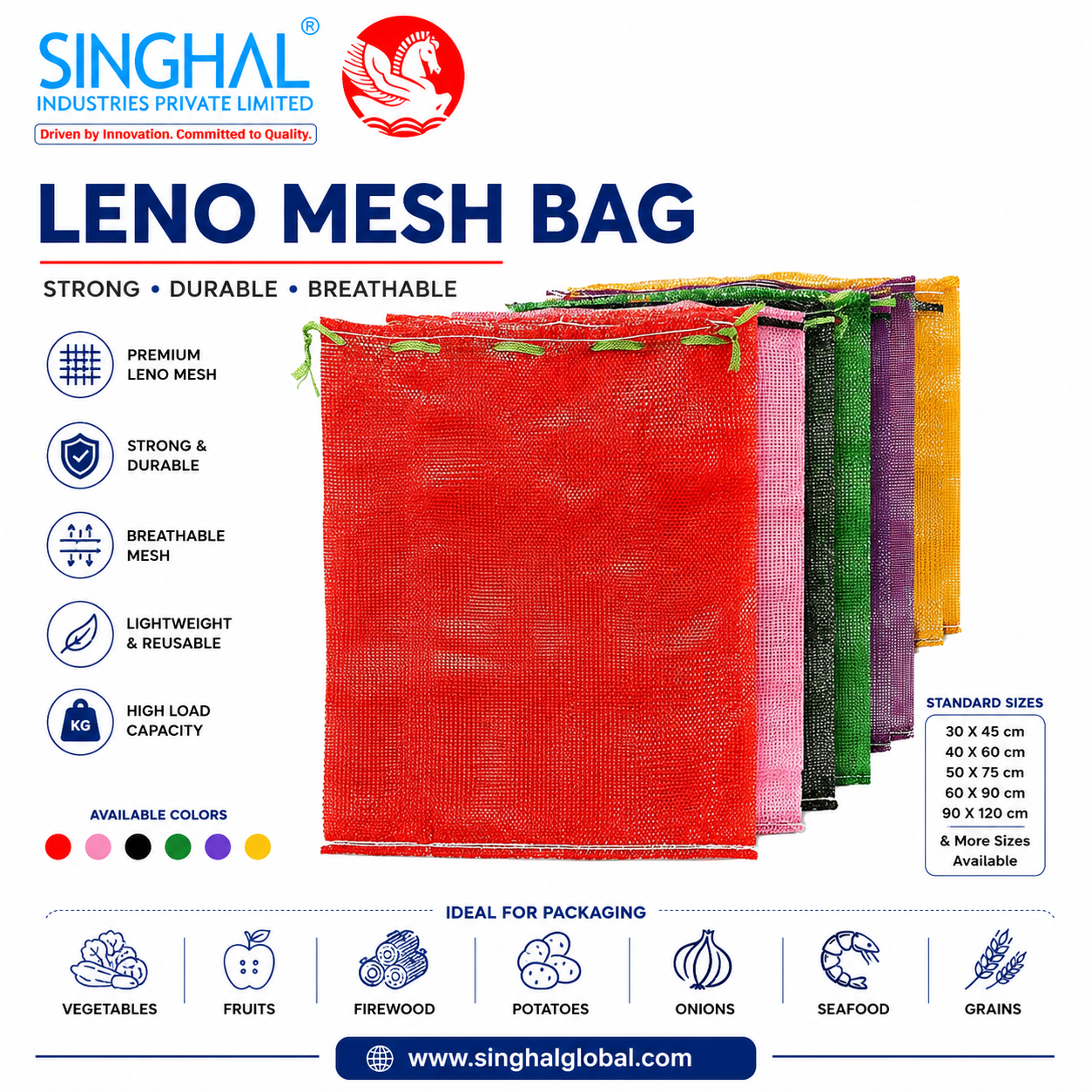
Mesh Bags are very light with flexible ourselves bags composed of woven polypropylene yarns. These bags are different from solid plastic sacks due to the small air spaces in them that permit air through the packaging. The breathable design helps make these particularly effective for items such as fresh produce, firewood, shellfish and various types of industrial materials. This can be attributed to the fact that Leno mesh bags allow for ventilation, which prevents heat and moisture build-up, making the product remarkably popular in onions, potatoes, garlic, citrus fruits, vegetables and agricultural products. The bags are sturdy enough for frequent handling but lightweight to minimize packaging and transport weight. They are offered with a variety of colors, sizes, capacities, lids and prints. Even a bad looking mesh bag yields different performance depending on yarn quality, weaving terms, stitching quality, size ratios of the bag and product weight packed. That means not all red mesh bag is the same.
Driven uses in agriculture and trade
Leno mesh bags are most of the time utilized to pack and transport fresh produce. They are used by farmers, wholesalers, exporters, retailers and food processors for onions, potatoes, garlic, carrots, oranges & lemons- coconuts and other fruits and vegetables. Air can circulate through the open structure surrounding the produce, and allows buyers to check what is inside without tearing it open. This is useful in ware house validation, market display, customs check and transportation. Leno mesh sacks are also used for firewood logs, shellfish, crop materials and some industrial goods. This is your expertise in bulk products and make them easier to lift, stack and move. That said, mesh packaging is not for every product. Unless a liner or inner bag is fitted fine powders, liquids and very small grains may all pass through the openings.
Leno Mesh Bags: Important Advantages
Leno mesh bags are most beneficial for ventilation. Vegetables exhale heat and moisture until harvested, but inadequate air circulation can accelerate mould development and cause them to soften faster or rot. Due to their somewhat open structure, leno bags allow for excess moisture and heat to escape, reducing the chance of premature spoilage. These bags are also lightweight, which helps to reduce tare weight and make the transport a bit more economical. Their transparent or semi-open design allows for rapid visual inspection, letting potential buyers see the colour of the product, its size and general condition without having to open (and cut into) the bag. Useful strength, flexibility, and resistance to normal handling are provided via polypropylene construction. Empty Leno bags can also be neatly folded, taking up very little space. Are they completely damage-proof? Just because it costs money doesn’t mean it’s safe Sharp produce, rough hooks, overfilling and careless loading can still tear the mesh or damage the seams.
Based on Size, Capacity, & Closure
There are various types of Leno mesh bags available based on specific needs for different produce and supply-chains. Retailing onions, garlic, potatoes, oranges and domestic firewood in small bags may also be possible. Wholesale and agriculture distribution makes use of larger sizes. Certain entries state 100-pounds (50 kg) capabilities, but this is conditional on bag building and use. The buyers are offered the choice of plain bags, printed bags, drawstring bags, stitched-mouth bags, sewn-bottom ones or even header and handle options. Drawstring bags are easy to showcase and open numerous times conversely; stitched bags work for bulk handling. Add extra volume and better standing with the help of Gusseted designs. Color can also help with identification of products or the presentation of brands. Color does not equal quality anyway, red green white yellow colors etc are all available.
Material, Weaving, and Strength
Most leno mesh bags are made of polypropylene a lightweight polymer chosen for strength and flexibility. The yarns themselves are weaved together in a leno pattern, which keeps the mesh nice and held whilst keeping a cross-flow of air. This comes down to yarn denier, mesh density, fabric weight, stitching, bottom construction and bag size. Well, the bag for 5 kg of onions can not have the same characteristics as a potato bag of 25 or 50 kg. The weight of the product, sharp edges, drop height to ground level, stacking method used for palletising, transport distance and whether bags will be handled by hand or machinery all need to be taken into account. the safe load capacity; test bags with genuine product. A weak bag is a strong mesh but weakly stitched. Similarly, carrying a heavier bag is pointless if something lighter delivers the same performance.
Printing and Product Presentation
Brand names, logos, product information, geographical origin data, handling instructions and retail messages can be printed on Leno mesh bags. In oversaturated markets, growers and distributors can imprint their identity on consumers. It also enables retailers to recognize the product as well as relay where it comes from. For fresh produce, visibility is an advantage in of itself, so printing should assist and plane to the product. The simpler designs that are easier to read generally perform best. Verify the artwork size, colour, print position, and its resistance to moisture as well as rubbing prior to mass manufacture. Lesson a sample Printing on mesh can look different compared to printing on smooth film. Instead of printing on every mesh section, some bags use labels, sewn-on strips or printed tapes. This can be actual more practical to replace your product info. Cheapest does not mean useful.
Selecting a Leno Mesh Bags
Leno Mesh Bags Manufacturer who knows your product, capacity and closure, handling process and market. Learn about the quality of polypropylene, mesh type & size along with safe working load, stitching, color and printing and packaging. Ask for samples and fill them with the real produce. Inspect ventilation, seam strength, ease of filling, handle comfort, stacking behavior and resistance to tearing. Singhal Industries’ Pvt Ltd Singhal Industries Private Limited is a leading Manufacturer and Supplier of PP leno mesh bags for fruits, vegetables & Agriculture packaging. PP, is noted as the material in its product information and includes fruits and vegetables among its common applications. Trade listings similarly position it as a manufacturer, supplier & exporter of packaging bags across various segments including leno mesh bags export capacity carriers in some formats up to 50 kg. For the most recent and accurate information, buyers must cross-verify specifications, production capacity, certificates availability, minimum order quantity as well as delivery schedules directly.
Best Buy Guide
Create the specification sheet right before placing an order. Also, tell the bag length, width, volume of the bag and color of the bag, mesh size density kung net this might not be a factor for most print shop but still some might need to. Their closure type printing packing method monthly that required in qty. Differentiate quickly between the bags for local sales, long-distance transport, export, cold storage and open-market display. Inquire for sample approval, quality inspection, replace rejected bags, payment terms and lead time out of supplier. Compare the total cost including service fees, not just the bag price. Very cheap bag might burst during loading, resulting in product loss, and an unnecessarily heavy bag will drive a transport cost up. Test a small batch first. See if the packaging (bags) stay fresh, how well produce stays ventilated, and whether it survives a typical drop or two. What if you need a liner? Talk about it early, because a liner enhances containment but could lower ventilation. Although at times it is required; other times would be rendering the purpose of going mesh moot.
Conclusion
Leno mesh bags are used for a variety of fruits, vegetables, including onions, potatoes, garlic and citrus as well as firewood, shellfish and other selected industrial goods. The main advantages of them are their airflow, low weight, visibility (and flexibility), being easy to handle and possessing usefully strength. Its real nature depends on the weight, moisture, size and sharpness of these products, transport conditions, and selling format. Buyers must scrutinise specifications such as material, mesh construction, stitching, closure, capacity and printing along another key aspect which is the supplier reliability. By collaborating with an established producer, it is feasible to lower tearing, deterioration and also handling concerns. Leno mesh bags look simple, but quality performance comes from careful specification and testing.
Frequently Asked Questions
Q1. What things are stacked in leno mesh bags ?
They are typically used for onions, potatoes, garlic, carrots, citrus fruits, vegetables, firewood and shellfish and some agricultural or industrial commodities.
Q2. Keeping the vegetables fresh in leno mesh bags?
The free-flowing structures allow air to pass through them freely which helps in the release of any excess moisture and heat that could otherwise give rise to conditions conducive, mould formation or premature spoilage. Proper storage is still essential.
Q3. Lenos mesh bag printing?
Yes. They are more than often printed with logos, product info, origin info, instructions and promotional designs. It can also be printed tapes or labels.
Q4. How do I select the right capacity?
Selecting by capacity for product weight & bulk volume, produce size, handling and transport conditions. Before bulk ordering, always a sample that has been subjected to your actual goods.
Q5. Who is the largest Suppliers Of Leno Mesh Bags ?
No one ranking is publicly verified to be indisputably the largest supplier of this kind in the world. Singhal Industries’ Pvt Ltd is a manufacture, supply and export of pp leno mesh bags for agricultural and fresh-produce packaging. In fact, one should analyses supplier based on important deciding factors such as capacity, mesh quality, stitching, printing quality, testing done at the factory pricing and delivery performance before choosing a supplier.