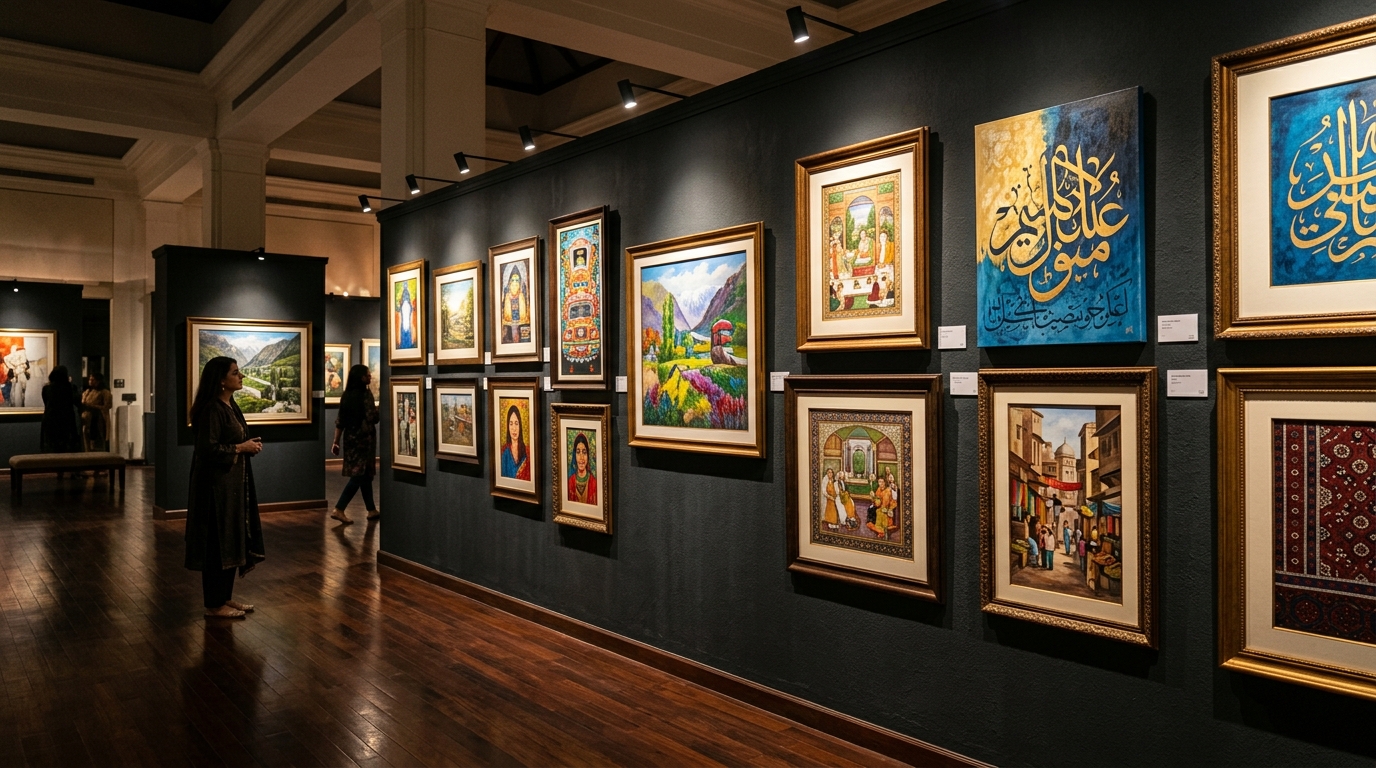
Calligraphy occupies a strange and privileged place in Pakistani visual culture. It is at once a devotional discipline, a decorative craft, and — in the last four decades — a fully modern art movement with its own galleries, collectors, and market. To understand where calligraphy sits today, it helps to separate the three layers that make it up: the inherited script traditions, the training system that keeps those traditions alive, and the generation of painters who broke the script open and turned it into something closer to abstract painting.
The Inherited Script Traditions
The inherited layer is the oldest and the most conservative. Urdu calligraphy in Pakistan grew out of the Nastaliq tradition, a flowing, diagonally cascading script that was refined in Iran and Central Asia before becoming the default hand for Urdu poetry, newspapers, and religious texts across South Asia. Nastaliq is notoriously difficult to typeset, which is why, well into the digital era, Urdu newspapers relied on katibs — professional scribes — to hand-letter entire pages before they went to print. That practical need kept a large, skilled population of calligraphers employed long after other regions had moved to Naskh-based type. Alongside Nastaliq sits Naskh, the more upright, legible script used for the Quran and formal religious inscriptions, and Thuluth, the bold, ornamental script favoured on mosque domes, shrine facades, and monumental architecture. A calligrapher trained in the traditional system typically works across all three, since mosque commissions, book work, and signage each call for a different hand.
Training in this tradition is still largely apprenticeship-based. A young katib learns by copying — thousands of repetitions of the same letterforms under a master’s eye — before being trusted with independent work. This model produced the generation of religious and architectural calligraphers whose work still covers the interiors of major mosques and shrines in Lahore, Multan, and Karachi, often unsigned and uncredited in the way that traditional craft has always been.
Breaking the Script Open: Sadequain and Modern Calligraphy
The break came in the 1960s and 70s, when a handful of trained painters — most notably Sadequain, and later artists associated with the National College of Arts in Lahore — began treating Arabic and Urdu letterforms not as text to be read but as form to be composed. Sadequain in particular pushed calligraphy toward monumentality: giant, gestural, almost sculptural renderings of Quranic verses and Ghalib’s poetry that covered entire walls and ceilings, most famously in the Frere Hall ceiling in Karachi and the Punjab Assembly. His calligraphy was legible to those who could read it, but it worked just as powerfully as pure visual rhythm for those who couldn’t — thick cactus-like strokes, sharp angles, and a sense of controlled violence in the line that had never been part of the devotional tradition.
That opening allowed calligraphy to migrate into the space normally occupied by modern painting. Artists like Gulgee took the practice further into abstraction, layering gold leaf, thick impasto, and gestural mark-making over calligraphic structure until the text became almost unreadable — a residue of meaning rather than a message. This hybrid, sometimes called calligraphic modernism, is now its own recognised genre in South Asian art history, distinct from both religious calligraphy and secular abstraction, and it remains one of the most commercially significant categories in Pakistani auction sales.
Contemporary Practice: Installation, Textile and Public Art
The contemporary scene has splintered further still. A newer cohort of artists — many trained at NCA, Indus Valley School of Art and Architecture, or Beaconhouse National University — treats calligraphy as raw material for installation, textile work, digital art, and street-facing public art rather than framed painting. Letterforms show up stencilled onto shipping containers, embroidered onto fabric, projected as light installations, or reduced to single fragmented characters blown up to mural scale. Some of this newer work deliberately strips the script of legibility altogether, using the shapes of Urdu and Arabic letters the way a Western abstract painter might use gesture, without any obligation to religious or literary meaning.
There is also a quieter, parallel economy that rarely gets covered in art writing: the commercial signage and shrine-decoration trade, where working calligraphers continue to paint shopfronts, truck cabins, and mazar interiors by hand, often for a fraction of what a gallery-represented artist earns for a comparable amount of linework. This is where most Pakistanis actually encounter calligraphy day to day, and it remains the base from which many gallery careers still emerge, since a number of well-known contemporary calligraphic artists started out painting signs or working in mosque decoration before moving into fine art.
What ties all of this together — the katib copying Nastaliq by rote, Sadequain’s wall-sized Ghalib, and a design student stencilling a fragmented Alif onto canvas — is a shared assumption that the Arabic-Urdu letterform is never just a container for words. It is treated as a living visual object with its own weight, rhythm, and emotional register, which is precisely why calligraphy has managed to move from mosque wall to gallery wall to shipping-container mural without ever really leaving its origins behind.
Gender, Region and the Market
The gender history of this tradition is also worth noting, because it complicates the usual telling. Traditional katib training was overwhelmingly male, structured around mosque and workshop apprenticeship systems that women rarely had access to. It was really the art-school route — NCA, Indus Valley, and later Beaconhouse National University — that opened calligraphic practice to a generation of women artists, many of whom now work at the more abstract, conceptual end of the field rather than in the devotional or commercial trade. This has produced an uneven but real shift: the artists most likely to be pushing calligraphy into new material territory, textile, video, and installation, are disproportionately graduates of programmes that simply didn’t exist, or didn’t admit women, a generation or two earlier.
Regional variation adds another layer that general accounts of PakistaniArt tend to flatten. Sindh has its own strong tradition of Ajrak-adjacent decorative lettering and Sufi shrine calligraphy tied closely to regional devotional practice, often more folk in character than the urban Lahore gallery scene. Punjab, and Lahore specifically, remains the centre of both the most traditional katib training and the most internationally visible contemporary calligraphic art, largely because of NCA’s continuous presence there since the colonial period. Karachi’s calligraphic scene is shaped heavily by its scale and commercial density — the city produces enormous volumes of signage, vehicle, and shrine lettering relative to its gallery output, which is part of why so much of the city’s calligraphic labour remains invisible in art-historical writing even though it may represent the largest concentration of working calligraphers in the country.
Collecting and the market have also reshaped how the tradition is discussed. Sadequain and Gulgee works now command some of the highest prices at South Asian art auctions internationally, which has had the paradoxical effect of pulling critical attention toward calligraphic modernism specifically, sometimes at the expense of both the older devotional tradition and the newest experimental work, neither of which moves through the auction system in the same way. A painting can be authenticated, catalogued, and resold; a mosque ceiling or a hand-lettered shop sign generally cannot, which quietly shapes which parts of the calligraphic tradition end up documented, taught in art history courses, and remembered at all.