
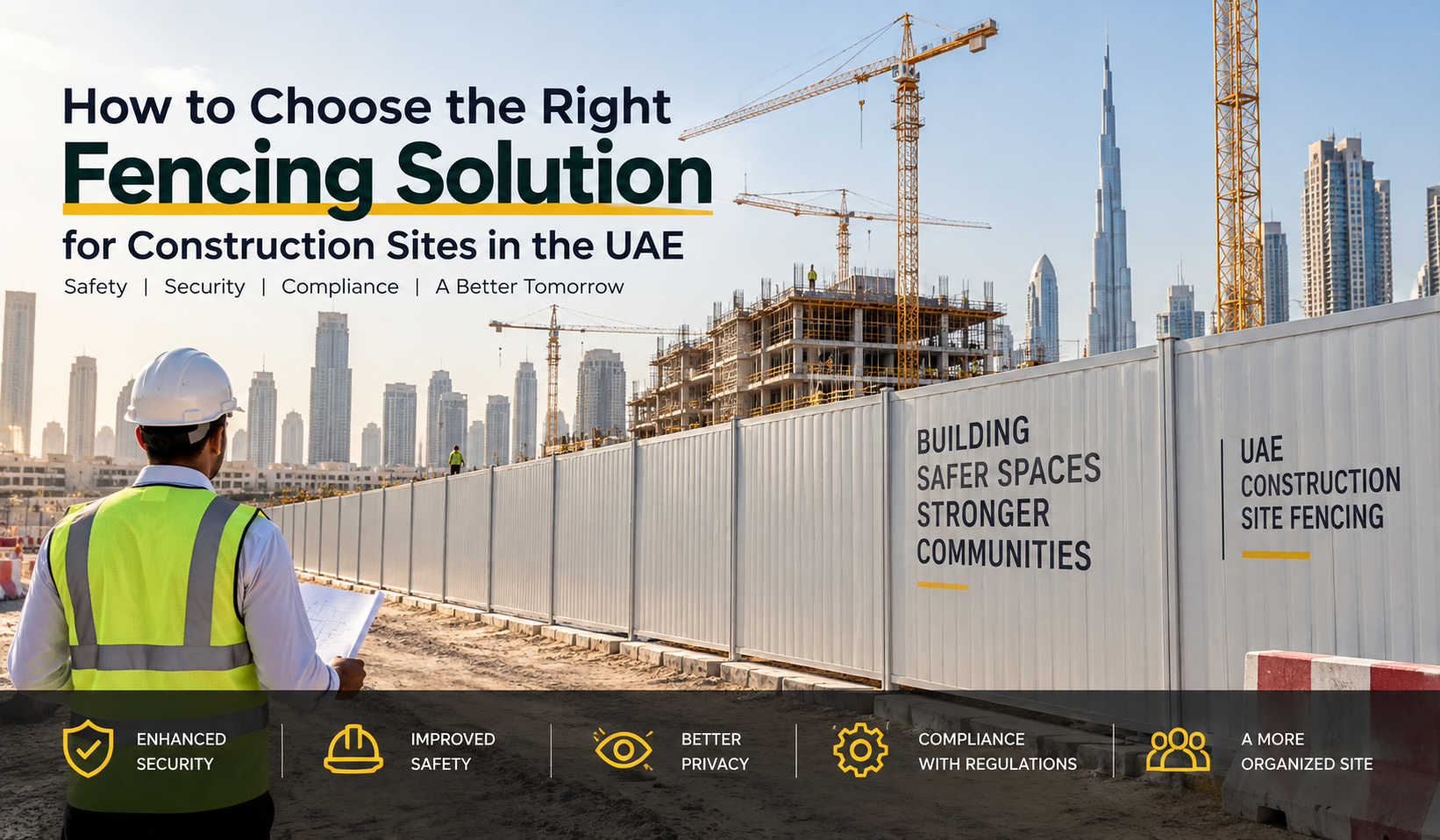
Construction projects in the UAE are often carried out in busy urban areas, commercial districts, residential communities, and industrial zones. With workers, heavy equipment, building materials, delivery vehicles, and members of the public moving around these locations, keeping the site properly enclosed is an important part of project management.
A construction fence is not simply a barrier placed around the edge of a site. It helps establish the project boundary, restrict unauthorized access, improve privacy, and create a safer separation between construction activities and surrounding areas. The right fencing system can also make a site look more organized and professional.
However, there is no single fencing option that works for every construction project. A small residential development may have very different requirements from a large infrastructure project. Factors such as project duration, location, security level, weather exposure, privacy, access requirements, and local regulations all need to be considered before choosing a fencing system.
Here is what contractors, developers, and project managers should consider when selecting construction fencing in the UAE.
Why Is Construction Site Fencing Important?
Construction areas can contain many potential hazards. Open excavations, machinery, electrical equipment, construction materials, and unfinished structures can pose risks to people who are not authorized to enter the site.
A properly installed perimeter fence creates a clear physical boundary between the work area and the surrounding environment. It can discourage trespassing and help control who enters and leaves the project.
Depending on the type of fence selected, it can also provide:
- Better site security
- Privacy from nearby roads and buildings
- Controlled pedestrian and vehicle access
- Protection for construction materials and equipment
- A clear boundary for the project
- Space for safety notices and approved project signage
- A more organized appearance around the construction area
For projects located close to busy roads or public spaces, fencing becomes even more important because construction activities need to be separated from normal public movement.
1. Determine What the Fence Needs to Do
Before comparing materials or requesting quotations, identify the main reason the fence is required.
Some projects primarily need a physical boundary, while others require a stronger security barrier. A development surrounded by residential buildings may need privacy, whereas a site beside a major road may be more concerned with keeping pedestrians away from active work areas.
Ask a few basic questions:
- Is security the main concern?
- Does the site require privacy?
- Will the public be close to the construction work?
- Does the fence need to remain in place for several years?
- Will the boundary change during the project?
- Are vehicles going to enter and leave regularly?
- Will branding or project information be displayed?
Answering these questions makes it much easier to identify a suitable fencing system.
2. Consider How Long the Project Will Last
Project duration has a direct effect on fencing requirements.
For a short-term construction project, a modular temporary fence can be practical because it can be installed quickly and removed when the work is finished. If the site layout changes during construction, panels can also be repositioned where necessary.
Longer projects require more attention to durability. A fence that remains outdoors for months or years needs to withstand the local environment without requiring constant repairs or replacement.
It is also worth considering whether the fencing can be reused. A contractor managing several projects may benefit from a system that can be dismantled, transported, and installed at another location instead of being treated as a one-time purchase.
3. Choose the Right Fencing Material
The material has a major influence on the fence’s strength, appearance, maintenance requirements, and expected service life.
PPGI Fencing
PPGI fencing is commonly considered for temporary construction applications where a solid perimeter is preferred. It can provide privacy and a clear separation between the work area and surrounding locations.
Its solid appearance can also be useful for projects where construction activities, stored materials, or equipment need to be screened from public view.
Steel Fencing
Steel is a suitable choice when strength and security are important considerations. It can be used around industrial facilities, infrastructure projects, construction sites, and other locations where a more robust physical barrier is required.
The exact specification should depend on the site’s conditions rather than simply choosing the heaviest available option.
Chain Link Fencing
Chain link fencing provides a visible boundary without completely blocking the view into or out of the site. This can be useful where supervision and visibility are more important than privacy.
It is often considered for projects where the surrounding environment does not require a solid visual barrier.
PVC Fencing
PVC fencing is another option for applications where appearance and low maintenance are important. Quality PVC systems can be suitable for outdoor environments and can offer resistance to issues commonly associated with exposed metal, such as rust.
The correct choice depends on the project’s purpose, location, expected duration, and required level of protection.
4. Take UAE Weather Into Account
Outdoor fencing in the UAE has to deal with demanding environmental conditions. High temperatures, strong sunlight, dust, humidity, and occasional high winds can all affect materials and supporting components.
This is why a fence should not be selected based solely on its appearance.
Pay attention to:
- Material quality
- Protective coatings
- Corrosion resistance
- UV exposure
- Structural strength
- Quality of posts and supports
- Connection hardware
- Base or anchoring arrangements
A good-quality fence can still perform poorly if it has been installed with inadequate supports. The complete system matters just as much as the individual panel.
5. Don’t Overlook Wind Conditions
Wind can be an important consideration, particularly when using solid fencing.
A solid panel presents a larger surface to the wind than an open mesh fence. If the supporting system is not suitable for the location, strong winds can place considerable stress on the panels, posts, connectors, and bases.
Before installation, consider the site’s exposure and the characteristics of the proposed system.
Depending on the project, the installation may require suitable:
- Base blocks
- Posts
- Anchoring
- Connectors
- Support spacing
- Ground fixing arrangements
The appropriate arrangement should be determined according to the site conditions and relevant technical requirements. Simply selecting a thick panel does not solve every stability problem.
6. Plan the Gates Before Installing the Fence
A construction perimeter needs more than panels. Gates should be planned as part of the overall site layout.
Poorly positioned gates can cause unnecessary traffic problems, particularly when large trucks and construction machinery share the same entrance with workers or pedestrians.
Before installation, identify:
- Main vehicle entrance
- Pedestrian entrance
- Delivery access
- Emergency access requirements
- Security or guard locations
- Gate operating direction
- Areas where vehicles need additional turning space
For larger developments, separate pedestrian and vehicle access can make movement around the site easier to control.
Gate design should also match the type of fencing being used. A strong perimeter with an unsuitable or poorly secured gate can create a weak point in the overall boundary.
7. Check Local Permit and Approval Requirements
Construction fencing can sometimes extend beyond the private boundaries of a project and affect public areas such as pavements, parking spaces, or roads.
In Dubai, for example, the Roads and Transport Authority has a specific service for temporary construction fences that occupy part of the right-of-way. The permit process includes project-related documentation and a layout showing the proposed occupation. Requirements can vary depending on the circumstances of the project.
This is an important point for contractors because installing a fence first and dealing with approvals afterward can lead to unnecessary delays or changes.
Before installation, check which authority has jurisdiction over the site and whether any permits, drawings, inspections, or other approvals are required.
The same principle applies outside Dubai. Requirements can differ between emirates and between different types of construction projects, so the project team should confirm the applicable rules rather than relying on assumptions.
8. Decide How Much Privacy You Need
Privacy is often an overlooked factor when selecting construction fencing.
A site next to a residential neighborhood may need considerably more screening than a site in an isolated industrial area. Similarly, a project in a busy commercial district may benefit from solid panels that hide construction activities and stored materials.
Solid fencing can help create a cleaner appearance around the site and reduce visibility into the work area.
On the other hand, open fencing can be preferable where visibility is useful for security personnel or where there is no particular need to conceal the construction activities.
The goal is to select the level of screening that suits the project instead of automatically choosing either a completely open or completely solid system.
9. Think About Branding and Site Signage
Construction fencing can also become part of a project’s public-facing appearance.
Developers and contractors may use perimeter panels to display approved:
- Project information
- Safety instructions
- Site rules
- Directional signs
- Contractor information
- Development graphics
- Company branding
However, branding and advertising are not necessarily treated in the same way as ordinary construction signage. Depending on the location and type of display, separate permissions may be required.
For this reason, signage should be planned before the fence is installed. The size, position, attachment method, and visibility of signs should be compatible with the fencing system.
10. Look at the Complete Fencing System
One of the biggest mistakes when comparing fencing quotations is focusing only on the panel price.
A construction fence normally consists of several components working together. These can include panels, posts, bases, connectors, gates, supports, and installation hardware.
A quotation should therefore be evaluated based on the complete solution.
For example, two suppliers may offer panels at similar prices, but one quotation may include installation, transportation, gates, and accessories while the other covers only the panels.
Before making a decision, ask what is included in the quoted price.
This helps avoid unexpected expenses later and gives the project team a more accurate idea of the actual cost.
11. Compare Suppliers on More Than Price
Price is naturally important, particularly when a project requires hundreds of meters of fencing. However, choosing a supplier based solely on the lowest quotation can create problems later.
When comparing the Best Fence Suppliers in UAE, contractors should look at the supplier’s product range, manufacturing standards, installation capability, delivery arrangements, previous project experience, and ability to provide support after installation.
A supplier that can provide several related services may also simplify project coordination. Instead of dealing with separate companies for materials, transportation, installation, and relocation, the contractor may be able to manage these requirements through one provider.
It is also useful to ask whether replacement panels and accessories are readily available. Construction sites can be demanding environments, and individual sections may occasionally require repair or replacement.
12. Consider Installation Quality
Even high-quality fencing can cause problems if it is installed incorrectly.
Panels should be properly aligned and connected, gates should operate smoothly, and supports should be suitable for the site conditions. The fence should also follow the approved site layout and remain stable during normal use.
Professional installation can be particularly useful on large projects where hundreds of panels need to be positioned around irregular boundaries, entrances, corners, and changing ground levels.
Before appointing an installer, ask about their experience with similar construction projects and whether installation is included in the overall service.
13. Plan for Fence Shifting
Construction sites rarely remain unchanged from start to finish.
As buildings progress, temporary roads may move, excavation areas may change, and different parts of the site may become active. This can mean that sections of perimeter fencing need to be relocated.
For projects where this is expected, choose a system that can be dismantled and reinstalled efficiently.
It can also be useful to work with a supplier that provides fence-shifting services. This reduces the need to source a new contractor whenever the project layout changes.
Planning for relocation from the beginning can save both time and money over the life of the project.
14. Calculate the Total Cost of Ownership
The cheapest fence at the beginning is not necessarily the cheapest option overall.
The total cost may include:
- Fence panels
- Posts and bases
- Gates
- Transportation
- Installation
- Maintenance
- Repairs
- Relocation
- Removal
- Storage
- Replacement components
For example, a low-cost system that requires frequent repairs may become more expensive than a durable system that performs reliably throughout the project.
When comparing quotations, consider how much the fencing is likely to cost over the entire period it will be used.
This approach provides a more realistic comparison than looking at the price of a single panel.
A Practical Construction Fencing Checklist
Before finalizing a fencing solution, project managers can review the following points:
| Factor | What to Check |
|---|---|
| Project duration | How long will the fence be required? |
| Security | What level of physical protection is needed? |
| Privacy | Is a solid visual barrier required? |
| Material | Is the material suitable for outdoor UAE conditions? |
| Wind exposure | Are supports and bases appropriate for the location? |
| Access | Where will vehicles, workers, and pedestrians enter? |
| Gates | Are the number and size of gates sufficient? |
| Approvals | Are local permits or permissions required? |
| Branding | Will signs or project graphics be displayed? |
| Installation | Who will install the fencing? |
| Relocation | Will panels need to be shifted later? |
| Maintenance | How easy are repairs and replacements? |
| Total cost | What services and accessories are included? |
Why the Right Supplier Makes a Difference
The fencing supplier can have a significant impact on how smoothly the installation process goes.
A reliable supplier should be able to understand the project’s requirements rather than simply supplying standard panels. They should be able to discuss material options, site conditions, access requirements, installation, transportation, and future relocation where necessary.
For contractors working on large or time-sensitive projects, having one experienced provider for multiple fencing requirements can make communication and scheduling considerably easier.
Vertex Fence, for instance, offers a range of fencing products and related services for residential, commercial, industrial, and construction applications. Its product range includes temporary fencing, PPGI fencing, PVC fencing, chain link fencing, aluminum fencing, anti-climb fencing, welded mesh, and other perimeter solutions.
For projects that require manufacturing as well as project-specific fencing support, working directly with a Best Fence Manufacturer in UAE can also provide greater flexibility when discussing specifications, quantities, customization, and installation requirements.
Final Thoughts
Construction fencing should be treated as an important part of site planning rather than an afterthought.
The right system can help establish a secure boundary, manage access, improve privacy, protect construction activities from public interference, and contribute to a more organized work environment. But choosing the right solution requires more than comparing panel prices.
Start by identifying the purpose of the fence and then consider the project’s duration, location, security requirements, privacy needs, weather exposure, access points, and expected changes to the site layout.
Material selection also matters. PPGI, steel, chain link, PVC, and other fencing systems each have different characteristics, making them suitable for different situations. The supporting components and installation method should receive the same attention as the panels themselves.
Most importantly, contractors should check the applicable local authority requirements before installation, particularly when temporary fencing affects public roads, footpaths, parking areas, or other parts of the right-of-way.
By considering the entire fencing system, installation process, future relocation, and total cost of ownership, construction teams can select a solution that is practical for the project today and remains useful as the work progresses.
