
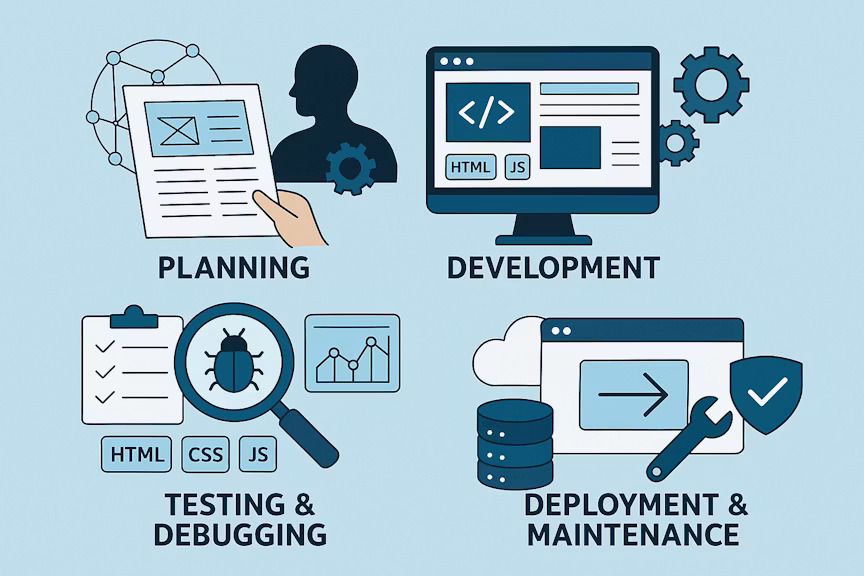
A strong online presence is essential for businesses that want to reach more customers, build credibility, and grow in a competitive digital market. Whether you need a simple business website, an eCommerce store, or a custom web application, professional web development can turn your ideas into a fast, secure, and user-friendly digital experience.
Professional Web Development Services help businesses create websites that are not only visually appealing but also functional, responsive, scalable, and optimized for users and search engines.
In this guide, we will explain what web development is, what web developers do, the technologies used in modern websites, the web development process, and how professional development services can help businesses build a stronger online presence.
What Is Web Development?
Web development is the process of creating, building, testing, deploying, and maintaining websites and web applications. It involves several technologies and skills that work together to deliver a complete online experience.
A website may look simple from the outside, but several components work behind the scenes. These can include frontend code, backend systems, databases, APIs, hosting, security, and performance optimization.
Depending on the project’s requirements, businesses may need:
- Custom website development
- Business website development
- eCommerce development
- WordPress development
- Frontend development
- Backend development
- Full-stack development
- Web application development
The right solution depends on the business goals, target audience, budget, and required functionality.
Why Professional Web Development Services Matter
A website is often the first interaction a potential customer has with a business. A slow, outdated, confusing, or poorly developed website can create a negative impression and make visitors leave.
Professional Web Development Services focus on creating websites that provide a better experience for both users and businesses.
A professionally developed website can help you:
- Build trust and credibility
- Improve user experience
- Reach customers on mobile devices
- Present your products or services effectively
- Generate leads and inquiries
- Support online sales
- Improve website performance
- Create a foundation for SEO
- Integrate third-party tools and services
- Scale as your business grows
Good web development is therefore not only about writing code. It is about solving business problems through technology.
What Does a Web Developer Do?
A web developer is responsible for building and maintaining websites and web applications. Their responsibilities can vary depending on whether they specialize in frontend, backend, or full-stack development.
A web developer may:
- Convert designs into functional web pages
- Write and maintain website code
- Build responsive layouts
- Develop interactive features
- Create APIs
- Connect databases
- Implement authentication systems
- Fix technical issues
- Test websites
- Improve website speed
- Implement security practices
- Maintain existing websites
- Deploy websites to hosting servers
Professional Web Developer Services can be particularly useful for businesses that do not have an in-house development team.
Types of Web Development
Web development can be divided into several areas. Understanding these areas can help businesses choose the right development approach.
Frontend Development
Frontend development focuses on everything visitors see and interact with on a website.
Frontend developers work with technologies such as:
- HTML
- CSS
- JavaScript
- React
- Vue
- Angular
- Tailwind CSS
- Bootstrap
The goal of Frontend Development Services is to create interfaces that are responsive, accessible, visually consistent, and easy to use.
A good frontend should work smoothly across desktops, tablets, and smartphones.
Backend Development
Backend development handles the server-side functionality of a website or application.
Backend developers may work with:
- Node.js
- Express.js
- PHP
- Laravel
- Python
- Django
- Java
- .NET
Backend systems can handle user authentication, databases, APIs, payments, forms, orders, and other business logic.
For businesses with complex requirements, Backend Development Services can provide the functionality needed to support a reliable web application.
Full Stack Web Development
Full-stack development combines frontend and backend development.
A full-stack developer can work on the complete application, from the user interface to the server, database, and APIs.
Full Stack Web Development Services are useful for businesses that need a complete web solution rather than separate frontend and backend teams.
Web Development Technologies
Modern websites can be developed using many different technologies. The right technology depends on the project’s requirements.
HTML
HTML provides the basic structure of a web page. It defines elements such as headings, paragraphs, images, links, forms, and other content.
CSS
CSS controls the appearance and layout of a website. It is used for typography, spacing, colors, responsive layouts, animations, and visual presentation.
JavaScript
JavaScript adds functionality and interactivity to websites. It can be used for dynamic content, forms, menus, interactive components, API communication, and web applications.
Content Management Systems
Content management systems allow businesses to manage website content without editing code for every change.
WordPress is one of the most widely used CMS platforms and can be suitable for blogs, business websites, portfolios, service websites, and many eCommerce projects.
For businesses that want an easy-to-manage website, WordPress Web Development Services can provide a flexible solution tailored to their requirements.
Databases
Web applications often need to store information such as customers, products, orders, accounts, or other business data.
Common database technologies include:
- MySQL
- PostgreSQL
- MongoDB
- Microsoft SQL Server
The database is usually connected to the backend so information can be securely stored and retrieved.
The Web Development Process
Professional development requires a structured process. A clear workflow helps reduce errors, improve communication, and ensure that the final website meets business requirements.
1. Requirement Analysis
The first step is understanding the business and its objectives.
This includes identifying:
- Business goals
- Target audience
- Required pages
- Website features
- Content requirements
- Technical requirements
- Budget and timeline
Understanding these requirements before development begins helps create a more effective solution.
2. Planning and Research
After gathering requirements, the development team plans the website structure and technology stack.
Research may include competitor websites, industry trends, user expectations, and technical requirements.
This stage creates a roadmap for the project.
3. UI/UX Design
Design determines how the website looks and how visitors interact with it.
The design process may include:
- Wireframes
- Page layouts
- Typography
- Color systems
- Navigation
- User flows
- Responsive designs
Good design and development should work together to create a consistent user experience.
4. Development
Once the structure and design are approved, developers begin building the website.
Depending on the project, this may involve frontend development, backend development, database integration, APIs, CMS configuration, and third-party integrations.
5. Responsive Development
Today, a large percentage of website visitors use smartphones and tablets.
Responsive Web Development Services focus on making websites adapt to different screen sizes and devices.
A responsive website should provide a smooth experience across:
- Mobile phones
- Tablets
- Laptops
- Desktop computers
6. Testing
Testing is an important part of professional website development.
Developers may test:
- Forms
- Buttons
- Navigation
- Links
- Mobile responsiveness
- Browser compatibility
- Website speed
- Database functionality
- Authentication
- Security
Testing helps identify and resolve issues before the website reaches its users.
7. Deployment
After testing is complete, the website is deployed to a hosting environment.
This may involve:
- Hosting configuration
- Domain connection
- SSL setup
- Database configuration
- Server settings
- Production deployment
The website is then made available to the public.
8. Maintenance
A website needs ongoing maintenance after launch.
Maintenance can include:
- Security updates
- Bug fixes
- Software updates
- Backups
- Performance improvements
- Content updates
- New features
Ongoing maintenance helps keep a website reliable and secure.
Custom Web Development Services for Businesses
Every business has different requirements. A standard template may work for some companies, but others need functionality that cannot easily be achieved with an off-the-shelf solution.
Custom Web Development Services allow businesses to create websites and applications based on their specific goals.
Custom development may be useful for:
- Unique business workflows
- Custom dashboards
- Customer portals
- Booking systems
- Membership platforms
- Business management systems
- API integrations
- Custom eCommerce functionality
- Internal web applications
The advantage of custom development is flexibility. Features can be designed around the business rather than forcing the business to adapt to a fixed website structure.
Business Website Development
A professional business website should clearly communicate what a company offers and make it easy for visitors to take action.
Business Website Development can include pages such as:
- Home
- About
- Services
- Products
- Portfolio
- Testimonials
- Blog
- Contact
Depending on the business, additional functionality such as contact forms, appointment booking, live chat, maps, payment systems, or customer portals may also be required.
A business website should have clear navigation, strong calls to action, fast loading times, and a mobile-friendly design.
eCommerce Web Development Services
For businesses selling products online, an eCommerce website needs more than attractive product pages.
eCommerce Web Development Services can include:
- Product catalogs
- Shopping carts
- Checkout systems
- Payment gateway integration
- Customer accounts
- Order management
- Inventory functionality
- Product filters
- Shipping integration
- Promotional features
Security and usability are especially important for eCommerce websites because customers need to feel comfortable browsing, purchasing, and providing information.
WordPress Web Development Services
WordPress can be an effective choice for businesses that want a flexible content management system.
WordPress Web Development Services can include:
- Business websites
- Service websites
- Blogs
- Portfolio websites
- WooCommerce stores
- Landing pages
- Custom WordPress functionality
- Theme customization
- Plugin integration
- Website maintenance
The platform can be customized according to a business’s branding, functionality, and content requirements.
Website Design and Development Services
Design and development should not be treated as completely separate processes.
Website Design and Development Services combine visual design with technical implementation to create a complete website experience.
A successful website should balance:
- Visual appeal
- Usability
- Performance
- Responsiveness
- Accessibility
- Functionality
- Brand consistency
- Search engine considerations
A beautiful website that is difficult to use will not perform well. Similarly, a technically functional website with poor design may fail to engage visitors.
What Makes a Good Website?
A high-quality website should provide value to both visitors and the business.
Important characteristics include:
Fast Performance
Visitors expect websites to load quickly. Unnecessary scripts, large images, poor hosting, and inefficient code can negatively affect performance.
Mobile Responsiveness
The website should work properly across different screen sizes and devices.
Easy Navigation
Visitors should be able to find important information without confusion.
Clear Calls to Action
Buttons such as “Contact Us,” “Get a Quote,” “Buy Now,” or “Book a Service” can guide visitors toward the next step.
Security
Websites should use appropriate security measures, including HTTPS, secure authentication, software updates, and reliable hosting practices.
Scalability
A website should be capable of supporting future growth. Businesses may eventually need additional pages, features, integrations, or users.
Web Development and SEO
Web development and SEO are closely connected.
While SEO involves much more than development, technical implementation can affect how easily search engines and users can access a website.
A developer can support SEO by creating:
- Mobile-friendly pages
- Fast-loading websites
- Clean website structures
- Crawlable navigation
- Proper HTML structure
- Search-engine-friendly URLs
- Secure HTTPS connections
- Optimized images
- Structured data where appropriate
SEO should ideally be considered during development rather than added as an afterthought.
How to Choose a Web Development Agency
Choosing the right Web Development Agency is an important decision because the quality of development can affect your website’s performance and long-term maintenance.
Before hiring an agency or developer, consider:
Portfolio
Review previous projects to understand their design and development capabilities.
Technical Expertise
Make sure the developer or agency has experience with the technologies required for your project.
Communication
Clear communication helps prevent misunderstandings and keeps the project moving efficiently.
Development Process
Ask how the agency handles planning, design, development, testing, deployment, and maintenance.
Support
Find out whether post-launch support and maintenance are available.
Business Understanding
A good developer should understand your business goals rather than focusing only on technical implementation.
Affordable Web Development Services
Cost is an important factor for many businesses, but the cheapest option is not always the best option.
Affordable Web Development Services should provide a reasonable balance between cost, quality, functionality, and long-term value.
Before comparing prices, consider:
- Required features
- Website size
- Design complexity
- Technology stack
- Integrations
- Security requirements
- Maintenance
- Hosting
- Future scalability
A website should be viewed as an investment in your business rather than simply an expense.
Web Application Development Services
Websites primarily provide information and services to visitors, while web applications often provide interactive functionality.
Examples of web applications include:
- Customer portals
- Online booking systems
- Project management platforms
- Learning management systems
- Business dashboards
- Inventory systems
- SaaS platforms
Web Application Development Services can help businesses build custom solutions that automate processes and provide users with interactive tools.
How to Become a Web Developer
If you are interested in web development as a career, you can start by learning the fundamentals and gradually building more advanced skills.
A common learning path is:
Step 1: Learn HTML and CSS
Understand how websites are structured and styled.
Step 2: Learn JavaScript
Learn how to add functionality and interactive behavior.
Step 3: Learn Git and GitHub
Version control is an important part of modern development workflows.
Step 4: Choose a Specialization
You can focus on frontend, backend, or full-stack development.
Step 5: Learn Frameworks and Tools
Depending on your career goals, you might learn technologies such as React, Node.js, Laravel, Django, or other frameworks.
Step 6: Build Real Projects
Create websites and applications that demonstrate your skills.
Step 7: Create a Portfolio
A portfolio helps employers and clients understand what you can build.
Web Development Career Paths
Web development provides several career opportunities.
Common roles include:
- Frontend Developer
- Backend Developer
- Full-Stack Developer
- WordPress Developer
- eCommerce Developer
- Web Application Developer
- UI Developer
- Software Developer
- Freelance Web Developer
- Web Development Consultant
Developers can work with technology companies, digital agencies, startups, eCommerce businesses, or directly with clients.
The Future of Web Development
Web development continues to evolve as businesses adopt new technologies and users expect faster and more personalized digital experiences.
Artificial intelligence is increasingly being used for development assistance, testing, automation, and software workflows. Cloud computing, APIs, modern JavaScript frameworks, serverless technologies, and advanced web applications are also shaping the industry.
For businesses, this means websites are becoming more than digital brochures. They can serve as sales platforms, customer service tools, business systems, and complete digital products.
For developers, continuous learning is becoming increasingly important.
Frequently Asked Questions
What is web development?
Web development is the process of building, testing, deploying, and maintaining websites and web applications using programming languages, frameworks, databases, and other technologies.
What does a web developer do?
A web developer creates and maintains websites and web applications. Their responsibilities may include coding, testing, database integration, API development, security, performance optimization, and maintenance.
How much do web development services cost?
The cost depends on the project’s requirements, number of pages, design complexity, functionality, integrations, technology, and maintenance needs. A simple business website will generally require less development work than a custom web application or large eCommerce platform.
What is custom web development?
Custom web development involves creating a website or application specifically around a business’s requirements instead of relying entirely on a pre-built solution.
Is WordPress suitable for business websites?
WordPress can be suitable for many business websites because it provides a content management system that allows businesses to manage and update their content. Its suitability depends on the project’s requirements.
Why is responsive web development important?
Responsive development ensures that a website adapts to different screen sizes and provides a usable experience on smartphones, tablets, laptops, and desktop computers.
What is the difference between frontend and backend development?
Frontend development focuses on the user-facing part of a website, while backend development handles server-side functionality, databases, APIs, authentication, and application logic.
Should I hire a web developer or a web development agency?
The right choice depends on your project. A freelancer or individual developer may be suitable for smaller projects, while a Web Development Agency can be useful for larger projects that require multiple skills, ongoing support, or a broader development team.
Conclusion
Web development is an essential part of building a successful online presence. From simple business websites to complex web applications, the right development approach can improve user experience, performance, functionality, and long-term scalability.
Professional Web Development Services can help businesses create responsive, secure, and effective digital experiences tailored to their goals. Whether you need Custom Website Development, Business Website Development, eCommerce Web Development Services, WordPress Web Development Services, Frontend Development Services, Backend Development Services, or Full Stack Web Development Services, choosing the right technology and development process is important.
A successful website is not simply about how it looks. It should be fast, easy to use, mobile-friendly, secure, scalable, and aligned with the needs of its users and business.
As technology continues to evolve, businesses that invest in a strong digital presence can create better opportunities to connect with customers, generate leads, sell products, and grow online.

