You wash your face twice a day. You avoid oily creams. You buy products labelled “acne control.” Yet the blackheads keep returning, the T-zone becomes shiny by afternoon, and new breakouts seem to appear without an invitation.
The problem is not always that you are cleansing too little.
Sometimes, you are simply using the wrong type of cleanser for the problem inside your pores.
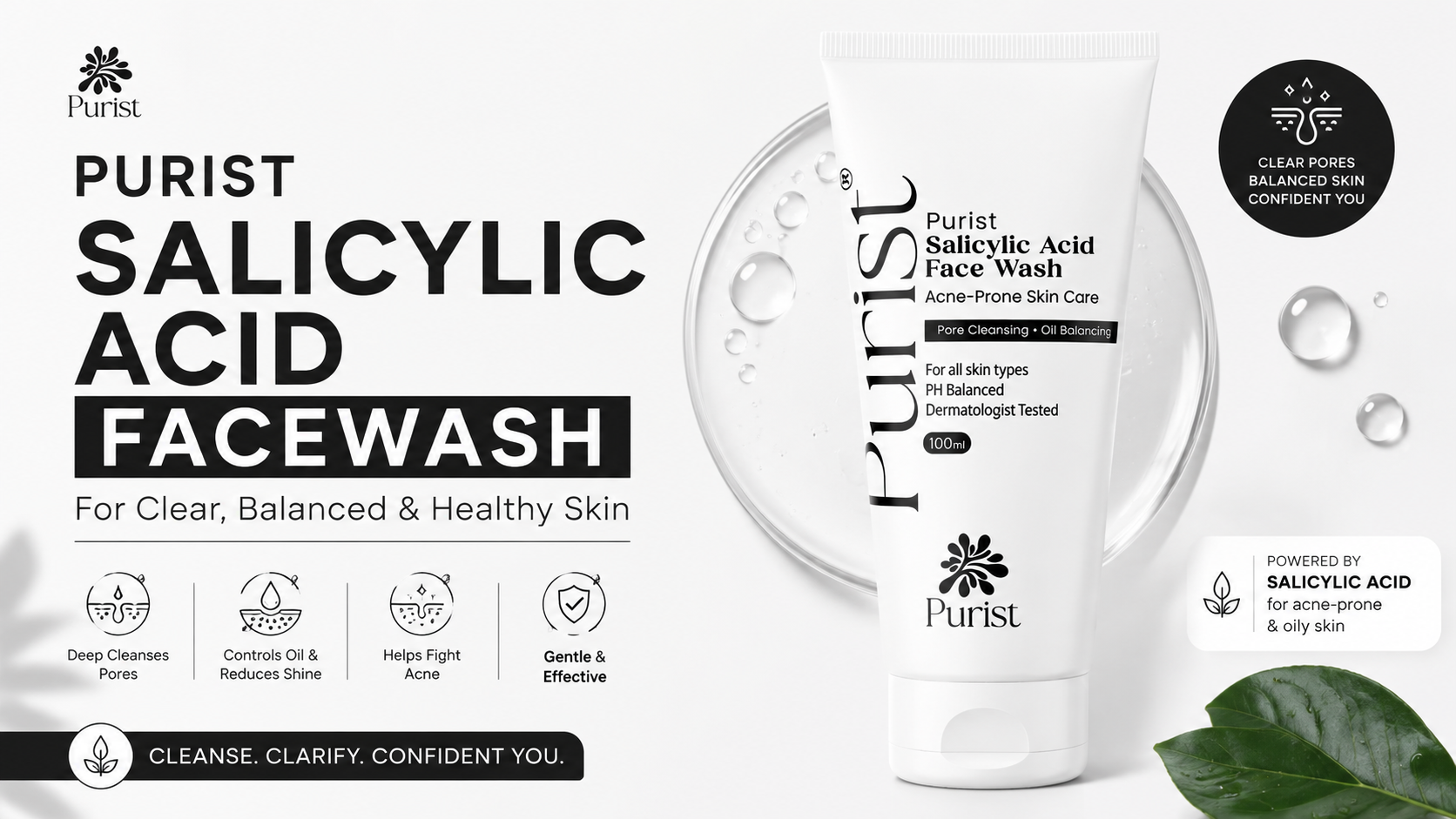
This is where a Salicylic Acid Face Wash can make sense.
Unlike a basic face wash that mainly removes sweat, sunscreen, dirt and surface oil, salicylic acid is particularly useful when your skin’s biggest issue is pore congestion. Think of clogged pores as the starting point of a traffic jam: oil, dead skin cells and debris slowly build up, and eventually blackheads, whiteheads or breakouts can follow.
But there is an important catch: salicylic acid is not a magic ingredient for every type of acne, and using it incorrectly can make your skin feel worse rather than better.
Let’s look at what it actually does and, more importantly, when it is worth using.
The Acne Problem Often Starts Before You See a Pimple
Most people start treating acne when a visible pimple appears.
By that stage, however, changes may already have been happening inside the pore.
Skin naturally produces sebum, an oily substance that helps support the skin barrier. Skin cells also naturally shed. Problems can develop when excess sebum and dead skin cells collect around the pore instead of clearing away efficiently.
That congestion may remain invisible at first.
Then it can develop into:
- Small bumps
- Blackheads
- Whiteheads
- Enlarged-looking pores
- Inflamed breakouts
This is why simply washing your face harder does not necessarily solve acne.
In fact, aggressive cleansing can create another problem: irritation.
The goal is not to attack the skin. The goal is to manage the buildup that contributes to clogged pores without turning your face into a desert.
Why Salicylic Acid Has a Different Job From an Ordinary Cleanser
Not all cleansing ingredients work in the same way.
Some cleansers are primarily designed to lift surface impurities away from the skin. That is useful, of course, but surface cleansing is only one part of managing oily and congestion-prone skin.
Salicylic acid belongs to a group of ingredients known as beta hydroxy acids, or BHAs.
Its important characteristic is that it is oil-soluble.
That makes it particularly relevant to oily areas and congested pores. Rather than acting only like a soap that washes the surface, salicylic acid helps loosen the buildup of dead skin cells and oil around the pore environment.
That is why people commonly look for a salicylic acid face wash when dealing with:
- Recurring blackheads
- An oily forehead or nose
- Congested skin
- Small acne bumps
- Whiteheads
- Frequent pore blockage
In simple terms, a basic cleanser cleans the street. Salicylic acid is more focused on the traffic building around the entrance.
Is Your Acne Actually the Type Salicylic Acid Can Help With?
This is a question many skincare articles skip.
Not every breakout has the same cause, and not every acne treatment works equally well for every person.
A salicylic acid face wash may be particularly useful when your skin concerns include oil and congestion.
It May Be a Good Match If Your Skin Has Lots of Blackheads
Blackheads form when a pore becomes blocked and the material at the opening reacts with air.
They are especially common around the nose, chin and forehead.
Because salicylic acid supports exfoliation and helps address pore buildup, it can be a useful ingredient for a routine focused on recurring blackheads.
It May Help If Your Face Gets Oily Soon After Cleansing
If your skin develops visible shine during the day and you frequently experience clogged pores, an appropriately formulated salicylic acid cleanser may be worth considering.
However, oily skin should not be stripped aggressively. A tight, squeaky-clean feeling is not necessarily a sign that your skin is healthier.
Sometimes it is a sign that your cleanser is simply too harsh.
It May Be Useful for Small, Repeated Breakouts
When breakouts repeatedly appear in areas affected by congestion, keeping the pores clearer may help support better skin management over time.
But if you have severe, painful, deep or widespread acne, relying on a face wash alone may not be enough.
That is a situation where professional dermatological advice can be more useful than endlessly buying stronger products.
The Biggest Mistake: Treating Salicylic Acid Like a Stronger Soap
This is where many people go wrong.
They think:
“My acne is bad, so I should wash more.”
Then they use the cleanser morning and night, scrub aggressively, add a serum, add a peeling solution and wonder why their skin suddenly feels angry.
Skincare has a strange sense of humour. Sometimes the harder you fight your skin, the more dramatic it becomes.
Salicylic acid is not about maximum force. It is about appropriate use.
If you are new to the ingredient, start gradually and observe your skin.
You do not need a complicated ritual. You need consistency and a routine your skin can actually tolerate.
A Smarter Way to Introduce a Salicylic Acid Face Wash
Instead of immediately changing your entire routine, make one change at a time.
Week One: Keep Things Simple
Use the cleanser according to the product directions and pay attention to how your skin feels afterwards.
Does your skin feel comfortable?
Does it feel unusually dry?
Do you notice persistent stinging or irritation?
Your skin’s response matters more than copying somebody else’s 12-step routine from social media.
Week Two and Beyond: Adjust Based on Tolerance
If your skin remains comfortable, you can continue using the product as appropriate for your skin type and the manufacturer’s instructions.
If dryness or irritation appears, reduce how frequently you use it.
The objective is not to use the maximum amount possible. The objective is to find a sustainable routine.
What Should You Apply After a Salicylic Acid Face Wash?
This is another area where acne routines often become unnecessarily complicated.
After cleansing, the skin still needs support.
A simple routine may include a suitable moisturizer. People with oily skin often avoid moisturizers because they assume hydration will make them shinier.
That is not necessarily true.
The key is choosing a product with a texture and formulation appropriate for your skin.
During the daytime, sunscreen should also be part of your routine.
A basic structure can look like this:
Morning: Cleanse → Moisturize if needed → Sunscreen
Evening: Cleanse → Appropriate treatment if used → Moisturize
You do not need ten products competing for space on your bathroom shelf.
Sometimes a shorter routine is easier to follow and easier to evaluate.
What Not to Do When Using Salicylic Acid
A good skincare ingredient can still become part of a bad routine.
Avoid these common mistakes.
Do Not Scrub Your Face Like You Are Cleaning a Frying Pan
Physical scrubbing can irritate acne-prone skin.
Apply your cleanser gently. Friction does not equal effectiveness.
Do Not Add Every Acne Ingredient on the Same Day
Starting a salicylic acid cleanser, retinoid, exfoliating toner and strong treatment at the same time is a terrible experiment if you want to know what your skin can tolerate.
Introduce products gradually.
Do Not Judge the Product After Two Washes
Acne and congestion do not usually develop overnight, and they rarely disappear overnight.
Give your routine reasonable time while monitoring for irritation.
Do Not Ignore Persistent Skin Problems
If acne is painful, severe, leaving scars or affecting your wellbeing, professional guidance is more valuable than repeatedly switching between products.
How to Choose a Salicylic Acid Face Wash in Pakistan
The best choice is not automatically the product with the loudest claim on the packaging.
When comparing a salicylic acid face wash in Pakistan, think about your actual skin concern.
Ask yourself:
Do I mainly have excess oil?
Are blackheads my biggest problem?
Is my skin sensitive as well as acne-prone?
Am I already using other active ingredients?
Can I realistically use this product consistently?
Also consider the overall formula rather than focusing only on one headline ingredient.
A cleanser should fit into your routine without forcing you to compensate for excessive dryness or irritation.
For someone with oily, congestion-prone skin, the ideal product may be different from what works for someone with dry skin and occasional hormonal breakouts.
There is no universal “best” face wash for every face.
And honestly, any article claiming there is probably deserves a raised eyebrow.
Salicylic Acid Face Wash vs Acne Face Wash: Are They the Same Thing?
Not necessarily.
“Acne face wash” is a broad category.
An acne cleanser might contain different ingredients depending on what the product is designed to address. Some focus on bacteria-related acne concerns, while others target excess oil, dead skin cell buildup or clogged pores.
Salicylic acid face wash is more specific.
It is generally chosen because salicylic acid can support exfoliation and help manage pore congestion.
That makes it particularly relevant for people dealing with blackheads, whiteheads and oily skin.
The best ingredient depends on the problem you are trying to solve.
How Long Does It Take to Notice a Difference?
There is no honest universal timeline.
Skin response depends on your individual skin, the nature of your breakouts, your complete routine and how consistently you use the product.
Some people may notice their skin feels cleaner or less congested relatively quickly.
Improvement in recurring acne and blackheads may take longer.
The important thing is to avoid constantly switching products every few days. At the same time, do not continue using a product that is clearly causing significant irritation.
Skincare works best when you pay attention rather than blindly following trends.
Frequently Asked Questions
Can I use salicylic acid face wash for oily skin?
Yes, it can be particularly relevant for oily skin because it is commonly used in routines targeting excess oil and clogged pores. Start according to the product instructions and adjust if your skin becomes irritated.
Is salicylic acid face wash good for blackheads?
It may help support blackhead management by addressing pore congestion and dead skin cell buildup.
Should I use it every day?
That depends on your skin’s tolerance and the specific product. Some people tolerate regular use well, while others need to start less frequently.
Can I use moisturizer after washing my face?
Yes. Moisturizing can be an important part of maintaining a balanced skincare routine, including for oily skin.
What if my skin starts burning or peeling?
Stop or reduce use and avoid continuing to irritate your skin. If symptoms are severe or persistent, seek advice from a qualified healthcare professional.
The Bottom Line
A salicylic acid face wash is not simply a “strong acne face wash.”
Its real value is more specific: it can help people dealing with excess oil, clogged pores, blackheads, whiteheads and congestion by supporting exfoliation during the cleansing step.
But better results do not come from using more and more products.
They come from understanding what your https://www.localhomeservicesblog.co.uk/ skin is actually dealing with.
If your problem is congestion, salicylic acid may have a useful place in your routine. If your skin is becoming dry, irritated or inflamed, pushing harder is rarely the answer.
Choose a well-formulated cleanser, introduce it thoughtfully and give your skin some breathing room.
Clearer-looking skin is usually built through consistency, not chaos.