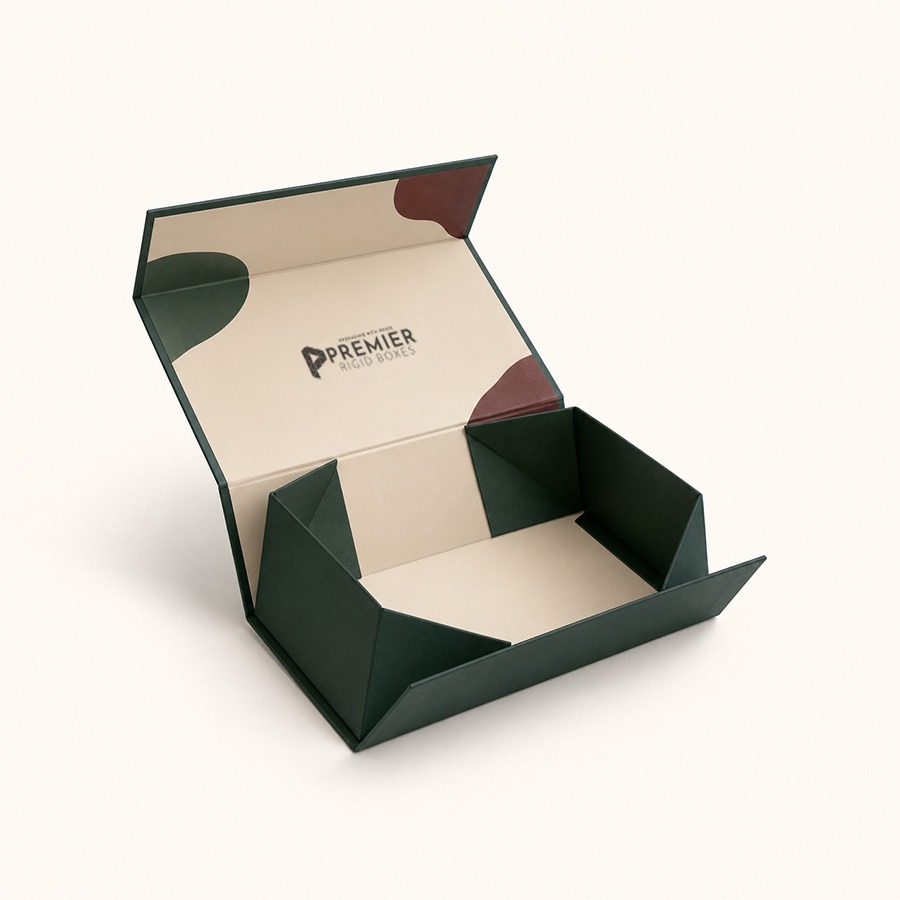
It doesn’t seem to make sense. How can one fold flat and still feel as high-quality as a rigid box? So, the solution is ingenious design. A collapsible box is designed to go flat for shipping and instantly be transformed into a solid, high-quality box in seconds. They do it all, and they don’t throw the luxury option out the window.
They solve the Puzzle, and it is your turn.
Begin by stating why this appears to be impossible. A “regular” hard box is intentionally stiff, and stiffness typically means it cannot be folded.
A thick, inflexible board is used to create rigid boxes, which is why they feel good. However, this rigidity usually also means that the box will retain its shape indefinitely and will ship bulky. A rigid box that is collapsible must maintain the stiffness and high quality of the rigid panels while still folding down flat.
The trick is to marry:
- Stiff premium panels.
- An envelope-shaped box that folds in the same plane as its width.
- An easy and strong build.
That’s precisely what collapsible construction is all about.
Rigid Panels, Flexible Joints,
The central concept is as follows. The panels remain stiff, but the joins between them move. This is the top secret.
Both sides of the box are made of stiff, wrapped rigid panels, similar to a typical box. The changes are in how those panels are joined. They are not glued into any permanent shape – they are joined at points which allow the box to collapse flat and then open again.
The construction works because it employs:
- Rigid panels for the high-end look.
- Flexible hinges where they meet.
- A structure that folds at the joints.
By holding the panels rigid and allowing only the joints to move, you get both qualities simultaneously.
What Is The Folding?
Consider the motion itself. A box folds along the hinges and collapses in a flat manner like a folded map, and then springs back up to a box.
Flat, the rigid panels can almost be compressed against one another. It is used by folding up along the hinges, and the box assumes its full shape. Magnetic closures or locking tabs then keep it secure, making it feel like it’s like a box for good.
The folding is done in simple steps:
- Panels are flat for shipping.
- They can fold up with hinges.
- Shape is closed by closures.
The appeal is that it is flat when it’s not needed and solid when it is needed.
What makes it so expensive?
The next, and most crucial part, is that this is where many people get into trouble. When put together, a foldable box provides the same feel and quality as a standard, non-collapsible box.
The same thick board and wrapped printed paper are used for the panels as for any rigid box. Weight, finish, and good overall feel are present. The difference is only at the folded edges, so the customer with the finished box can’t tell it was ever folded flat.
The superior feel is maintained as it retains:
- The same thickness of board.
- Wrapped finish is the same.
- Equal solid mass.
The folding is never seen in the finished box and is never damaged.
The Closures Do Important Work
Consider how it is held together. Closed boxes are more than just something to look at—they help create a sense of solidity and permanence when the box is folded.
A good collapsible rigid box will not feel flimsy or loose because the magnetic closures securely hold it open. Folding lids and locking tabs perform similar functions. The collapsible rigid boxes are an essential component of the premium feel, unlike a fold-up carton.
Closures are important because they:
- Press the box to keep it in shape.
- Don’t let it lose; loosen it up.
- Enhance the high-quality ambiance.
Good closures make a folding construction a solid box.
What is the source of the savings?
Think payoff, as the neat build is for a reason. The box ships and stores flat, which will save real money in shipping and storage.
A flat box requires much less space than a formed box, and many more of them fit in a shipping carton or occupy shelf space in a warehouse. That equates to reduced freight costs and storage space. The engineering behind the hinges and closures all exists to unlock this saving.
In the flat form, the potential savings are achieved through:
- Fitting more per shipment.
- Saving storage.
- Cutting freight costs.
The entire smart arrangement is worthwhile due to reduced shipping and storage expenses.
The Small Trade-Off
The real scoop is, there is one, but here it is. A collapsible box must be folded before use, whereas a standard box is ready to use.
This assembly, for most brands, takes only seconds per box and is painless. However, if you are entering extremely high volumes by hand, that small step can add up in man-hours. This is a good trade, but not something to be taken aback by.
What you need to keep in mind is that:
- Boxes are not packed in a cuboid shape.
- Assembling only takes a few seconds.
- It makes a difference when you multiply Volume.
The savings with almost all brands is much greater than the fast fold.
Final Thoughts
A clever construction of rigid panels and flexible hinges makes a collapsible rigid box flat and maintains premium quality through folding: rigid panels connect to each other with flexible hinges. The panels provide a solid, high-end look, and the joints allow the entire box to fold flat for shipping and then open up in seconds.
Since the panels are identical in the board, wrap, and finish to a normal rigid box, the finished product feels the same, and the folding is entirely concealed. The shape is firm and remains so with good closures, so that it does not feel floppy.
All this with only one fast assembly step in exchange, to save on shipping and storage, while retaining that premium appearance. The design is intelligent; it offers luxury packaging while reducing costs.