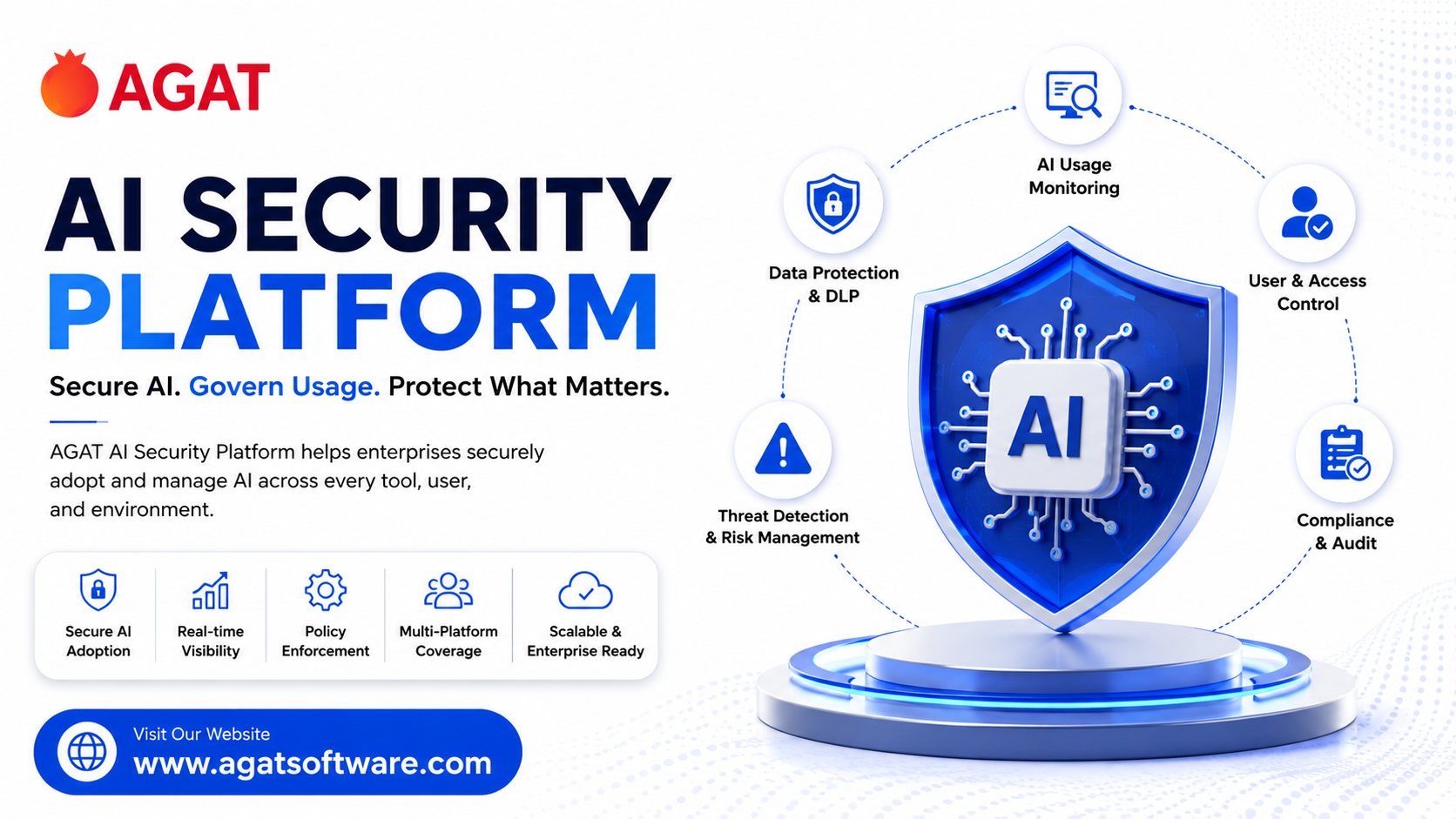
Quick Answer: An AI security platform gives enterprises a dedicated control layer for AI use, protecting prompts, models, agents, and business data in real time. For a furniture business, this can help secure customer service, product search, design tools, and internal workflows while reducing data leakage, unsafe AI actions, and unmanaged AI use.
Artificial intelligence is moving from an optional productivity tool to part of everyday enterprise operations. In a US furniture business, AI may help customers choose the right sofa, generate product descriptions, analyse sales data, support merchandising teams, answer supplier questions or power internal search. The opportunity is substantial, but so is the security surface.
Traditional cybersecurity still matters, but it was not designed around systems that interpret natural-language instructions, generate content and, increasingly, take actions through connected tools. NIST’s Generative AI Profile recommends managing generative AI risks across its lifecycle, while the 2025 OWASP Top 10 for LLM and GenAI applications places prompt injection, sensitive information disclosure and excessive agency among the risks organisations need to address.
That is why an ai security platform is becoming a practical part of enterprise cybersecurity strategy. Instead of treating AI as just another application, security teams can apply controls to the prompts, models, agents, data and access paths that make AI useful.
What Is an AI Security Platform?
An ai security platform is a security and governance layer built specifically for AI systems. It can monitor AI traffic, inspect prompts and responses, apply policies, control access to models and services, protect sensitive information, assess model risk and provide audit visibility.
The goal is not necessarily to stop employees from using AI. A better approach is controlled enablement: allow useful AI activity while putting clear boundaries around what users and agents can access, share and do.
For example, a furniture manufacturer could permit an AI assistant to summarise approved product specifications, but prevent it from sending confidential supplier pricing to a public model. A retailer could allow an agent to help draft customer responses while requiring approval before it changes an order or accesses restricted customer records.
Why Enterprise Cybersecurity Needs an AI-Specific Layer
AI changes the relationship between users, data and applications. A conventional application generally follows defined workflows. An AI system can interpret unstructured input and decide what information or tool it needs next. When connected to business systems, that flexibility can create new paths to sensitive data or business actions.
| Traditional Security Focus | AI-Specific Concern | Useful Control |
| Network and endpoints | AI traffic across public and internal services | AI gateway and traffic visibility |
| Identity and access | Agents acting with delegated permissions | Agent identity, scoped access and runtime policy |
| Data loss prevention | Sensitive data entered into prompts | Prompt inspection, classification and redaction |
| Application security | Prompt injection and unsafe outputs | Prompt injection protection and output controls |
| Software supply chain | Untrusted or poorly assessed models | AI model protection and model risk assessment |
How an AI Security Platform Protects the AI Attack Surface
1. Prompt Injection Protection
Prompt injection happens when crafted instructions manipulate an AI system into ignoring intended rules or performing an unintended task. OWASP lists prompt injection as LLM01 in its 2025 Top 10. The risk becomes more serious when an AI agent can access files, APIs, customer records or other business tools.
A mature ai security platform can inspect prompts and AI interactions, identify risky content and enforce policies before an unsafe request reaches the model or connected workflow. For a furniture company, that could mean blocking an attempt to make a product-support agent reveal internal instructions or use a connected tool outside its permitted purpose.
The important point is that prompt injection protection should sit alongside identity, permissions, data controls and monitoring. No single filter should be treated as a complete defence.
2. AI Model Protection and Trust
Models are another part of the supply chain that deserves scrutiny. Enterprises may use commercial models, open-source models, fine-tuned models or local models. Each can carry different licensing, provenance, vulnerability and behavioural considerations.
AI model protection can include model inventory, provenance checks, static analysis, security testing and red teaming before a model is approved. AGAT’s Model Guardian, for example, describes a risk engine that evaluates models using source intelligence, static analysis and dynamic red teaming.
For a furniture enterprise, this is particularly useful when an internal AI application is connected to product data, pricing logic or operational systems. The model should be evaluated before it is trusted with those responsibilities.
3. The Role of an Enterprise AI Gateway
An enterprise ai gateway provides a central control point between applications, users or agents and AI providers. Instead of allowing every application to connect independently to multiple models, organisations can route AI traffic through a governed layer.
This improves visibility and makes policy enforcement more consistent. AGAT states that its AI Gateway can route AI API traffic through a single gateway while tracking usage, cost, providers and policy controls.
Imagine a furniture retailer using several AI services for customer support, marketing and analytics. A central gateway can help security and IT teams understand which teams are using which models, apply access rules and monitor consumption without rebuilding controls separately for every application.
4. Private AI for Sensitive Business Workloads
A private ai platform can be valuable where an organisation needs tighter control over data and deployment. Instead of sending sensitive information to a public AI service, businesses can run AI within approved infrastructure, such as on-premises or a controlled private cloud environment.
For furniture businesses, sensitive workloads might include supplier agreements, wholesale pricing, product-development documents, customer information, employee records or unreleased collections. A private deployment can help keep those workloads inside a controlled environment while still enabling useful AI capabilities.
Private AI is not a replacement for security controls. It should still have access policies, monitoring, data classification, model governance and clear ownership.
5. AI Agent Risk Management
AI agents introduce a different level of risk because they can perform actions rather than simply return answers. An agent might search a catalogue, update a CRM record, create a support ticket, call an API or trigger a workflow.
That makes ai agent risk management an important part of enterprise security. Organisations should know which agents exist, who owns them, what tools they can access, what permissions they have and which actions require approval.
AGAT’s Guardian Agent is designed around agent discovery, activity monitoring, policy enforcement and runtime controls. The broader principle is simple: an autonomous system should have no more authority than it needs.
Practical Furniture Industry Use Cases
The furniture sector has a wide range of AI use cases, from customer-facing recommendations to internal operations. Security controls should be designed around the value and sensitivity of each workflow.
| Furniture Use Case | Sensitive Area | Security Priority |
| AI product recommendations | Customer preferences and product data | Protect personal data and enforce approved data access |
| Customer service assistants | Orders, returns and customer conversations | Limit data exposure and require controls for sensitive actions |
| Product content generation | Specifications, descriptions and images | Validate outputs and restrict access to unreleased product information |
| Supplier and procurement analysis | Pricing, contracts and forecasts | Use private or governed AI for confidential documents |
| Internal knowledge assistants | Policies, manuals and business documents | Apply role-based access and data classification |
| AI-powered sales agents | CRM, inventory and customer workflows | Use runtime controls and approval for consequential actions |
A Practical AI Security Framework for Enterprises
A strong programme does not begin with buying a tool. Start by mapping how AI is actually being used, then apply controls according to risk.
- Inventory AI tools, models, agents, APIs and business owners.
- Classify the data each AI workflow can access or receive.
- Separate public AI use from sensitive or private workloads.
- Put high-value AI traffic behind an enterprise ai gateway where appropriate.
- Deploy prompt inspection and prompt injection protection for exposed workflows.
- Assess models before approving them for production use.
- Limit agent permissions and require approval for high-impact actions.
- Log activity, investigate anomalies and review policies regularly.
Expert Tips for Security and IT Leaders
- Do not rely on employee training alone. Put technical controls around high-risk AI workflows.
- Treat prompts and model outputs as security-relevant data, especially when they can influence business systems.
- Start with the AI workflows that handle customer, financial, supplier or intellectual-property data.
- Use least privilege for agents. If an agent only needs read access, do not give it write access.
- Test controls against realistic attack paths, including indirect prompt injection through documents and web content.
- Measure adoption and risk together. A policy that nobody can follow will encourage shadow AI rather than reduce it.
How AGAT Can Help Secure Enterprise AI
For organisations moving from AI experiments to production, AGAT Software’s Pragatix platform brings AI security, governance and private AI capabilities together. Its security suite covers prompts, agents, models and AI traffic, while its private AI offering is designed for controlled enterprise deployment.
The right architecture depends on the systems, data and risk profile of the business. A useful next step is to map current AI usage and identify where a gateway, prompt controls, model assessment or private deployment would provide the greatest security benefit.
A practical review can help your security and technology teams identify blind spots before AI adoption expands further.
Frequently Asked Questions
What is an AI security platform?
An ai security platform is a dedicated control and governance layer for AI systems. It can monitor AI use, inspect prompts and responses, protect sensitive data, manage model access, govern agents and provide audit visibility.
Why is prompt injection protection important?
Prompt injection can manipulate an AI model into behaving in unintended ways. The risk is higher when an AI system can access business data or tools. Prompt inspection, policy enforcement, scoped permissions and runtime monitoring can reduce the exposure.
What does an enterprise AI gateway do?
An enterprise ai gateway centralises AI traffic between business applications and approved AI services. It can help organisations enforce access policies, monitor usage, manage providers and costs, and apply consistent security controls.
When should a business use a private AI platform?
A private ai platform is worth considering for workloads involving sensitive customer, supplier, financial, intellectual-property or operational data where the organisation needs greater control over where data and AI processing occur.
What is AI agent risk management?
AI agent risk management is the process of identifying, monitoring and controlling AI agents that can access tools, data or business systems. Key controls include agent inventory, ownership, least-privilege access, runtime policy enforcement, logging and approval for high-impact actions.
How does AI governance software support cybersecurity?
AI governance software helps turn security requirements into enforceable policies. It can provide visibility into AI use, classify data, define permitted use cases, monitor activity and create evidence for risk and compliance reviews.
Conclusion
Enterprise cybersecurity is changing because AI changes how people and software interact with data. An ai security platform gives security teams a way to govern that interaction without treating AI adoption as something that must simply be blocked.
For a US furniture business, the value can be practical: protect customer and supplier information, control AI-powered workflows, reduce shadow AI, assess models before production and keep autonomous agents within defined boundaries. Combining an enterprise ai gateway, prompt injection protection, AI model protection and private AI where appropriate creates a more resilient foundation for responsible AI adoption.
The strongest approach is risk-based. Identify where AI creates business value, map the data and permissions involved, then place the right controls around those workflows. That allows organisations to move forward with AI while keeping security, privacy and accountability firmly in the picture.