

In modern Sewage Treatment Plants (STP) and Effluent Treatment Plants (ETP), efficient aeration is essential for maintaining biological treatment performance, controlling operating costs, and achieving consistent treated-water quality. Among the available aeration technologies, the Fine Bubble Silicone Membrane Tube Diffuser offers an effective solution for transferring oxygen into wastewater through a large number of fine bubbles.
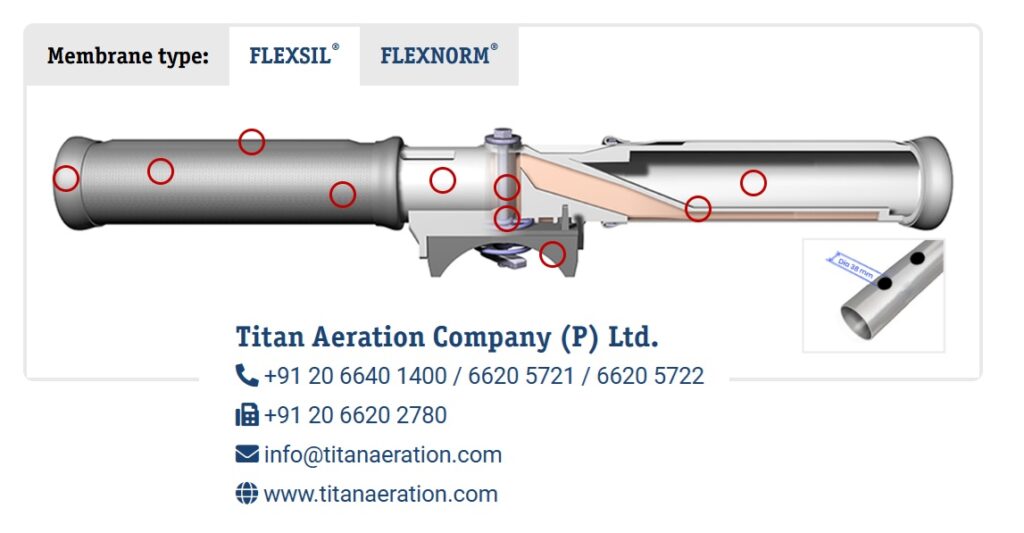
We use fine bubble tube diffusers where efficient oxygen transfer, reliable operation, chemical resistance, and long service life are important considerations. The diffuser is designed to distribute compressed air throughout an aeration tank while producing fine bubbles that provide substantial contact between air and wastewater.
A properly selected and installed silicone membrane tube diffuser for STP/ETP can support biological processes such as activated sludge treatment, nitrification, and organic-load reduction while helping treatment plants optimize their aeration systems.
What Is a Fine Bubble Silicone Membrane Tube Diffuser?
A fine bubble silicone membrane tube diffuser is an aeration device consisting primarily of a flexible silicone membrane mounted over a supporting tube or diffuser assembly. Small perforations in the membrane release air into the wastewater when the aeration system is operating.
When compressed air enters the diffuser, the membrane expands and the fine perforations open to release air. When the air supply is stopped, the membrane contracts and the openings close. This operating principle helps reduce the possibility of wastewater entering the diffuser during periods when aeration is not running.
The fine bubbles generated by the diffuser rise gradually through the aeration tank. Their relatively small size creates a large air-water interface, allowing oxygen to transfer from the air into the wastewater.
Why Silicone Membrane Is Used in STP and ETP Aeration?
Silicone membrane is selected for aeration applications because silicone has useful characteristics for demanding wastewater environments. It can provide flexibility, resistance to many environmental conditions, and stable membrane performance when the diffuser is correctly designed for the application.
For STP and ETP installations, membrane material is particularly important because wastewater can contain organic matter, suspended solids, cleaning chemicals, oils, and other substances that may affect aeration equipment.
A suitable silicone membrane can provide:
- Good flexibility
- Fine and uniform bubble generation
- Resistance to many wastewater conditions
- Reliable repeated expansion and contraction
- Low susceptibility to permanent deformation when properly operated
- Longer operational life under suitable conditions
- Consistent aeration performance
The exact membrane life, however, depends on wastewater chemistry, air quality, operating temperature, fouling, cleaning practices, pressure, and overall diffuser design.
Fine Bubble Tube Diffuser Working Principle
The working principle of a fine bubble tube diffuser is straightforward but important to overall aeration efficiency.
Compressed air is supplied through a blower and air distribution pipeline. The air reaches the diffuser assembly installed at the bottom of the aeration tank. As air pressure builds inside the diffuser, it passes through the microscopic membrane perforations.
The air exits as numerous small bubbles. These bubbles travel upward through the wastewater, transferring oxygen along their path.
The biological microorganisms present in an activated-sludge process consume dissolved oxygen while breaking down biodegradable organic matter. In nitrification systems, sufficient dissolved oxygen is also required to support microorganisms responsible for converting ammonia into oxidized nitrogen compounds.
Therefore, the diffuser becomes an important component connecting the blower, air distribution system, aeration tank, and biological treatment process.
Advantages of Silicone Fine Bubble Tube Diffusers
1. Efficient Oxygen Transfer
Fine bubbles provide a comparatively large surface area for air-water contact. This can make fine bubble aeration an efficient method for oxygen delivery when the system is properly designed and operated.
The actual oxygen transfer performance depends on factors such as water depth, dissolved oxygen concentration, wastewater characteristics, air flow, diffuser density, fouling, and tank configuration.
2. Uniform Air Distribution
Properly arranged tube diffusers can distribute air over a large portion of the aeration basin. Uniform distribution helps avoid poorly aerated zones and supports more consistent biological treatment.
We should design the diffuser layout according to tank dimensions, oxygen demand, airflow requirements, mixing requirements, and the biological process being used.
3. Flexible Silicone Membrane
The flexibility of silicone allows the membrane to respond to changes in internal air pressure. This is particularly useful for aeration systems that operate intermittently.
The membrane should be selected according to the operating pressure and airflow conditions specified by the manufacturer.
4. Reduced Wastewater Intrusion During Shutdown
A flexible membrane diffuser can close its perforations when air pressure falls. This can help limit the entry of wastewater and suspended material into the diffuser during shutdown periods.
This feature is especially useful in plants where aeration equipment is frequently switched on and off.
5. Suitable for Different Treatment Applications
Silicone membrane tube diffusers can be considered for several applications, including:
- Municipal STP aeration
- Industrial ETP aeration
- Activated sludge treatment
- Biological wastewater treatment
- Equalization and aeration systems
- Nitrification processes
- MBBR and other biological treatment configurations where the diffuser design is compatible
- Industrial process-water treatment
Fine Bubble Silicone Diffuser for STP
In an STP, the aeration system normally supplies oxygen required by microorganisms responsible for biological wastewater treatment.
The quantity and arrangement of diffusers should not be selected simply according to tank volume. We consider the wastewater flow, BOD load, COD characteristics, ammonia load, biological process, desired dissolved oxygen concentration, operating conditions, water depth, blower capacity, and diffuser oxygen-transfer characteristics.
A well-designed STP fine bubble diffuser system can help maintain adequate dissolved oxygen throughout the aeration zone while avoiding unnecessary air consumption.
Maintaining the correct dissolved oxygen concentration is important. Excessive aeration can waste blower energy, while insufficient aeration can negatively affect biological treatment.
Fine Bubble Silicone Diffuser for ETP
Industrial Effluent Treatment Plants can present more challenging conditions than municipal sewage treatment systems. Industrial effluent may contain chemicals, oils, solvents, salts, suspended solids, and variable organic loads.
For this reason, diffuser membrane selection becomes particularly important.
A silicone membrane tube diffuser for ETP should be evaluated against the actual wastewater characteristics rather than selected solely on price. Compatibility with wastewater chemistry, operating temperature, cleaning requirements, airflow, pressure, and expected service conditions should all be considered.
For difficult industrial applications, we should obtain the diffuser manufacturer’s chemical compatibility recommendations before finalizing the membrane material.
Important Silicone Membrane Tube Diffuser Specifications
When selecting a fine bubble diffuser, several specifications should be reviewed.
Membrane Material
The membrane may be manufactured from silicone or other elastomeric materials depending on the application. Silicone is often selected when its flexibility and chemical/environmental characteristics suit the wastewater.
Diffuser Length
Tube diffusers are available in different lengths. Common configurations are selected according to the tank geometry and required air distribution.
Airflow Capacity
Each diffuser has a recommended operating airflow range. Operating significantly outside the manufacturer’s recommended range can affect bubble formation, pressure, oxygen transfer, and membrane life.
Operating Pressure
The diffuser requires sufficient pressure to overcome membrane resistance and hydrostatic pressure at the installation depth.
Bubble Size
Fine bubble diffusers are designed to produce relatively small bubbles. Bubble size can change with membrane design, airflow, water depth, fouling, and operating conditions.
Connection Type
The diffuser connection should match the air distribution header or lateral piping system. Secure connections are essential to prevent air leakage.
How to Select the Right Fine Bubble Diffuser for an Aeration Tank?
We recommend evaluating the complete aeration system rather than selecting a diffuser independently.
Important factors include:
- Wastewater flow rate
- BOD and COD loading
- Ammonia and nitrogen load
- Required oxygen demand
- Aeration tank volume
- Water depth
- Required dissolved oxygen
- Blower airflow and pressure
- Number of diffusers
- Diffuser airflow per unit
- Membrane material
- Wastewater temperature
- Chemical characteristics
- Expected fouling conditions
- Cleaning and maintenance requirements
The diffuser quantity should be calculated from the plant’s oxygen requirement and the diffuser’s effective oxygen-transfer performance under actual operating conditions.
Installation of Silicone Membrane Tube Diffusers
Correct installation is essential for achieving reliable aeration.
The diffuser support system should be properly aligned and securely fixed. Air distribution piping should be designed to minimize pressure losses and provide balanced airflow across the aeration basin.
Before commissioning, we should inspect the connections for leakage and verify that the air distribution is reasonably uniform.
Diffusers should generally be positioned according to the manufacturer’s recommended installation arrangement and the process engineer’s aeration design.
Improper installation can cause uneven airflow, excessive membrane stress, leakage, vibration, or reduced aeration performance.
Maintenance of Fine Bubble Silicone Diffusers
Even high-quality diffusers require maintenance.
Over time, biological fouling, inorganic scaling, suspended solids, and chemical deposits can accumulate on membrane surfaces. Fouling can increase pressure requirements and reduce oxygen transfer.
Routine maintenance may include:
- Visual inspection
- Monitoring blower pressure
- Monitoring airflow
- Checking dissolved oxygen
- Inspecting air distribution
- Identifying unusual pressure increases
- Cleaning membranes when required
- Checking diffuser connections
- Replacing damaged or deteriorated membranes
A sudden increase in operating pressure can be an indication of diffuser fouling or another problem in the air distribution system.
Fine Bubble Diffuser vs. Coarse Bubble Diffuser
Fine bubble and coarse bubble diffusers serve different aeration requirements.
Fine bubble diffusers generally provide smaller bubbles and a greater air-water interface, making them attractive for oxygen-transfer-focused applications.
Coarse bubble diffusers produce larger bubbles and may provide stronger mixing characteristics and greater resistance to certain fouling conditions.
The correct choice depends on the treatment process. In many biological aeration systems, fine bubble aeration is preferred when energy-efficient oxygen transfer is a major objective, while coarse bubble systems can be advantageous where mixing or specific wastewater characteristics are dominant considerations.
Energy Efficiency in STP and ETP Aeration
Aeration is frequently one of the largest energy-consuming operations in biological wastewater treatment.
For this reason, improving oxygen-transfer efficiency can have a significant effect on operating costs.
A properly designed fine bubble silicone membrane diffuser system can help make better use of blower air by providing effective air-water contact. However, energy efficiency does not depend on the diffuser alone.
The complete system should be optimized, including:
- Blower selection
- Blower control
- Air pressure
- Diffuser density
- Airflow distribution
- Dissolved oxygen control
- Tank mixing
- Membrane cleanliness
- Operating schedule
Variable-speed blowers and dissolved-oxygen-based control strategies may further reduce unnecessary aeration when appropriately designed.
Common Problems with Fine Bubble Tube Diffusers
Several problems can affect diffuser performance.
Membrane Fouling
Fouling can restrict membrane openings and increase pressure requirements.
Uneven Air Distribution
Blocked diffusers, incorrect pipe sizing, or poor installation can result in uneven air distribution.
Excessive Airflow
Operating above the recommended airflow can increase membrane stress and may negatively affect bubble characteristics.
Low Airflow
Insufficient airflow can lead to poor bubble formation and inadequate oxygen supply.
Air Leakage
Loose connections or damaged components can cause air losses and reduce system efficiency.
Regular monitoring helps identify these problems before they significantly affect plant performance.
Why Choose a Quality Silicone Membrane Tube Diffuser?
The diffuser represents a relatively small component of a wastewater treatment plant, but thousands of diffuser units may operate continuously in a large aeration system. Therefore, membrane quality, diffuser construction, airflow performance, and installation reliability can have a meaningful effect on long-term operation.
A quality diffuser should provide predictable airflow characteristics, appropriate membrane flexibility, secure connections, suitable mechanical construction, and compatibility with the intended wastewater environment.
We should evaluate suppliers based on technical specifications and application suitability rather than comparing products only by initial purchase price.
Conclusion
The Fine Bubble Silicone Membrane Tube Diffuser for STP/ETP is an important aeration solution for biological wastewater treatment applications where efficient oxygen transfer and dependable operation are required.
Its flexible silicone membrane, fine bubble generation, and ability to distribute air throughout an aeration basin make it suitable for many municipal and industrial wastewater treatment systems. However, successful performance depends on selecting the correct diffuser specifications, designing the air distribution system properly, maintaining appropriate airflow, and controlling membrane fouling.
For a new STP or ETP project, we should determine diffuser quantity and arrangement from the actual oxygen demand, wastewater characteristics, tank geometry, operating depth, blower capacity, and manufacturer’s tested performance data. With appropriate engineering and maintenance, a silicone membrane fine bubble tube diffuser system can contribute to stable biological treatment and efficient aeration operation.
