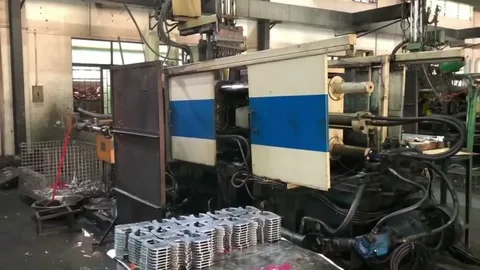
Custom die casting has become one of the most efficient manufacturing methods for producing high-precision metal parts at scale. Industries such as automotive, aerospace, electronics, and industrial machinery increasingly rely on this process because it reduces material waste while improving production efficiency. Unlike traditional machining methods that remove material from a solid block, die casting injects molten metal into reusable molds, allowing for faster cycles and minimal scrap.
In a competitive global market where cost efficiency and sustainability are key priorities, custom die casting offers a strategic advantage. It not only lowers production expenses but also reduces environmental impact through optimized material usage and repeatable manufacturing processes. This article explores how custom die casting achieves these benefits across different stages of production.
Efficient Material Utilization in Manufacturing
Custom die casting is highly efficient in its use of raw materials because it shapes molten metal directly into the required form. This eliminates the excessive cutting, grinding, or machining typically associated with subtractive manufacturing methods. As a result, manufacturers can significantly reduce raw material waste while maintaining high dimensional accuracy.
Additionally, leftover materials from the die casting process can often be recycled and reused in subsequent production cycles. This closed-loop system ensures that very little metal is wasted, making the process both cost-effective and environmentally responsible.
Key benefits of material efficiency:
- Minimal raw material waste compared to machining processes
- High recyclability of excess metals and scrap
- Reduced need for secondary finishing operations
- Improved sustainability in large-scale production
- Lower procurement costs for raw materials
Reduced Labor and Operational Costs
One of the major cost-saving advantages of custom die casting is the reduction in manual labor requirements. Once the molds are created, the process becomes highly automated, allowing machines to handle most of the production cycle with minimal human intervention. This leads to lower labor costs and fewer human errors.
Moreover, automation increases production speed and consistency, which reduces downtime and improves overall operational efficiency. Manufacturers can produce large volumes of identical components without the need for continuous manual adjustments.
Operational cost-saving advantages:
- Reduced dependency on skilled manual labor
- Lower risk of human error in production
- Faster cycle times due to automation
- Consistent output quality across batches
- Decreased machine downtime and maintenance interruptions
High Precision That Reduces Rework and Scrap
Custom die casting is known for its ability to produce highly precise and complex parts in a single process. This level of accuracy reduces the need for post-production machining, which in turn lowers both time and cost. When parts are manufactured correctly the first time, manufacturers avoid expensive rework and material waste.
The consistency of die-cast parts also ensures better assembly compatibility, reducing errors in downstream manufacturing processes. This is particularly important in industries like automotive and aerospace, where precision is critical for safety and performance.
Precision-related cost benefits:
- Reduced need for secondary machining or finishing
- Lower rejection rates due to manufacturing defects
- Improved part consistency and dimensional accuracy
- Fewer assembly line disruptions
- Reduced overall scrap rates
Faster Production Cycles and Higher Output Efficiency
Custom die casting significantly shortens production cycles compared to traditional manufacturing methods. Once the die is created, parts can be produced rapidly in high volumes, allowing manufacturers to meet large-scale demand efficiently. Faster production reduces overhead costs per unit, improving profitability.
In addition, high-speed production enables better resource planning and inventory management. Companies can produce exactly what is needed within shorter timeframes, reducing the costs associated with overproduction and storage.
Production efficiency advantages:
- Rapid cycle times for mass production
- Lower per-unit manufacturing cost
- Improved ability to meet tight deadlines
- Reduced inventory holding costs
- Enhanced scalability for large orders
Sustainable Manufacturing and Waste Reduction
Sustainability is a major concern in modern manufacturing, and custom die casting supports eco-friendly production methods. Because the process generates minimal scrap and allows for metal recycling, it reduces the environmental footprint of manufacturing operations. This makes it an attractive option for companies aiming to meet green production standards.
Furthermore, the long lifespan of die casting molds means fewer resources are consumed in tooling replacements. This durability reduces both material consumption and long-term production costs, contributing to a more sustainable manufacturing cycle.
Sustainability and waste reduction benefits:
- Lower industrial waste generation
- High recyclability of metals used
- Long-lasting reusable molds reduce tooling waste
- Reduced energy consumption per unit produced
- Supports eco-friendly manufacturing initiatives
Conclusion
Custom die casting is a powerful manufacturing solution that significantly reduces production costs and waste while improving efficiency and product quality. By maximizing material utilization, reducing labor dependency, enhancing precision, and accelerating production cycles, it offers a complete cost-saving system for modern industries.
As companies continue to prioritize sustainability and operational efficiency, custom die casting stands out as a reliable and future-ready manufacturing method. Its ability to minimize waste while delivering high-quality, high-volume production makes it an essential technology for competitive industrial growth.