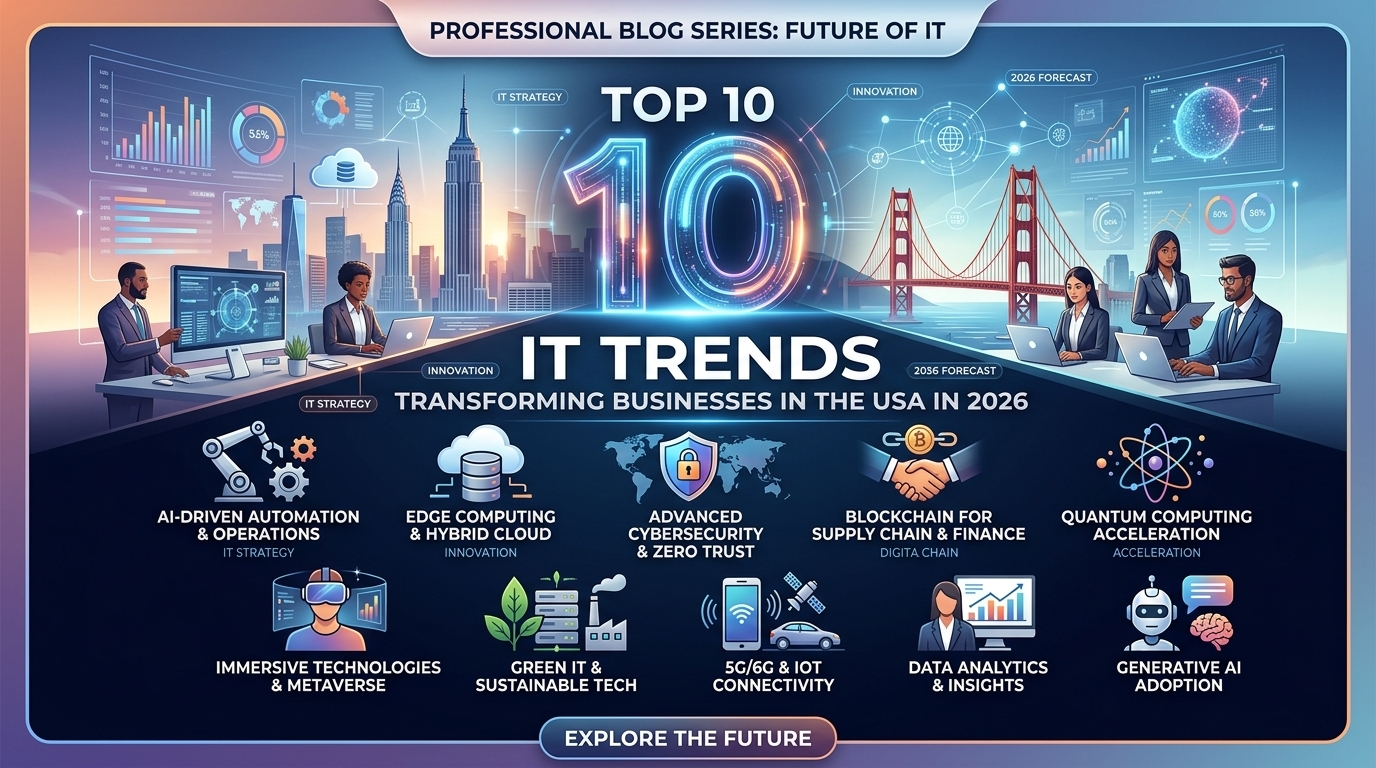
The American business landscape is evolving faster than ever, and technology is at the center of that transformation. In 2026, organizations across industries are embracing cutting-edge innovations to improve efficiency, enhance customer experiences, and gain a competitive advantage. From artificial intelligence to cloud-native infrastructure, businesses that adapt to these changes are positioning themselves for long-term success.
Whether you’re a startup, SME, or enterprise, understanding these emerging IT trends can help you make smarter investment decisions and future-proof your operations.
1. Artificial Intelligence (AI) Becomes a Business Standard
Artificial Intelligence is no longer a competitive advantage—it’s becoming a necessity. Companies are using AI-powered tools to automate repetitive tasks, generate insights from data, personalize customer experiences, and improve decision-making.
Businesses are increasingly investing in AI software development, machine learning models, and generative AI applications to streamline operations and reduce costs. Industries such as healthcare, retail, finance, and manufacturing are leading this adoption.
External linking keywords:
- AI software development services
- custom AI solutions
- machine learning development
2. Cloud-Native Application Development Continues to Dominate
Organizations are moving away from traditional infrastructure in favor of scalable cloud-native architectures. Applications built for the cloud offer better performance, faster deployment cycles, and improved reliability.
Businesses are migrating workloads to hybrid and multi-cloud environments while adopting containerization and microservices for greater flexibility.
External linking keywords:
- cloud application development
- cloud migration services
- custom cloud solutions
3. Cybersecurity Moves Beyond Prevention
With increasingly sophisticated cyber threats, businesses in the USA are prioritizing proactive cybersecurity strategies. Zero Trust Architecture, endpoint protection, threat intelligence, and AI-driven monitoring are becoming standard practices.
Companies understand that protecting customer data is not just about compliance—it’s essential for maintaining trust and business continuity.
External linking keywords:
- enterprise cybersecurity solutions
- IT security consulting
- managed security services
4. Low-Code and No-Code Platforms Accelerate Innovation
Businesses need applications delivered faster than traditional development cycles allow. Low-code and no-code platforms empower organizations to rapidly build internal tools, automate workflows, and prototype digital products.
While these platforms simplify development, many enterprises still rely on professional developers to create scalable, secure, and customized solutions.
External linking keywords:
- custom software development
- enterprise application development
- digital transformation services
5. Hyperautomation Improves Operational Efficiency
Hyperautomation combines AI, robotic process automation (RPA), analytics, and workflow orchestration to automate complex business processes.
Instead of automating isolated tasks, companies are redesigning entire workflows—from customer onboarding to invoice processing—to reduce manual effort and increase productivity.
Key benefits include:
- Lower operational costs
- Faster service delivery
- Improved data accuracy
- Better employee productivity
6. Data Analytics and Business Intelligence Drive Strategic Decisions
Modern businesses generate enormous volumes of data. The challenge is turning that data into actionable insights.
Advanced analytics platforms, predictive modeling, and real-time dashboards enable organizations to forecast trends, optimize inventory, understand customer behavior, and make evidence-based decisions.
Companies investing in business intelligence solutions gain greater visibility into performance and market opportunities.
External linking keywords:
- business intelligence services
- data analytics consulting
- predictive analytics solutions
7. Mobile-First Experiences Continue to Shape Customer Engagement
Consumers increasingly expect seamless digital experiences across smartphones and tablets. As a result, businesses are prioritizing high-performance mobile applications for e-commerce, healthcare, banking, logistics, and customer service.
Cross-platform frameworks and progressive web technologies enable companies to reach users more efficiently while reducing development costs.
External linking keywords:
- mobile app development company
- iOS app development
- Android app development
- cross-platform app development
8. Blockchain Expands Beyond Cryptocurrency
Blockchain technology is finding practical applications in supply chain management, healthcare, finance, digital identity verification, and contract management.
By creating transparent and tamper-resistant records, blockchain helps organizations improve security, reduce fraud, and enhance trust between stakeholders.
Businesses exploring decentralized technologies are increasingly seeking customized blockchain implementations tailored to industry-specific requirements.
External linking keywords:
- blockchain development services
- smart contract development
- enterprise blockchain solutions
9. Internet of Things (IoT) Creates Smarter Operations
Connected devices continue to revolutionize industries by providing real-time monitoring and automation. Manufacturing facilities use IoT sensors for predictive maintenance, retailers optimize inventory tracking, and logistics companies improve fleet management.
Combined with AI and cloud computing, IoT enables businesses to make faster operational decisions while minimizing downtime and reducing waste.
Common applications include:
- Smart factories
- Asset tracking
- Remote equipment monitoring
- Energy management systems
10. Custom Software Replaces One-Size-Fits-All Solutions
Many organizations have discovered that off-the-shelf software cannot meet their unique operational needs. As competition intensifies, businesses are investing in tailor-made applications that integrate seamlessly with existing systems and support long-term scalability.
Custom platforms provide greater flexibility, enhanced security, and features designed specifically around business objectives.
External linking keywords:
- custom software development company
- enterprise software solutions
- web application development services
- digital product development
Frequently Asked Questions
What is the biggest IT trend in 2026?
Artificial Intelligence remains the most influential IT trend in 2026, with businesses using AI for automation, customer service, predictive analytics, content generation, and operational efficiency.
Why are businesses investing more in cloud technologies?
Cloud platforms provide scalability, cost savings, improved collaboration, disaster recovery capabilities, and faster software deployment compared to traditional infrastructure.
How does custom software benefit businesses?
Custom software aligns with an organization’s unique workflows, integrates with existing systems, enhances security, improves productivity, and offers greater flexibility than generic solutions.
Which industries are adopting these IT trends the fastest?
Healthcare, financial services, retail, manufacturing, logistics, education, and professional services are among the sectors rapidly embracing AI, cloud computing, cybersecurity, and automation technologies.
Final Thoughts
The pace of technological innovation in 2026 is creating new opportunities for businesses across the United States. Organizations that embrace AI, cloud computing, cybersecurity, hyperautomation, mobile innovation, blockchain, IoT, and custom software development are better equipped to improve efficiency and remain competitive.