Electric Resistance Welding (ERW) is one of the most widely adopted metal joining technologies in modern manufacturing, especially in high-volume production environments. It is valued for its speed, automation capability, energy efficiency, and consistent weld quality, making it essential for automotive, HVAC, appliance, electrical, and structural fabrication industries.
For manufacturing engineers, OEMs, and automation integrators, understanding ERW is critical for optimizing production efficiency and achieving reliable joint performance in sheet metal assemblies.
What is Electric Resistance Welding?
Electric resistance welding is a solid-state or fusion-based joining process in which heat is generated by the resistance of metal to electric current flow, while pressure is simultaneously applied to form a weld joint.
When high current passes through overlapping metal sheets, intense localized heating occurs at the interface, creating a weld nugget. The electrodes apply force to maintain contact and control the weld formation.
In industrial systems, ERW includes several variants:
- Spot welding
- Seam welding
- Projection welding
- Flash welding
These processes are widely used in automated production lines for fast and repeatable joining of sheet metals.
Working Principle of Electric Resistance Welding
The core principle of ERW is simple but highly effective:
- Two metal surfaces are clamped together under pressure
- A high electrical current passes through the contact area
- Resistance at the interface generates heat
- Metal reaches plastic or molten state locally
- Pressure forges the joint into a solid weld
Heat generation follows Joule’s law:
- Higher resistance → higher heat concentration
- Controlled current → controlled weld size
- Applied force → consistent nugget formation
Typical process parameters include:
- Welding current
- Weld time
- Electrode force
- Electrode geometry
This precise control is what makes ERW ideal for automated manufacturing systems.
Types of Electric Resistance Welding
1. Resistance Spot Welding (RSW)
Used for joining sheet metals at discrete points. Common in automotive body assembly.
2. Resistance Seam Welding (RSEW)
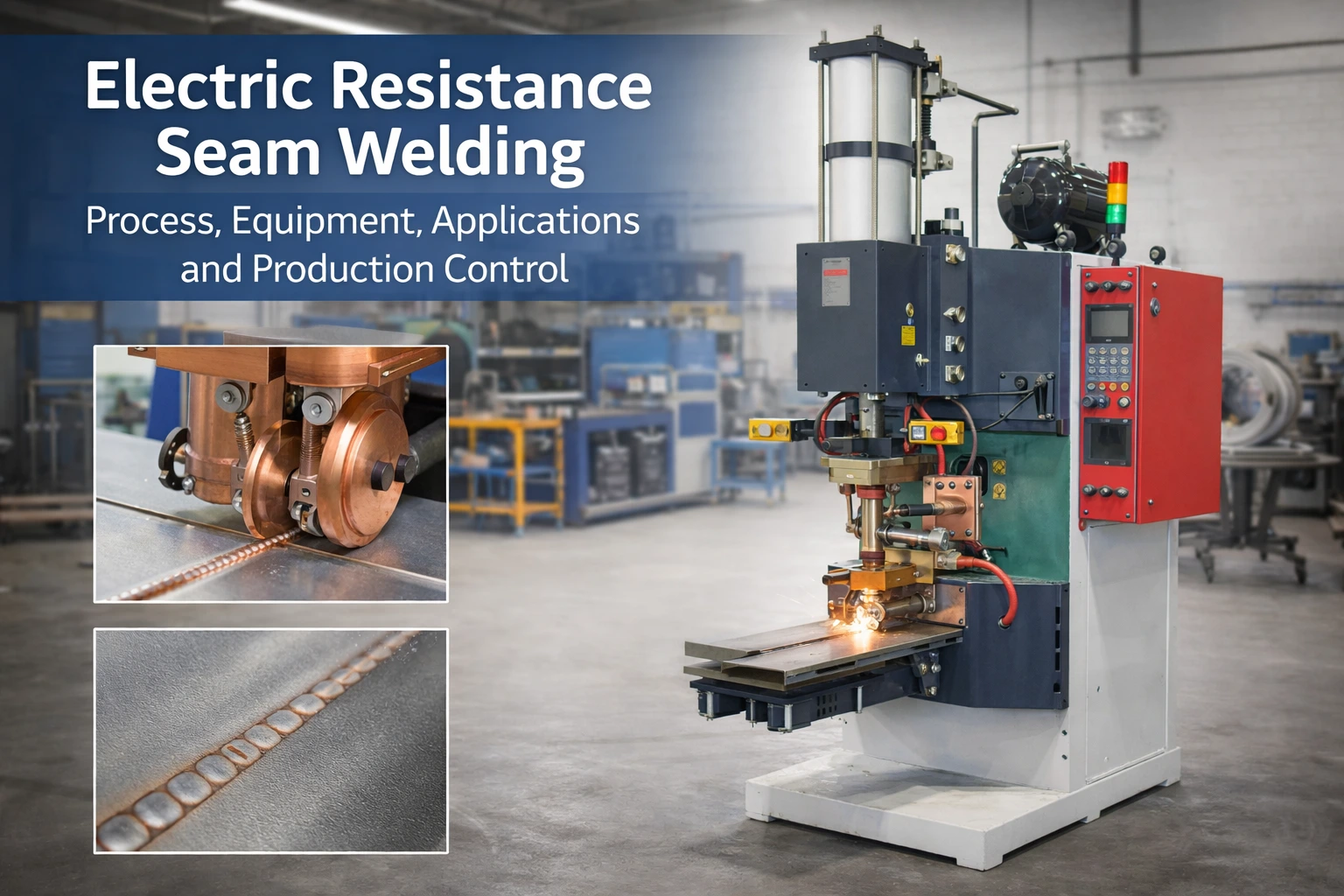
Produces a continuous weld using rotating wheel electrodes, ideal for airtight containers and tanks.
3. Projection Welding
Utilizes pre-formed projections to concentrate heat at specific weld points.
4. Flash Welding
Used for joining larger sections such as rods, bars, or rings.
Each method is selected based on production geometry, material type, and structural requirements.
Industrial Applications of Electric Resistance Welding
Electric resistance welding is heavily used across mass-production industries:
Automotive Manufacturing
- Car body panels
- Door frames
- Structural reinforcements
- Exhaust systems
Electrical & Electronics Industry
- Battery tabs
- Enclosures
- Conductive components
HVAC & Appliance Manufacturing
- Air conditioners
- Refrigeration units
- Water heaters
- Sheet metal ducts
Pipe & Tube Production
- Steel pipes (ERW pipe manufacturing)
- Structural tubing
Because of its high production speed, ERW is often the backbone of automated assembly lines.
Advantages of Electric Resistance Welding
ERW offers several engineering and production benefits:
1. High Production Speed
Welds can be completed in fractions of a second, ideal for mass manufacturing.
2. Automation-Friendly Process
Easily integrated into robotic and CNC-controlled production lines.
3. No Filler Material Required
Reduces cost and simplifies process control.
4. Clean and Environmentally Friendly
No arc fumes, shielding gas, or flux required.
5. Consistent Weld Quality
Uniform current and pressure ensure repeatability.
Electric Resistance Welding vs Other Welding Methods
Compared to arc welding processes, ERW offers:
- Lower heat distortion
- Faster cycle time
- Better suitability for thin sheets
- Easier integration into automated systems
However, it is typically limited to overlapping sheet geometries and moderate material thickness.
This makes ERW a specialized but highly efficient solution for production environments rather than heavy structural welding.
Key Challenges in ERW Processes
While highly efficient, ERW requires careful control of:
- Electrode wear and maintenance
- Current consistency
- Material surface cleanliness
- Heat balance across weld zones
Poor control can lead to weak nuggets, expulsion, or inconsistent bonding.
Best Practices for Optimizing ERW Performance
For manufacturing engineers and production managers:
- Maintain clean, oxide-free surfaces
- Optimize electrode force and alignment
- Use MFDC power supplies for precision control
- Implement real-time weld monitoring systems
- Regularly maintain electrode tips
- Match current settings to material thickness
These practices significantly improve weld reliability and production efficiency.
Heron Welder – Advanced ERW & Resistance Welding Solutions
As a global manufacturer of resistance welding and automation systems, Heron Welder provides advanced solutions for modern industrial production needs.
Our expertise includes:
- Spot welding machines
- Seam welding systems
- MFDC resistance welding technology
- Projection welding equipment
- Automated welding production lines
- Clinching and FSPR riveting systems
Heron’s engineering approach focuses on precision, productivity, and process stability, helping manufacturers achieve higher throughput with lower operational cost.
FAQs About Electric Resistance Welding
1. What materials can be joined using ERW?
Mostly steel, stainless steel, aluminum alloys, and other conductive metals used in sheet form.
2. Is electric resistance welding suitable for automation?
Yes, it is one of the most automation-friendly welding processes used in modern factories.
3. What industries use ERW the most?
Automotive, HVAC, appliance manufacturing, electrical equipment, and pipe production industries.
4. What is the main limitation of ERW?
It is best suited for thin sheets and lap joints, not thick structural components.
5. Why is ERW preferred in mass production?
Because it is fast, repeatable, energy-efficient, and easy to integrate into robotic systems.
Final Thoughts
Electric Resistance Welding continues to be a cornerstone technology in modern manufacturing due to its unmatched combination of speed, consistency, and automation capability. As industries move toward smarter and more efficient production systems, ERW remains essential for scalable metal joining applications.
For customized resistance welding machines, automated production solutions, or technical consultation, Heron Welder provides engineered systems designed for high-performance industrial environments.
Contact Heron Welder today to request a quote or discuss your tailored welding and automation requirements.