
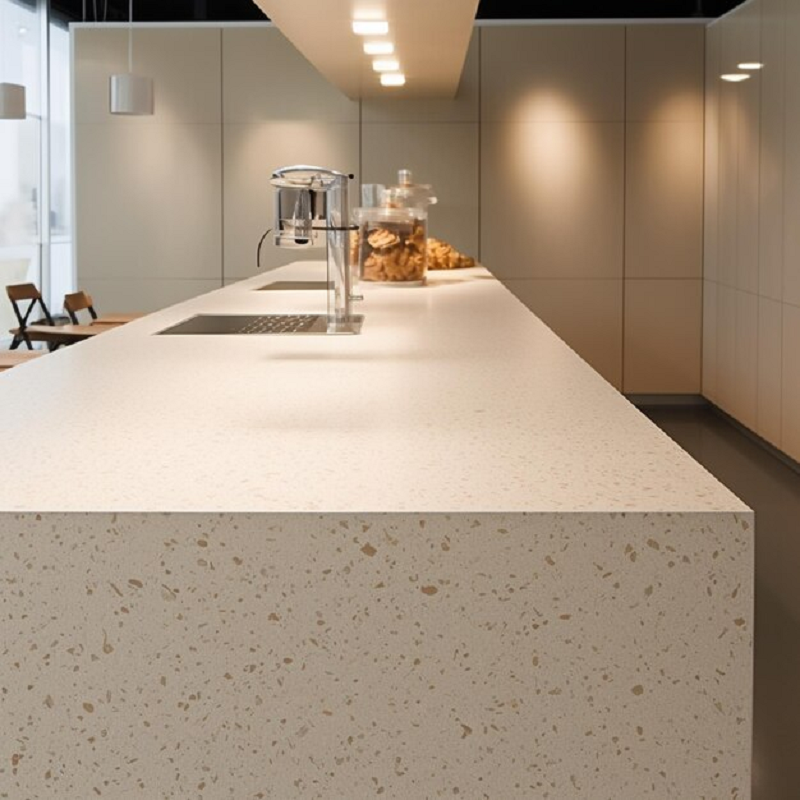
At first glance, white granite worktops and white quartz worktops can look remarkably similar sitting in a showroom. Both offer that clean, bright surface that works beautifully in contemporary and traditional kitchens alike. But scratch the surface, sometimes literally, and the differences become significant.
Choosing between white granite worktops and white quartz worktops isn’t simply a matter of taste. It’s a decision that touches on maintenance, durability, cost, and the realistic demands of your household. Getting it right means understanding what you’re actually buying.
What Makes White Granite Worktops Different
White granite worktops are cut from natural igneous rock formed deep within the earth over millions of years. The colour variation, the subtle speckles, and the occasional flashes of mineral within white granite worktops are entirely natural, no two slabs are identical. Common varieties include Colonial White, White Ice, Alaska White, and Bianco Romano, each with slightly different characteristics.
White granite worktops are extremely hard, harder than marble and most other natural stones. They’re also reasonably heat-resistant and, with proper sealing, can be made quite stain-resistant. The key word there is proper sealing. Granite is naturally porous, and white granite worktops in particular can show staining more visibly simply because any discolouration stands out against a pale background.
Most suppliers recommend sealing white granite worktops annually. Some higher-density granites may need less frequent attention, but the basic maintenance commitment is ongoing. If you neglect it, you may find oils and acidic liquids leaving marks that dull the surface over time.
The Reality of White Quartz Worktops
White quartz worktops are manufactured from ground quartz mineral, typically around 93%, mixed with polymer resins and white pigment. The result is a surface that’s completely non-porous, highly consistent in colour and pattern, and entirely free of the maintenance demands that come with natural stone.
The practical appeal of white quartz worktops is considerable. They won’t absorb wine, juice, coffee, or cooking oils. They don’t need sealing. Cleaning is as simple as a cloth and mild soapy water. For a white surface, where any staining is immediately visible, this lack of porosity is genuinely reassuring.
White quartz worktops also offer design flexibility that white granite worktops can’t match. You can choose surfaces with a barely-there veining to mimic Carrara marble, or go for a clean, pure white with no patterning at all. The uniformity is engineered, so what you see in a sample tile is reliably what you’ll get across the whole installation.
How Do They Perform in Real Kitchens?
In terms of scratch resistance, white granite worktops have a slight edge. Granite typically scores around 6–7 on the Mohs scale, and the quartz mineral in engineered surfaces is similarly hard. But the resin binders in white quartz worktops can be vulnerable to sustained heat, placing a very hot pan directly on the surface can potentially cause discolouration or cracking. With white granite worktops, the risk is generally lower, though thermal shock can still cause damage to any stone.
For everyday kitchen tasks, chopping (though always use a board), placing warm dishes, spills, both white granite worktops and white quartz worktops perform well. The difference tends to emerge over years of use rather than weeks.
One area where white quartz worktops have a clear advantage is hygiene. Because the surface is non-porous, bacteria cannot penetrate it in the way they potentially can with an unsealed or poorly sealed stone. For families with young children or anyone with hygiene concerns in the kitchen, this is a meaningful distinction.
Cost and Availability
White granite worktops and white quartz worktops occupy a similar price bracket in the UK market. You can expect to pay anywhere from £300 to £600 per square metre installed for either material, depending on the grade of stone or quartz, the complexity of the installation, edge profiles, and the supplier.
Premium white granite worktops, particularly imported varieties from India or Brazil, can push to the higher end of that range. Equally, higher-end white quartz worktops from brands like Silestone or Caesarstone come with a premium price tag that reflects their quality and warranty.
Both materials are widely available from stone suppliers across the UK, and both can be matched with undermount sinks, various edge profiles, and waterfall sides for island units.
Which One Should You Choose?
If you’re drawn to natural stone and you enjoy the idea that no two kitchens will ever have quite the same surface, white granite worktops offer something unique. The natural variation and depth of colour in granite is something engineered stone genuinely can’t replicate.
If your priority is a white surface that stays white, handles daily life without demanding annual maintenance, and can be wiped clean without anxiety, white quartz worktops are the more practical choice. They’re designed for the realities of modern kitchen use, and they perform accordingly.
Neither material is wrong. The better question is which one suits how you actually cook, clean, and live in your kitchen.

