A forging company India has become a regular name in supply-chain discussions for buyers who need strong, reliable metal components without paying top-dollar prices from traditional Western or East Asian sources. Automotive groups, oilfield equipment makers, agricultural machinery producers, railway wagon builders, crane manufacturers and general heavy engineering firms increasingly keep one or two forging company India units on their approved vendor lists. The shift happened gradually — first for simple parts, then for more technical forgings like precision connecting rods, gears, valve bodies and structural fittings.
What draws repeat business is not just the initial price tag. When partnered properly, a forging company India delivers consistent material quality, workable lead times, responsive engineering support and landed costs that stay competitive even after adding freight, duties and occasional third-party inspection fees. The advantages show up clearest when the buyer matches the right forging company India to the part family, volume and specification.
Cost Structure Remains a Strong Pull
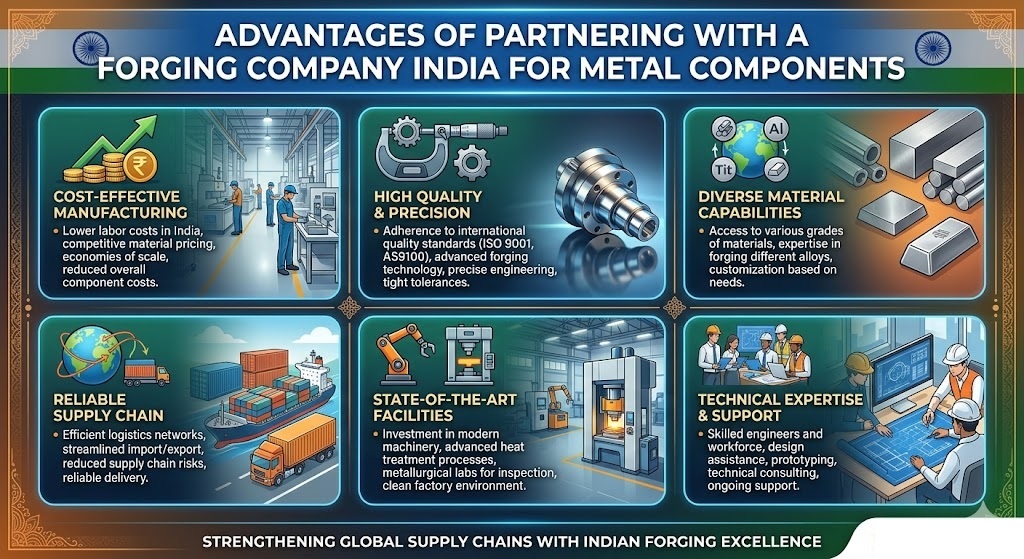
The most obvious advantage starts with money. Wages for skilled forge operators, die makers and inspectors in India sit much lower than in Germany, Italy, USA or even many parts of China today. Electricity tariffs for industrial use, building rent in industrial zones and local taxes add less burden. A forging company India can therefore quote 30–50 percent below equivalent European or American prices for mid-volume runs before shipping enters the picture.
Freight from ports like Nhava Sheva, Mundra or Chennai to Europe or North America usually adds 8–15 percent depending on container rates and part weight. Even with that, total landed cost frequently lands 25–40 percent below what the same buyer pays closer to home. For high-volume automotive or agri parts the savings compound quickly — enough to cover tooling amortization over the first few thousand pieces and still leave margin.
Beyond raw price, a forging company India often keeps flash low in closed-die work, so material yield stays high (70–85 percent typical). Less scrap means lower effective cost per piece. Buyers who run annual volume forecasts sometimes negotiate fixed-price periods or escalation clauses tied to steel indices, locking in part of the advantage for 6–12 months.
Access to Domestic Steel Supply
India produces a wide range of forging-grade steels locally. Mills roll billets in C45, EN8, EN9, EN19, EN24, 4140, 4340, 16MnCr5, 8620 and basic stainless like 304/316 with chemistry and cleanliness that meet most international specs now. Inclusion ratings have tightened in recent years, and many mills supply with 3.1 certificates straight from the melt.
A forging company India that buys directly from large integrated producers or reliable secondary mills gets consistent billets without long import lead times. For carbon and low-alloy grades this cuts raw-material delays and price swings compared to buyers who import everything. Special alloys — duplex stainless, 17-4PH, Inconel — still require imports in most cases, but fewer forging company India units handle these regularly so they maintain stock or quick-order channels.
Technical Capability Has Grown Steadily
Modern forging company India plants use CAD for die design, basic-to-advanced forging simulation to check metal flow, and CNC die-sinking machines for accurate cavity cutting. Engineers understand GD&T, forging draft rules, fillet requirements and typical machining allowances. Many read international drawings without translation issues and ask sensible questions about critical features before cutting steel.
For precision forging — connecting rods, rocker arms, yoke ends, shift forks — some forging company India units achieve 1.0–2.5 mm stock consistently, reducing finish machining time at the buyer’s end. In heavier work — open-die blocks up to 20 tonne, rolled rings for bearings or flanges — capacity exists in multiple plants. Upset forging for axle blanks or bolt heads with large ratios also appears regularly.
Process Range Covers Most Needs
Partnering with a capable forging company India means access to:
- Closed-die impression forging for gears, flanges, levers, knuckles
- Precision closed-die with minimal stock for automotive and agri parts
- Open-die for large shafts, spindles, pancakes, custom blocks
- Seamless ring rolling for bearing races, gear rims, tower flanges
- Upset + finish sequences for headed components
Many run combined flows — blocker impression + final die, or rolled preform + closed-die — which helps control grain flow and reduces forging loads.
Quality Controls Match Requirements
A serious forging company India follows these steps as routine:
- Billet inspection + heat-number traceability
- Heating logs with pyrometer or chart records
- Die preheat and lubrication checks
- Heat treatment in continuous or bogie furnaces with recorder paper
- Ultrasonic, magnetic particle or dye penetrant on critical zones
- Final gauging of key dimensions + 100 % visual check
- Rust-preventive oil, VCI paper and sturdy crating
Automotive buyers get PPAP documentation, oil & gas orders include API-level traceability, and pressure-equipment parts carry PED material certificates. Third-party inspection (SGS, TUV, Lloyd’s) happens without pushback on most export lots.
Lead Time and Flexibility
Repeat orders from a forging company India often ship in 6–10 weeks once dies exist. First-time parts with new tooling take 12–16 weeks total. Compared to some European shops that quote 20–30 weeks for similar work, the difference helps buyers keep inventory lean or respond faster to demand spikes.
Volume flexibility stands out too. Some forging company India units handle 200–2000 piece monthly automotive runs smoothly. Others take 5–50 piece heavy forgings without minimum charges. Multi-shift operation and spare press capacity absorb sudden increases better than single-line plants in higher-cost countries.
Tooling Ownership and Support
Die costs get handled in practical ways. Many forging company India units let the buyer own the die after payment, amortize the cost over the first 1000–5000 pieces, or quote low forging price with separate tooling line-item. In-house die-sinking means modifications or corrections happen faster and cheaper than sending drawings overseas.
Engineering teams often suggest small changes — adjusted fillet radii, balanced preform shape, optimised draft — that improve fill or cut machining without altering function.
Logistics Work Smoothly for Exports
Packing follows standard export practice: VCI-treated, silica gel bags, steel-strapped crates on pallets. Documents — commercial invoice, packing list, certificate of origin, inspection reports — come accurate when the forging company India has regular export experience.
FOB Nhava Sheva or Mundra remains common; CIF or DAP possible with advance notice. Freight forwarders familiar with heavy forgings handle oversized or overweight containers without drama.
Risks Managed Through Careful Partnering
Not every forging company India suits every buyer. Smaller shops may struggle with traceability or consistent heat treatment. Price-focused units sometimes cut corners on testing or lubrication. The advantage appears when you evaluate properly — site visit or detailed video audit, sample batch approval, complete technical data package with marked critical items.
Buyers who do this homework usually end up with 2–4 forging company India partners covering different part types. They get the cost edge plus predictable quality and delivery.
Closing Note
Partnering with a forging company India brings clear advantages for metal components — meaningful cost savings, reliable domestic steel access, growing technical depth, wide process coverage, solid quality controls and workable lead times. The key stays in selection: match the forging company India to your volume, specification and certification needs, start with trials, keep drawings clear and communication steady. When done right, the arrangement moves from trial sourcing to long-term supply partnership, delivering value that holds up across automotive, energy, agriculture, railway and heavy engineering applications.