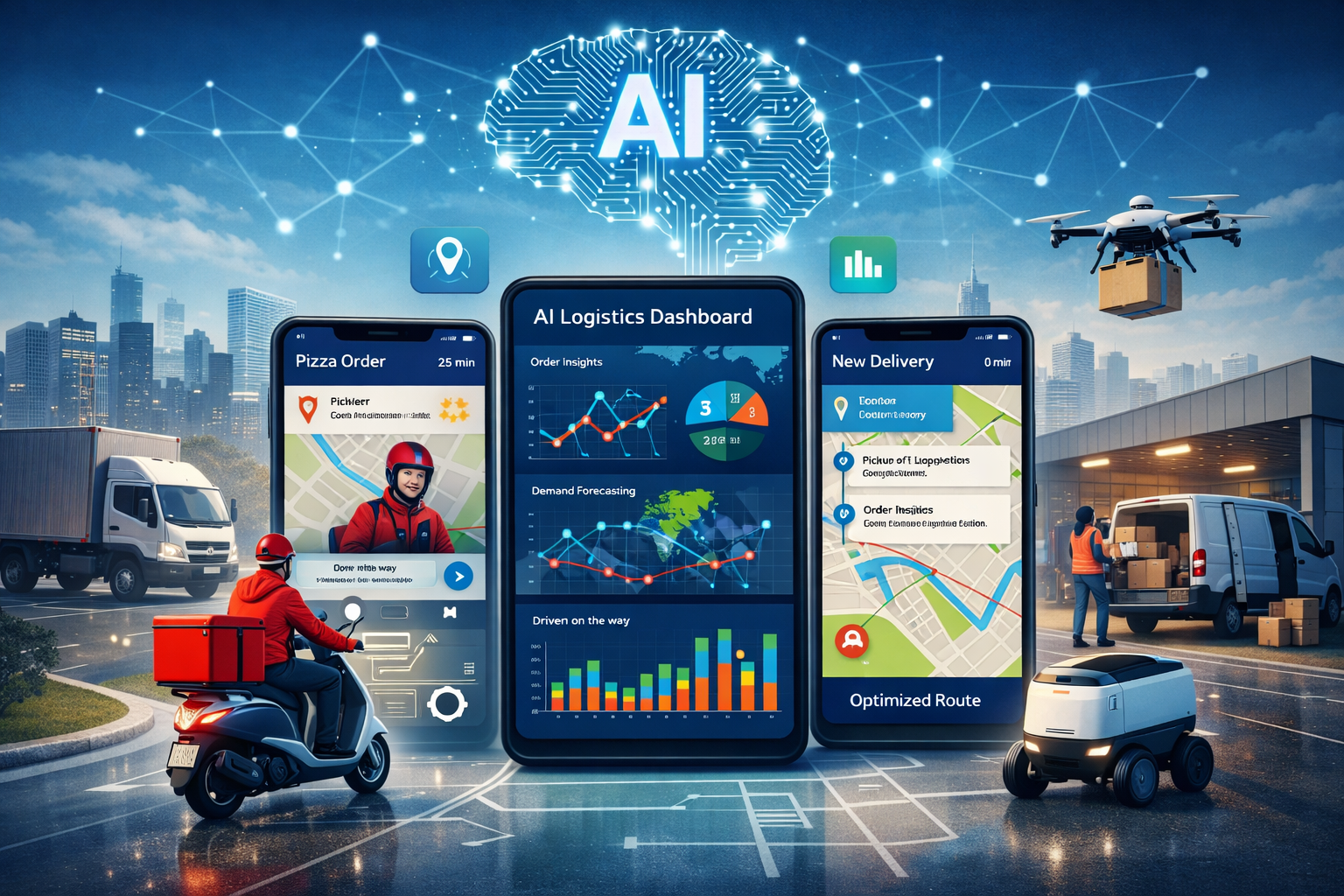
The logistics and on-demand delivery ecosystem has evolved rapidly over the last decade. With the exponential growth of eCommerce, quick commerce, grocery delivery, and hyperlocal service platforms, businesses are under constant pressure to deliver faster, cheaper, and more efficiently. Traditional delivery systems relying heavily on manual dispatching, static routing, and reactive decision-making are no longer sufficient.
An AI-Powered White label delivery app represents the next phase of smart logistics platforms. It combines the scalability of a ready-to-deploy software solution with advanced artificial intelligence capabilities such as predictive analytics, automated dispatch, intelligent route optimization, demand forecasting, fraud detection, and real-time performance monitoring.
Instead of building a logistics system from scratch, businesses can leverage a Readymade Delivery app integrated with AI modules to accelerate time-to-market while maintaining high customization and branding control. This approach significantly reduces development risks and allows companies to focus on operations, marketing, and customer experience rather than backend engineering complexities.
What Is an AI-Powered White Label Delivery App and How It Works
A White label delivery app is a pre-built delivery software solution that businesses can rebrand and customize as their own. It typically includes essential modules such as user apps, driver apps, admin dashboards, dispatch panels, payment integration, and analytics.
When artificial intelligence is embedded into this system, the platform transforms into a smart logistics engine capable of learning from data patterns and optimizing operations autonomously.
AI-powered logistics platforms operate through the following layers:
Data Collection and Integration
The app continuously collects data from multiple sources including customer orders, driver locations, traffic conditions, delivery times, user behavior, and historical trends. This data becomes the foundation for machine learning models.
Intelligent Decision Engines
AI algorithms process incoming data to make real-time decisions. These decisions may include assigning the nearest driver, adjusting delivery routes based on traffic congestion, predicting peak demand hours, or recommending surge pricing models.
Predictive and Prescriptive Analytics
Beyond reacting to live data, AI models forecast future demand and recommend operational strategies. For example, the system may suggest increasing driver availability in specific zones based on historical demand clusters.
By combining automation with intelligence, the White label delivery app evolves from a simple dispatch tool into a self-optimizing logistics platform.
Key AI Technologies Transforming Smart Delivery Platforms
Artificial intelligence in logistics is not limited to basic automation. Several advanced technologies contribute to a high-performing smart delivery system.
Machine Learning for Demand Forecasting
Machine learning models analyze historical order data to predict future demand spikes. This is crucial for food delivery, grocery platforms, pharmacy apps, and courier services. Predictive demand planning helps businesses allocate drivers efficiently and reduce delayed deliveries.
Route Optimization Algorithms
AI-powered route optimization considers multiple variables such as traffic congestion, weather conditions, distance, road closures, and delivery priorities. Unlike static GPS routes, AI continuously recalculates optimal paths to ensure timely delivery and fuel efficiency.
Intelligent Driver Allocation
Dynamic driver assignment ensures that the nearest and most suitable driver is assigned to each order. AI evaluates driver ratings, current workload, performance metrics, and proximity to minimize idle time and maximize productivity.
Natural Language Processing for Customer Support
Integrated chatbots powered by NLP handle common customer queries, order tracking, and complaint resolution without human intervention. This reduces operational costs and improves response time.
Computer Vision for Proof of Delivery
Advanced delivery platforms integrate image recognition systems to validate proof-of-delivery images. This minimizes disputes and fraudulent claims.
Business Advantages of AI-Enabled White Label Delivery App Platforms
Investing in an AI-driven White label delivery app offers measurable business benefits that directly impact profitability and scalability.
Reduced Operational Costs
AI reduces manual intervention in dispatch, routing, and customer support. Automated decision-making decreases human errors and lowers labor expenses.
Improved Delivery Speed and Accuracy
Intelligent route optimization and predictive demand management ensure that orders are delivered faster with fewer delays. This directly enhances customer satisfaction.
Enhanced Customer Experience
Real-time order tracking, accurate ETAs, proactive notifications, and AI-powered chat support create a seamless customer journey. Satisfied customers are more likely to become repeat users.
Data-Driven Strategic Planning
AI analytics dashboards provide actionable insights into customer behavior, regional demand trends, peak business hours, and driver performance. These insights support strategic expansion and targeted marketing campaigns.
Scalability Without Infrastructure Overload
As order volumes grow, AI algorithms automatically adapt resource allocation without requiring major infrastructure changes. This makes scaling operations more manageable.
Why Businesses Prefer a Readymade Delivery App Over Custom Development
While fully custom development offers flexibility, it also involves long timelines, high investment, and technical uncertainty. A Readymade Delivery app with AI integration provides a balanced alternative.
Faster Deployment
Pre-built architecture allows businesses to launch within weeks rather than months. This is critical in competitive markets where speed determines success.
Lower Development Costs
Building AI-powered logistics software from scratch involves data engineering, model training, backend development, and security compliance. A Readymade Delivery app eliminates much of this complexity.
Proven Technology Stack
White label platforms are tested across multiple deployments, reducing the risk of system instability. AI modules are pre-trained and optimized for logistics use cases.
Custom Branding and Feature Extensions
Despite being pre-built, businesses retain full control over branding elements such as logo, UI design, theme colors, and domain configuration. Additional modules can be integrated as the business grows.
Core Features Every AI-Powered White Label Delivery App Should Include
To remain competitive, a modern smart logistics platform must integrate comprehensive features across customer, driver, and admin interfaces.
Customer Application Features
- Smart search and order placement
- Real-time tracking with AI-generated ETAs
- Multiple payment gateways
- AI-driven order recommendations
- Automated notifications and updates
Driver Application Features
- Intelligent order assignment
- Optimized route suggestions
- Earnings analytics dashboard
- In-app communication
- Digital proof of delivery system
Admin Panel Features
- AI analytics and forecasting dashboard
- Heat maps of high-demand areas
- Automated commission management
- Fraud detection monitoring
- Multi-zone operational management
These features collectively ensure that the White label delivery app operates as a centralized command system for smart logistics operations.
Industry Use Cases of AI-Powered Smart Delivery Platforms
AI-driven delivery platforms are not limited to a single industry. They support diverse sectors including:
- Food and restaurant delivery
- Grocery and supermarket logistics
- Pharmacy and healthcare delivery
- Courier and parcel services
- eCommerce last-mile fulfillment
- Hyperlocal service marketplaces
Each industry benefits differently from AI capabilities, but the underlying objective remains the same: faster delivery, optimized costs, and improved customer retention.
Challenges in Implementing AI in Delivery Platforms and How to Overcome Them
Despite its advantages, integrating AI into logistics platforms presents certain challenges.
Data Quality and Consistency
AI systems require clean, structured data. Businesses must ensure proper data collection mechanisms and validation protocols.
Integration Complexity
AI modules must seamlessly integrate with GPS systems, payment gateways, CRM tools, and inventory management software. Selecting a robust White label delivery app provider simplifies this process.
Continuous Model Training
AI algorithms improve over time but require regular updates and retraining. Choosing a solution with ongoing technical support ensures long-term performance optimization.
Data Privacy and Security
Since delivery platforms handle sensitive user data, compliance with data protection regulations and strong encryption practices is essential.
Future Trends Shaping AI-Powered Logistics Platforms
The evolution of AI in logistics is accelerating, and several trends will define the next phase of smart delivery systems.
Autonomous Delivery Integration
AI platforms will increasingly integrate with drones and autonomous vehicles for last-mile delivery.
Hyper-Personalized Customer Experiences
AI will analyze customer preferences to offer tailored delivery slots, promotions, and product suggestions.
Blockchain-Enabled Smart Contracts
Combining AI with blockchain can enhance transparency and secure automated payment settlements.
Sustainability Optimization
AI-driven route planning will focus on reducing carbon emissions and optimizing fuel consumption, aligning with global sustainability goals.
As these innovations mature, AI-powered White label delivery app platforms will transition from operational tools to intelligent logistics ecosystems.
Conclusion
AI-powered logistics platforms are redefining how modern delivery businesses operate. By combining automation, predictive intelligence, and scalable infrastructure, a White label delivery app enables businesses to deliver smarter, faster, and more efficiently.
Instead of investing years in complex development cycles, companies can adopt a Readymade Delivery app enhanced with AI capabilities to accelerate growth, reduce costs, and stay competitive in a rapidly evolving market. As demand for instant and reliable delivery services continues to grow, intelligent logistics platforms will become the foundation of sustainable and scalable digital commerce.
Frequently Asked Questions
What is the difference between a white label delivery app and a custom-built delivery platform?
A white label delivery app is a pre-built, customizable solution that can be branded and launched quickly, whereas a custom-built platform is developed from scratch based on specific business requirements. White label solutions reduce time-to-market and cost while still offering flexibility.
How does AI improve delivery efficiency in logistics platforms?
AI improves efficiency through automated driver allocation, predictive demand forecasting, real-time route optimization, and intelligent analytics. These capabilities minimize delays, reduce fuel consumption, and enhance overall operational performance.
Is a Readymade Delivery app scalable for enterprise-level operations?
Yes, a Readymade Delivery app designed with cloud infrastructure and AI capabilities can scale to handle high order volumes, multi-location operations, and large driver networks without major system restructuring.
Can AI-powered delivery apps integrate with existing business systems?
Most modern platforms support integration with CRM software, payment gateways, ERP systems, and third-party APIs. Seamless integration ensures smooth operational workflows and centralized data management.
What industries benefit the most from AI-powered white label delivery platforms?
Industries such as food delivery, grocery services, eCommerce, healthcare logistics, and courier services benefit significantly due to high order volumes and time-sensitive deliveries where optimization and automation directly impact profitability.