
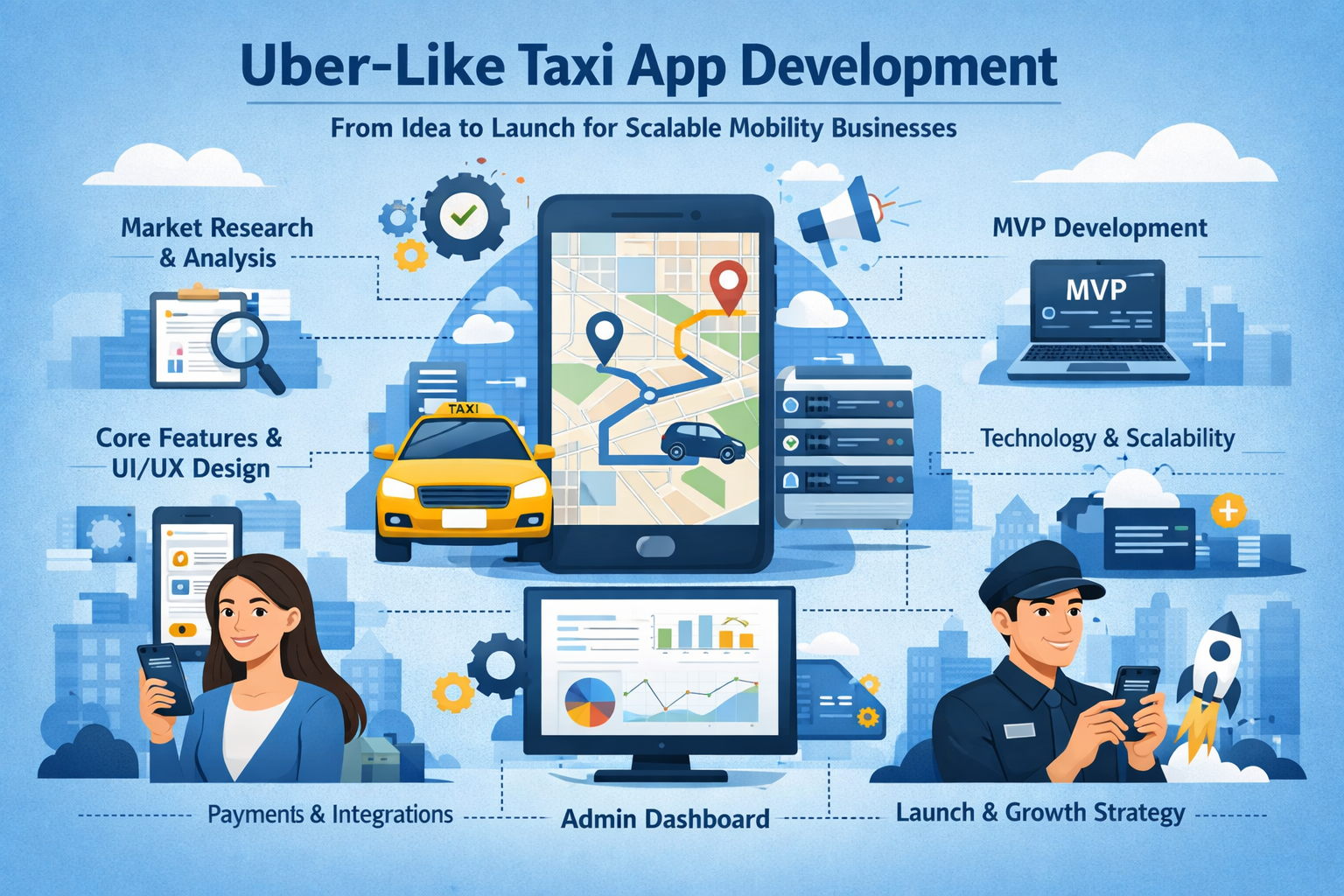
Building a successful on-demand taxi platform starts with a clear understanding of the mobility problem you want to solve. Uber Like taxi App Development is not only about replicating ride booking functionality but also about addressing local transportation gaps, user convenience, driver engagement, and operational scalability. A strong vision aligns business goals with user expectations, regulatory environments, and long-term growth plans. Before moving to design or development, businesses must define their target market, service model, revenue streams, and differentiation strategy to ensure the product has a sustainable foundation.
Market Research and Business Modeling as the First Strategic Step
Comprehensive market research helps validate demand and refine the app concept. This includes analyzing user behavior, competitor offerings, pricing strategies, and regional mobility challenges. In Uber Like taxi App Development projects, this phase often determines whether the platform will focus on city taxis, intercity travel, corporate mobility, or niche segments such as women-only or electric-vehicle rides. Business modeling follows research, outlining commission structures, surge pricing logic, driver incentives, and customer acquisition costs. A well-defined model ensures predictable revenue while keeping the ecosystem attractive for both riders and drivers.
Defining Core Features for a Scalable Uber Clone App Ecosystem
Feature planning is central to creating a competitive Uber clone app. For riders, essential features include real-time ride booking, GPS tracking, fare estimation, multiple payment options, and ratings. Drivers require intuitive onboarding, trip management, earnings dashboards, and navigation support. Admin panels must provide complete operational control, including user management, pricing configuration, analytics, and dispute handling. Scalability should be considered from the start so that features can support increasing users, multiple cities, and new services without performance degradation.
Designing an Intuitive User Experience for Riders, Drivers, and Admins
User experience design plays a critical role in adoption and retention. Successful Uber Like taxi App Development focuses on minimizing steps, reducing wait times, and offering clarity at every interaction. Rider apps must deliver quick booking flows and transparent pricing, while driver apps should prioritize ease of use during active trips. Admin dashboards need clear data visualization for decision-making. Thoughtful UI and UX design ensures that all stakeholders can interact with the platform efficiently, which directly impacts customer satisfaction and operational efficiency.
Choosing the Right Technology Stack for Performance and Scalability
The technology stack determines how well the platform performs under real-world conditions. A robust backend architecture supports real-time data processing, GPS tracking, and secure transactions. Cloud-based infrastructure allows the system to scale dynamically as demand grows. For Uber Like Taxi App Development Company solutions, selecting the right frameworks, databases, and APIs ensures stability, faster development cycles, and easier maintenance. Security protocols must also be integrated to protect user data and payment information, meeting compliance standards across regions.
Development Process from MVP to Full-Scale Platform
Development typically begins with a minimum viable product that includes core ride-hailing features. This allows businesses to test assumptions, gather feedback, and refine functionality before a full launch. Agile development methodologies are commonly used to enable iterative improvements. As the platform matures, advanced features such as AI-based route optimization, dynamic pricing, and loyalty programs can be introduced. This phased approach reduces risk while ensuring the Uber clone app evolves in line with market needs.
Integrating Payments, Maps, and Third-Party Services
Third-party integrations enhance functionality and reliability. Payment gateways enable cashless transactions through cards, wallets, and local payment methods. Mapping and navigation services support accurate route planning and real-time tracking. Notification services keep users informed about ride status, promotions, and updates. Effective integration ensures seamless interactions across the platform and contributes to a professional, trustworthy user experience in Uber Like taxi App Development projects.
Testing, Quality Assurance, and Compliance Readiness
Thorough testing is essential before launch. Functional testing ensures features work as intended, while performance testing evaluates how the system handles peak demand. Security testing protects against data breaches and fraud. Compliance with local transportation regulations, data protection laws, and payment standards must also be verified. A reliable Uber Like Taxi App Development Company prioritizes quality assurance to minimize post-launch issues and build long-term trust with users.
Launch Strategy and Post-Launch Growth Planning
Launching the app involves more than publishing it on app stores. Marketing strategies, driver onboarding campaigns, and promotional offers help attract initial users. Monitoring performance metrics after launch provides insights into user behavior and operational efficiency. Continuous updates, feature enhancements, and geographic expansion are key to scaling the business. A well-planned launch sets the stage for sustainable growth in competitive mobility markets.
Long-Term Scalability and Innovation in Mobility Platforms
Scalability depends on the ability to adapt to changing user expectations and technological advancements. Future enhancements may include electric vehicle integration, autonomous ride readiness, AI-driven demand forecasting, and multimodal transportation options. Uber Like taxi App Development is an ongoing process that requires innovation, data-driven decision-making, and a commitment to improving urban mobility solutions over time.
Conclusion
From idea validation to post-launch scaling, building a successful ride-hailing platform requires strategic planning, robust technology, and a user-centric approach. Uber Like taxi App Development offers businesses an opportunity to enter the growing mobility market with a proven model, but long-term success depends on differentiation, quality execution, and continuous innovation. By working with an experienced Uber Like Taxi App Development Company, enterprises can transform their vision into a scalable, reliable, and competitive Uber clone app that meets modern transportation demands.
What is Uber Like taxi App Development and who is it suitable for?
Uber Like taxi App Development refers to creating a ride-hailing platform with features similar to leading on-demand taxi apps. It is suitable for startups, transportation companies, and enterprises looking to launch or expand digital mobility services.
How long does it take to build an Uber clone app?
Development timelines vary based on feature complexity, integrations, and customization. A basic version may take a few months, while a fully scalable and customized solution can take longer.
Why should businesses work with an Uber Like Taxi App Development Company?
An experienced Uber Like Taxi App Development Company brings technical expertise, industry knowledge, and proven processes, reducing development risks and accelerating time to market.
Can an Uber clone app be customized for local markets?
Yes, an Uber clone app can be customized to support local languages, payment methods, pricing models, and regulatory requirements, ensuring relevance in specific regions.
How can scalability be ensured in Uber Like taxi App Development?
Scalability is achieved through cloud infrastructure, modular architecture, optimized databases, and continuous performance monitoring, allowing the platform to grow with user demand.


