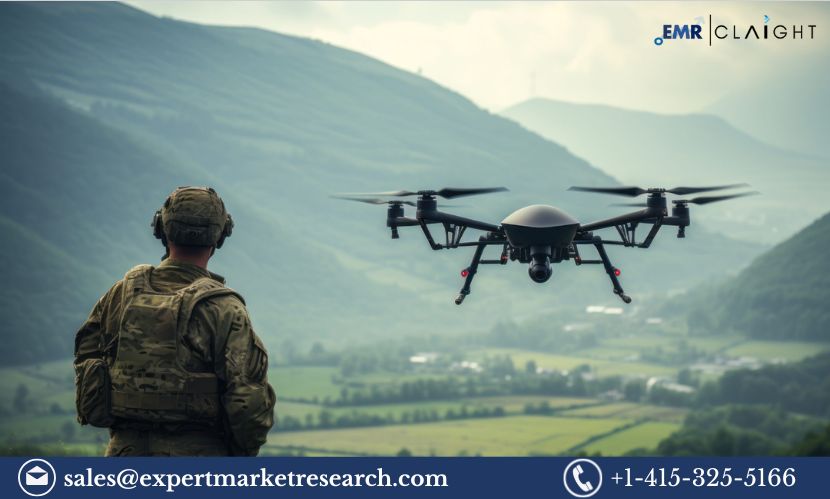
Military Drone Market Outlook
According to the report by Expert Market Research (EMR), the global military drone market size attained a value of USD 15.57 billion in 2025. Aided by the increasing adoption of unmanned systems for surveillance, reconnaissance, combat support, and intelligence-gathering operations, along with rising defence expenditures across major economies, the market is expected to grow at a robust CAGR of 9.50% during the forecast period of 2026–2035. By 2035, the military drone market is projected to reach a value of USD 38.59 billion.
Military drones, also referred to as unmanned aerial vehicles (UAVs), are remotely piloted or autonomous aircraft systems used by defence forces for a wide range of missions, including intelligence, surveillance, and reconnaissance (ISR), target acquisition, border monitoring, electronic warfare, and combat operations. These systems provide strategic and tactical advantages by reducing risks to personnel, enhancing situational awareness, and enabling persistent operations in complex and hostile environments.
The increasing focus on modernising armed forces, coupled with the growing importance of network-centric warfare and real-time data intelligence, is significantly boosting the demand for military drones worldwide. Furthermore, rapid advancements in sensor technologies, artificial intelligence (AI), and autonomous flight systems are enhancing the operational capabilities of military drones, thereby strengthening their role in modern defence strategies.
Military Drone Market Size
The global military drone market has experienced substantial growth over the past decade, driven by rising geopolitical tensions, asymmetric warfare scenarios, and the need for advanced surveillance and precision strike capabilities. In 2025, the market reached a value of USD 15.57 billion, reflecting strong procurement activities by defence forces across North America, Europe, Asia Pacific, and the Middle East.
The market size is expected to expand significantly over the forecast period as governments continue to invest in next-generation unmanned systems to strengthen national security. Increasing deployment of drones in border security, maritime patrol, and counter-terrorism operations is further contributing to the expansion of the market. Additionally, the growing integration of drones into multi-domain operations involving air, land, sea, space, and cyber domains is expected to support sustained market growth.
Request a Free Sample Report with Table of Contents – https://www.expertmarketresearch.com/reports/military-drone-market/requestsample
Military Drone Market Share
Regionally, North America holds a dominant share of the global military drone market, primarily driven by high defence spending, advanced technological infrastructure, and continuous investments by the United States Department of Defense in unmanned systems. The presence of leading drone manufacturers and defence contractors further strengthens the region’s market position.
Europe represents a significant share of the military drone market, supported by increasing defence collaborations, joint drone development programmes, and rising investments in ISR and combat UAVs by countries such as the United Kingdom, France, and Germany. Asia Pacific is emerging as a rapidly growing regional market, driven by rising defence budgets, border security concerns, and indigenous drone development initiatives in countries including China, India, and South Korea.
By type, fixed-wing drones account for a substantial share due to their long endurance and suitability for long-range surveillance and reconnaissance missions. Rotary-wing and hybrid drones are also gaining traction, particularly for tactical and short-range operations. In terms of application, ISR drones dominate the market, followed by combat and logistics support drones.
Military Drone Market Trends
Several key trends are shaping the global military drone market. One of the most prominent trends is the increasing shift towards autonomous and semi-autonomous drone systems powered by artificial intelligence and machine learning algorithms. These technologies enable drones to perform complex missions with minimal human intervention, improving operational efficiency and decision-making speed.
Another notable trend is the growing use of swarm technology, where multiple drones operate collaboratively to perform surveillance, reconnaissance, or electronic warfare missions. Swarm drones enhance mission effectiveness by increasing redundancy, coverage, and resilience against countermeasures.
The integration of advanced payloads, such as high-resolution electro-optical and infrared (EO/IR) sensors, synthetic aperture radar (SAR), and electronic intelligence systems, is also gaining momentum. Additionally, there is a rising focus on developing stealth-capable drones with reduced radar and infrared signatures to enhance survivability in contested environments.
Drivers of Growth
Several factors are driving the growth of the global military drone market. The increasing need for real-time intelligence, surveillance, and reconnaissance capabilities is a primary growth driver, as drones provide persistent monitoring and rapid data transmission without endangering personnel.
Rising geopolitical tensions and border security challenges are also contributing significantly to market growth, prompting nations to invest in advanced unmanned systems for continuous monitoring and threat detection. Additionally, the growing emphasis on cost-effective defence solutions is favouring the adoption of drones, as they offer lower operational and maintenance costs compared to manned aircraft.
Technological advancements in propulsion systems, communication networks, and sensor integration are further enhancing drone performance, thereby expanding their operational roles across defence applications. Moreover, the increasing use of drones in joint military operations and allied defence collaborations is supporting sustained market expansion.
Technology and Advancements
Technological innovation is at the core of the military drone market’s evolution. Advances in artificial intelligence, data analytics, and autonomous navigation systems are enabling drones to perform complex missions, including target recognition, route optimisation, and threat assessment.
Improvements in communication technologies, such as satellite-based and secure line-of-sight data links, are enhancing real-time connectivity and mission reliability. Additionally, the development of advanced propulsion and power management systems is extending drone endurance and operational range.
The integration of modular payload architectures is allowing defence forces to customise drones for specific missions, improving flexibility and cost efficiency. Furthermore, advancements in cybersecurity and electronic counter-countermeasure technologies are strengthening the resilience of military drones against cyber and electronic threats.
Military Drone Market Segmentation
The market can be divided based on product type, technology, range, system, application, and region.
Market Breakup by Product Type
- Fixed Wing
- Hybrid
- Rotary Wing
Market Breakup by Technology
- Remotely Operated Drones
- Semi-Autonomous Drones
- Autonomous Drones
Market Breakup by Range
- Visual Line of Sight (VLOS)
- Extended Visual Line of Sight (EVLOS)
- Beyond Visual Line of Sight (BVLOS)
- Others
Market Breakup by System
- Airframe
- Avionics
- Propulsion
- Electric Propulsion Engine
- Turboprop Engine
- Turboshaft Engine
- Payload
- Cameras
- CBRN Sensors
- EOIR Payload
- Radar
- LiDAR
- Others
- Software
- Others
Market Breakup by Application
- Intelligence, Surveillance, Reconnaissance, and Targeting (ISRT)
- Combat Operations
- Battle Damage Management
- Logistics and Transportation
- Others
Market Breakup by Region
- North America
- Europe
- Asia Pacific
- Latin America
- Middle East and Africa
Competitive Landscape
Some of the major players explored in the report by Expert Market Research are as follows:
- Saab AB
- General Atomics
- Lockheed Martin Corporation
- Textron Systems
- Elbit Systems Ltd
- Thales Group
- BAE Systems Plc
- Northrop Grumman Company
- AeroVironment Inc.
- Hindustan Aeronautics Ltd
- Israel Aerospace Industries Ltd.
- Boeing
- Others
Military Drone Industry Analysis
The global military drone market is characterised by a high level of technological sophistication and the presence of established defence contractors and specialised UAV manufacturers. Key players are focusing on research and development, strategic partnerships, and government contracts to strengthen their market positions.
Leading companies are investing heavily in next-generation drone platforms, autonomous systems, and advanced payload technologies. Collaboration with defence agencies and participation in long-term procurement programmes are central strategies adopted by market participants. Additionally, several countries are promoting domestic drone manufacturing through defence indigenisation initiatives, creating opportunities for local players and start-ups.
Challenges and Opportunities
Despite strong growth prospects, the military drone market faces certain challenges. High development and procurement costs, particularly for advanced combat and long-endurance drones, can limit adoption in budget-constrained defence forces. Regulatory and ethical concerns related to autonomous weapon systems also pose challenges to market expansion.
Moreover, vulnerabilities to cyberattacks, electronic warfare, and anti-drone systems necessitate continuous investment in security and countermeasure technologies, increasing overall system costs.
However, the market presents significant opportunities. The increasing focus on unmanned and autonomous warfare, coupled with advancements in AI and sensor technologies, offers substantial growth potential. The rising demand for drones in logistics, disaster response support, and intelligence-sharing operations further expands the scope of military drone applications. Additionally, international defence collaborations and export opportunities are expected to create new revenue streams for manufacturers.
Military Drone Market Forecast
The global military drone market is expected to witness strong growth during the forecast period of 2026–2035, expanding at a CAGR of 9.50% to reach a value of USD 38.59 billion by 2035. Growth will be driven by increasing defence modernisation programmes, rising adoption of unmanned systems, and continuous technological advancements.
North America is expected to retain its leading position, supported by sustained defence investments and innovation. Asia Pacific is projected to register the fastest growth due to rising defence budgets, regional security concerns, and expanding indigenous manufacturing capabilities. Europe and the Middle East are also anticipated to experience steady growth driven by defence modernisation and security initiatives.