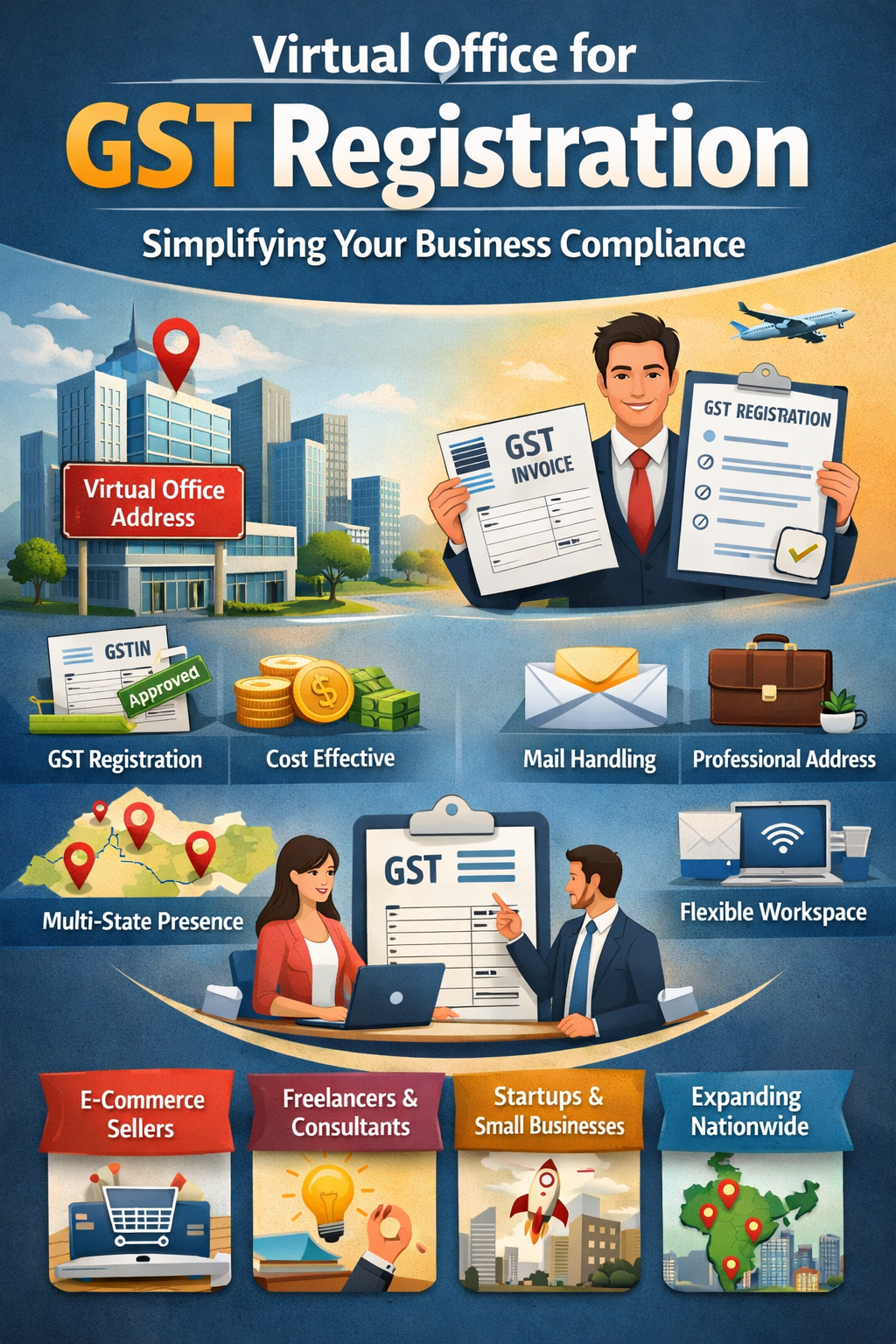
The Goods and Services Tax (GST) made India’s indirect tax system more consistent, but it also made it difficult for enterprises who do business in more than one state to figure out where to pay taxes. One of the most common mistakes people make when it comes to GST law is not knowing what a “place of business” is and whether things like virtual addresses are permitted. This makes things even more confusing for new businesses, service providers, and internet vendors who are moving to other states.
It’s crucial to know what the law allows and what it doesn’t, and how firms may stay fully compliant to avoid GST rejection, cancellation, or future legal action.
Understanding GST Jurisdiction The Central Goods and Services Tax Act, 2017 (CGST Act) specifies that the GST jurisdiction in India is mostly based on where the supplier is and where the goods are delivered. Each state has its own virtual office for GST registration. This means that a business has to have a different GSTIN for each state where it does business and pays taxes.
Most people think you need to own property to register for GST, but that’s not true. It needs a real and verified company location in the state, as well as the necessary documents.
What Does “Place of Business” Mean with GST?
Section 2(85) of the CGST Act establishes a wide definition of “place of business.” It includes:
• A place where business is normally done
• A warehouse or godown where items are housed
• A place where records of accounts are kept
• Any place where a taxable person performs business
The legislation keeps this definition fluid on purpose so that it can keep up with how businesses change. It’s crucial to remember that it doesn’t limit the business location to regular offices.
This legal flexibility is what lets you register for GST from a virtual office, as long as you do it right.
Can you legally register for GST using a virtual office?
A virtual office is not a “fake” address when it comes to GST. This is a business address that you rent out for business purposes. It offers you the permission to use it legally and documentation that you have that right.
The GST officials look at the facts of a matter, not how it seems. The address is a true place of business if it:
• Is registered as a business
• Has valid rent/lease or authorization paperwork.
• Can be checked during an inspection; utility bills and a NOC back it up; then it is a true place of business.
People have suggested many times that you may utilize a virtual office to register for GST as long as there is real paperwork and activity going on at the address.
Main Place of Business vs. Extra Place of Business
Businesses need to tell the government where their Principal Place of Business (PPOB) is. This is the main place where they store their books of accounts. They also need to tell the government where their Additional Place of Business (APOB) is, which is any other place where they do business.
For service providers and consultants, the virtual address is generally their main office. People in eCommerce and other businesses often term it an extra place of business.
The declaration has to match up with the company model and how things really work. Misclassification is one of the most typical reasons for GST audits.
VPOB for ecommerce sellers for people who sell things online: Sellers on Separate Legal Construct have to obey stricter rules. Section 24 of the CGST Act says that online vendors must register in any state where they hold products or offer them through a marketplace.
VPOB is quite crucial for internet sellers at this point. VPOB, or Virtual Place of Business, is often used to:
• Register GST in areas where marketplace warehouses are situated
• Meet the standards of platforms like Amazon and Flipkart
• Sell things across state lines without needing to have a real office
VPOB is allowed as long as it matches an actual business, warehouse, or fulfillment facility.
GST Officers and Virtual Addresses Check
Businesses often concern about GST physical verification. The law lets authorities check the reported place of business, either before or after the business is registered.
Verified, manned, and professionally run virtual offices pass verification because:
• The address is authentic
• Records or access may be provided
• Authorization documents are legitimate
Businesses only get into difficulty when they utilize paper-only or unverifiable addresses, which are against the law.
The courts and the government have different views on virtual addresses.
The GST law doesn’t state anything about “virtual offices,” but courts and administrative practice focus on control, access, and validity instead of ownership.
Courts and other authorities have always ruled that:
• You don’t have to own the property; a lease or permission to use it is adequate; and you have to establish that you need it for business.
Registration can’t be denied for no reason as long as the taxpayer can prove that the business and the address are truly connected.
What Could Go Wrong If You Use a Virtual Address That Doesn’t Comply
Businesses who don’t set up their virtual address appropriately could face:
• Refusal of GST applications
• Cancellation under Section 29
• Stopping e-way invoices
• Putting marketplace accounts on hold
The virtual office model itself isn’t the problem; the problem is that the providers aren’t very effective at keeping records.
Businesses should make sure that any virtual office for GST registration or VPOB for online sellers has infrastructure and compliance support that has been reviewed by a lawyer.
The best ways to follow the GST rules
To stay on the right side of the law, businesses should:
• Only use registered commercial premises
• Keep explicit agreements and NOCs
• Make sure that address usage matches business operations
• Keep records open for inspection
• Not use the same location for unrelated businesses
Being compliant doesn’t imply not being checked; it means being ready for an inspection at any moment.
Conclusion: What the Law Really Says
GST legislation knows that business models evolve faster than owning property. You can’t break the law by using virtual offices or VPOBs. They are lawful tools if you utilize them in a responsible and open way.
The law lets you be flexible as long as you follow the rules. This is true whether you are a consultant extending between states or an online vendor developing through marketplaces.
To make sure that expansion is legal, scalable, and long-lasting, you need to know what GST jurisdiction means, accurately establish your place of business, and employ virtual solutions that follow the laws.