Key Takeaways
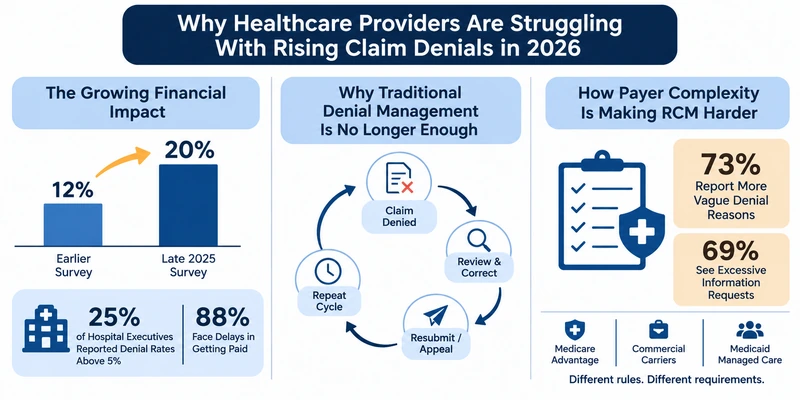
- Denials are getting worse, not better. In the 2026 HFMA/Guidehouse survey, 20% of providers reported a final denial rate above 5%, up from 12% a year earlier.
- Efficiency comes from moving work upstream. AI in revenue cycle management scores claims, checks eligibility and flags documentation gaps before submission, so staff fix problems once instead of chasing them for weeks. This is also where healthcare revenue cycle automation pays back fastest.
- Better patient experience is a side effect. Fewer authorization delays and billing surprises mean fewer interrupted treatments and fewer confused patients.
- Prior authorization is the next pressure point. CMS-0057-F brings payer API deadlines on January 1, 2027, and providers that prepare now will feel less friction.
- Staying competitive means measuring. Track clean claim rate, days in A/R and cost to collect before and after any AI rollout, and keep humans in the review loop.
A claim that gets denied costs you twice. You lose the payment’s timing, and you pay staff to work the claim again.
For years, hospitals answered this with bigger denial teams: find the reason, fix the claim, appeal, wait. That model still matters, but it’s reactive by design. The money is already at risk by the time anyone looks.
AI in revenue cycle management changes the order of operations. Instead of explaining why a claim failed, it predicts which claims will fail and stops them before they reach the payer. That’s the core idea behind AI in healthcare revenue cycle management, and it’s why denial prevention in healthcare is replacing the appeals-first mindset. This guide covers where AI in revenue cycle management works, what the CMS prior authorization rule means for your timeline, how to evaluate revenue cycle management solutions, and how to measure ROI.
Why Healthcare Providers Are Struggling With Rising Claim Denials in 2026
The Growing Financial Impact of Insurance Claim Denials
The numbers have turned ugly. Guidehouse and HFMA surveyed 191 provider executives in late 2025. Twenty percent reported final denial rates above 5%, compared with 12% in the previous survey. Hospital executives fared worst, with 25% reporting rates above that line. And 88% of respondents said disagreements with payers keep their organizations from being paid on time and in full.
Every denied claim stretches days in accounts receivable and ties up cash that finance teams had already forecast. Rework is expensive too: someone has to pull the chart, find the missing piece, resubmit or write an appeal, and track it. Multiply that by thousands of claims a month and you’re funding a small department whose only job is undoing earlier mistakes.
Why Traditional Denial Management Is No Longer Enough
Classic denial management starts after the damage. A claim comes back, an analyst reads the remark codes, a biller corrects it, and the cycle restarts.
The problem is that the same errors keep returning. A coding mismatch, a lapsed policy that nobody verified at registration, a missing authorization number. These are predictable, and manual review can’t catch them at volume. Worse, retrospective analysis tells you what went wrong last quarter while this quarter’s claims repeat the mistake.
Appeals are also a weak safety net. Not every denial is worth appealing, and appeals take time that small billing teams don’t have.
Quick Question: “What’s the difference between a claim rejection and a claim denial?”— A rejection happens before adjudication, usually when a clearinghouse or payer front-end edit finds a formatting or data error. You can correct and resubmit it. A denial happens after the payer reviews the claim and refuses payment, which typically means a correction or formal appeal.
How Payer Complexity Is Making Revenue Cycle Management More Difficult
Payer rules change constantly. Medicare Advantage plans, commercial carriers and Medicaid managed care each define medical necessity differently, require different documentation and apply their own authorization lists. In the HFMA/Guidehouse data, 73% of leaders reported more vague denial reasons or underpayments, and 69% cited excessive information requests as a shift in payer behavior.
Meanwhile, revenue cycle teams are short-staffed. Fewer people are being asked to track more rules. That mismatch is exactly where automation earns its place.
From Reactive Denial Management to AI-Powered Denial Prevention
What Is Traditional Denial Management?
Healthcare denial management is the process of identifying denied claims, finding the root cause, correcting the error, submitting an appeal where warranted, and following up until payment arrives. Done well, it recovers revenue. Done manually, it’s slow, inconsistent and heavily dependent on individual staff knowledge.
What Is AI-Powered Denial Prevention?
Denial prevention is the most practical use of AI in revenue cycle management. It applies machine learning to historical claims, payer behavior, clinical documentation and billing patterns. The model learns which combinations of codes, payers, providers and documentation produce denials. Before a claim is submitted, it assigns a risk score and tells the biller what looks wrong.
The biller then fixes the problem with context in hand. No guesswork, no waiting for the remittance.
Key Differences Between Traditional and AI-Driven RCM
| Traditional RCM | AI-powered RCM |
|---|---|
| Reactive claim correction | Predictive claim analysis |
| Manual eligibility checks | Automated eligibility verification |
| Manual error identification | AI-based error detection |
| Retrospective denial analysis | Predictive denial scoring |
| Manual reporting | Real-time analytics |
| Repetitive administrative work | Automated workflows |
The shift isn’t about automating one billing task. AI in revenue cycle management changes where in the revenue cycle problems get caught. Teams evaluating AI denial management software or claim denial management software should ask a simple question: does it only help after a denial, or does it prevent one?
7 Ways AI Is Transforming Healthcare Revenue Cycle Management
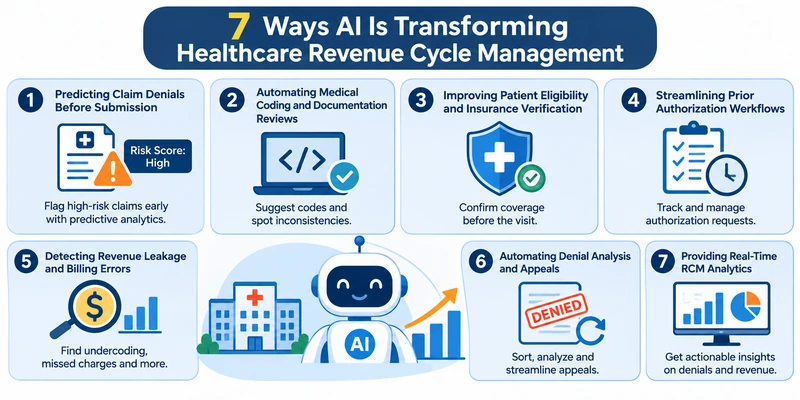
1. Predicting Claim Denials Before Submission
Predictive models compare each claim against historical outcomes for that payer, service line and code combination, then assign a denial-risk score. High-risk claims go to a human reviewer.
Picture a claim for an outpatient imaging procedure. The order is on file, but the clinical note doesn’t document the symptoms the payer’s policy requires for medical necessity. A rule-based system passes it. A predictive model recognizes that similar claims to this payer were denied and flags it for a documentation fix before it goes out.
2. Automating Medical Coding and Documentation Reviews
Natural language processing can read clinical notes and suggest codes, or spot inconsistencies between the documented diagnosis and the billed procedure. It also surfaces gaps, such as a missing laterality or an unsupported level of service.
Certified coders still make the final call. AI shortens the review; it doesn’t replace clinical and coding judgment, and it shouldn’t.
3. Improving Patient Eligibility and Insurance Verification
Many denials trace back to registration. Coverage has lapsed, the plan changed, or the benefit doesn’t cover the service. Automated eligibility checks run at scheduling and again before the visit, catching these problems while there’s still time to talk to the patient about alternatives.
4. Streamlining Prior Authorization Workflows
AI can identify which scheduled services need authorization for a given payer, gather the supporting documents, and track each request’s status. Automated reminders prompt staff when a payer asks for more information, so cases don’t stall in an inbox.
5. Detecting Revenue Leakage and Billing Errors
Not all leakage shows up as a denial. Undercoded visits, missed charges, duplicate claims and incomplete billing quietly reduce revenue without triggering any alert. Anomaly detection compares what was delivered with what was billed and highlights the gaps, which protects reimbursement you’ve already earned.
6. Automating Denial Analysis and Appeals (Plus Automated Claims Processing)
Even with strong prevention, some denials will get through, and automated claims processing keeps them from piling up. AI sorts them by reason code, routes them to the right work queue, and ranks them by recovery potential. It can also draft appeal letters from the claim and clinical record. A trained specialist should still review each appeal before submission.
7. Providing Real-Time RCM Analytics and Financial Insights
Dashboards turn raw claims data into something finance leaders can act on: denial rates by payer, clean claim rate, days in A/R and reimbursement trends. When one payer starts rejecting a specific procedure code, you’ll see the pattern in days rather than at quarter-end.
Off-the-shelf tools handle the common cases well. But if your payer mix, specialties or EHR setup are unusual, custom AI app development lets you train models on your own denial history instead of generic benchmarks.
Why Prior Authorization Automation Is Becoming Critical for US Healthcare Providers
Understanding CMS-0057-F and the 2027 Interoperability Requirements
The CMS Interoperability and Prior Authorization Final Rule (CMS-0057-F) targets payers rather than providers. It applies to Medicare Advantage organizations, state Medicaid and CHIP programs, Medicaid managed care plans, CHIP managed care entities and Qualified Health Plan issuers on the federally facilitated exchanges.
Two milestones matter. Starting January 1, 2026, impacted payers must send decisions within 72 hours for expedited requests and seven calendar days for standard ones, and must give a specific reason when they deny. (The standard-request timeframe excludes QHP issuers on the federally facilitated exchanges, and drugs are outside the rule.) By January 1, 2027, those payers must also support a FHIR-based Prior Authorization API, along with Provider Access and Payer-to-Payer APIs. That’s about five weeks from today.
Quick Question: “Do these deadlines apply directly to hospitals and practices?”— No. The decision timeframes and API requirements bind the payers. Providers benefit from faster, more transparent exchanges, though CMS has separately added a Prior Authorization measure to MIPS and the Medicare Promoting Interoperability Program for eligible hospitals and CAHs, starting with the CY 2027 reporting period.
How AI and FHIR Integration Can Improve Prior Authorization
FHIR gives systems a common language for sharing data. When a payer exposes a Prior Authorization API, a provider-side platform can check whether a service needs authorization, pull the relevant clinical documentation from the EHR, submit the request and track the response automatically.
AI adds a layer on top: spotting missing information before submission and prioritizing requests that are close to a decision deadline. But keep these separate in your planning. Payer API compliance is a regulatory requirement for the payer. AI automation on your side is an operational choice that happens to work better because the APIs exist.
What Healthcare Providers Should Do Before 2027
- Audit how your EHR and RCM systems exchange data today, and whether they can support FHIR-based workflows.
- Ask your major payers about their API readiness and endpoints.
- Map the authorization steps your staff still perform by phone, fax or portal.
- Schedule testing, staff training and a data security review before go-live.
Providers that wait for payers to finish their builds will lose months. Those that prepare integrations now can start using the new channels as they open.
What Healthcare Providers Should Look for in AI-Powered RCM Software
Choosing healthcare revenue cycle management software is a long-term commitment, and demos tend to look alike. When you compare revenue cycle management solutions, these are the criteria that separate AI in revenue cycle management tools that work in production from those that don’t.
AI-Based Denial Prediction and Prevention
Ask how claim scoring works, which data it learns from and whether it can show payer-specific denial trends. A vendor that can’t explain why a claim was flagged is asking you to trust a black box. Billers won’t.
EHR, Practice Management and Clearinghouse Integration
Software is only as useful as the data it receives. Confirm support for HL7 and FHIR, plus connections to your clearinghouse, practice management system and payer portals. Weak integration is the most common reason AI projects stall.
Data Security and HIPAA-Aligned Architecture
You’re handing over protected health information, so look for role-based access controls, encryption, audit trails and a signed business associate agreement. Ask for the vendor’s security assessment documentation, not just a checkbox answer.
Customizable Dashboards and Scalable Workflows
A multi-site health system and a five-physician practice need different reports. Look for custom denial categories, configurable work queues and the ability to scale without a rebuild.
How to Measure the ROI of AI in Revenue Cycle Management
Key RCM Performance Metrics to Track
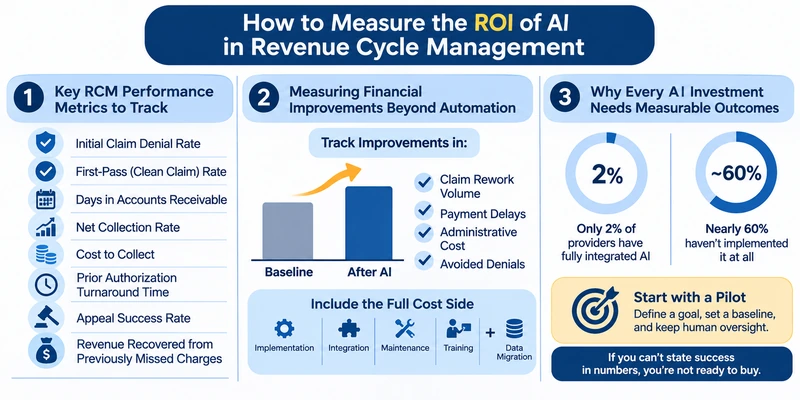
The ROI of AI in revenue cycle management only means something against a baseline. Capture one before you deploy anything, then track:
- Initial claim denial rate
- First-pass (clean claim) rate
- Days in accounts receivable
- Net collection rate
- Cost to collect
- Prior authorization turnaround time
- Appeal success rate
- Revenue recovered from previously missed charges
Measuring Financial Improvements Beyond Automation
Hours saved matter, but they’re not the whole picture. Compare post-launch performance against your baseline for claim rework volume, payment delays and administrative cost. Then put a number on avoided denials: claims that would have been rejected and weren’t.
Count the full cost side too. Implementation, integration, maintenance, training and data migration all belong in the calculation, or your ROI will look better than it is.
Why Every AI Investment Needs Measurable Outcomes
Adoption is still early. Guidehouse reports that only about 2% of providers have fully or mostly integrated AI and automation across revenue cycle operations, and nearly 60% haven’t implemented it at all. That’s no reason to rush. A pilot with a defined goal, a baseline and human oversight beats a broad rollout built on hype. If you can’t state what success looks like in numbers, you’re not ready to buy.
How to Implement AI-Powered Revenue Cycle Management Without Disrupting Existing Operations
Rolling out AI in revenue cycle management works best in small, measured steps rather than one big cutover.
Step 1: Identify Existing Revenue Cycle Bottlenecks
Start with your own data. Which denial codes appear most? Which payers? Which manual steps eat the most staff hours? The answers point to your first project.
Step 2: Evaluate Existing Healthcare Software and Integration Requirements
List your EHR, billing and practice management systems, and note where data gets stuck. Check clearinghouse and payer connection requirements. Many hospitals discover at this stage that integration work, not the AI model, is the real project, which is where software development services for enterprises can close gaps that packaged tools leave open.
Step 3: Start With High-Impact AI Workflows
Don’t automate everything at once. Begin with denial prediction, eligibility verification, prior authorization support or automated documentation checks, whichever your Step 1 analysis ranks highest.
Step 4: Monitor Performance and Improve AI Models
Set baselines, then watch for false positives (clean claims flagged as risky) and false negatives (risky claims that slipped through). Have billing specialists review the AI’s recommendations, and feed real denial outcomes back into the model. A model that isn’t retrained on new payer behavior gets stale.
How SISGAIN Helps Healthcare Providers Move Toward AI-Powered Revenue Cycle Management
SISGAIN is a healthcare app development company in UAE that builds AI-enabled software and integrations for healthcare organizations. Its approach to revenue cycle management centers on four areas.
AI-Driven Claim Analysis and Denial Prevention
SISGAIN’s approach to AI in revenue cycle management focuses on claim scoring, denial prediction and revenue leakage detection, helping billing teams spot potential claim issues earlier in the cycle.
Integrated Prior Authorization and Healthcare Interoperability
Prior authorization workflow support is paired with FHIR and HL7 integration, connecting EHRs, billing platforms and payer systems so teams aren’t working across fragmented tools.
Flexible RCM Software and Implementation Models
Engagements can include software development, managed services or both, with configurable workflows for different organization types, plus dashboards, implementation support and room to scale.

Frequently Asked Questions
How Does AI Help Prevent Healthcare Claim Denials?
AI in revenue cycle management predicts which claims are likely to be denied by comparing them with historical payer outcomes. It scores claim risk, checks documentation for gaps and automates eligibility verification, so staff can correct issues before submission.
Can AI Automate the Entire Healthcare Revenue Cycle?
No. AI handles repetitive, rules-heavy work well: eligibility checks, claim scrubbing, work-queue routing. Coding validation, complex appeals and payer negotiations still need trained people.
What Is the Difference Between AI Denial Management and Denial Prevention?
Denial management recovers money after a claim is rejected. Denial prevention identifies problems before submission so the denial never happens. AI supports both, but the larger financial gain comes from prevention.
How Does AI Improve Prior Authorization in Healthcare?
Prior authorization automation identifies services that need authorization, collects supporting documents, flags missing information and tracks request status. With FHIR integration, those steps can connect directly to payer systems that offer the required APIs.
How Much Does AI-Powered Revenue Cycle Management Software Cost?
It varies. Pricing depends on integration complexity, customization, deployment model, functionality, data migration and ongoing support. Request a scoped quote based on your EHR environment and denial profile rather than comparing list prices.