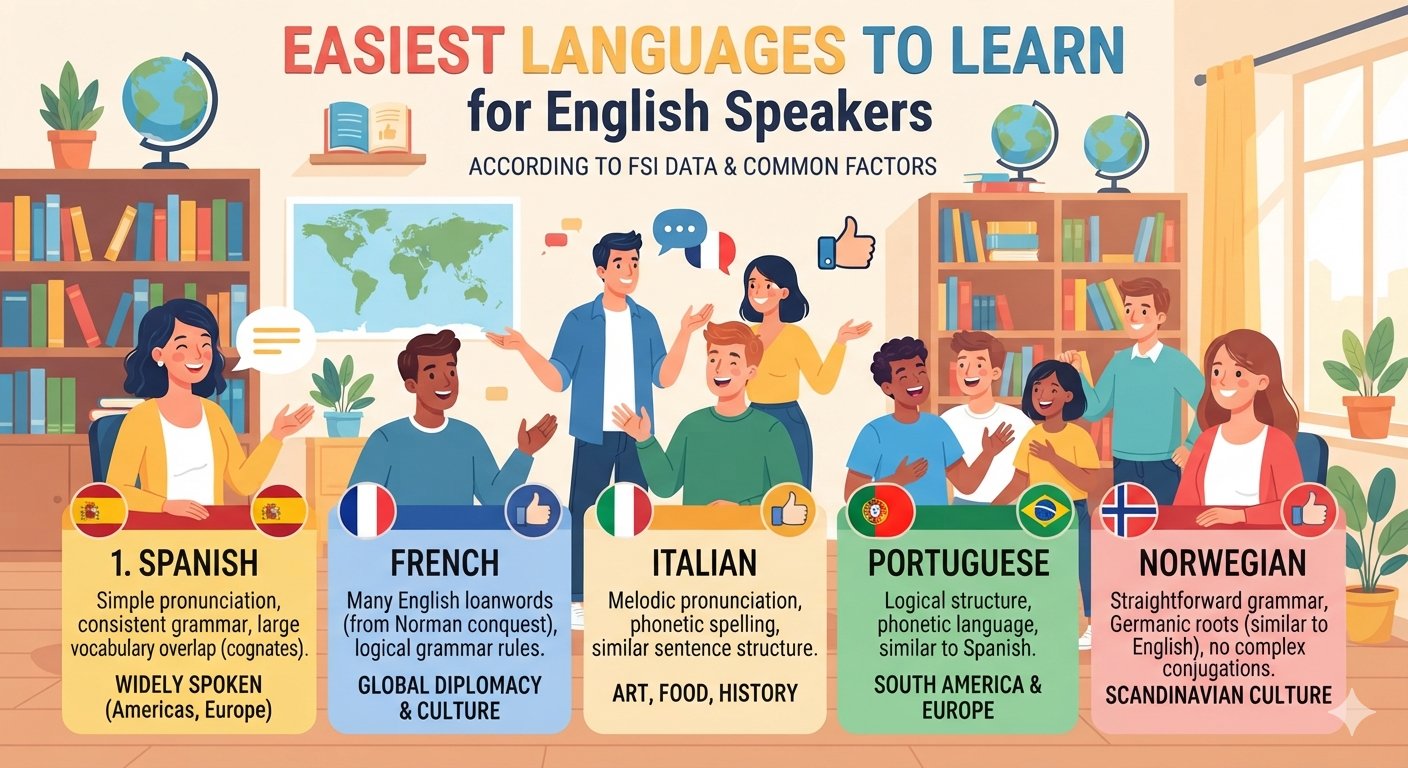
The easiest languages for English speakers to learn are Norwegian, Swedish, Spanish, Dutch, Portuguese, Italian and French. They share vocabulary, grammar or writing with English and take roughly 24–30 weeks of full-time study, according to the U.S. Foreign Service Institute. Japanese takes far longer, though its greeting, konnichiwa, is easy to learn.
What Makes a Language “Easy” for English Speakers?
People searching for the Course Easiest Language to Learn usually want one thing: a language they can actually stick with. Difficulty comes down to a few practical factors:
- Shared roots. English borrowed heavily from French and Latin and is itself a Germanic language, so many words look familiar.
- Writing system. The Latin alphabet saves months compared with learning new scripts.
- Pronunciation. Languages that are spelled the way they sound are easier to read aloud.
- Grammar. Fewer cases, simpler verb forms and no tones make early progress faster.
- Resources. More courses, tutors, podcasts and shows mean more practice.
The most cited benchmark is the U.S. Foreign Service Institute (FSI), which groups languages by the time English-speaking diplomats typically need to reach professional proficiency. Category I languages take about 24–30 weeks (600–750 class hours). Japanese sits in Category IV at about 88 weeks (2,200 class hours). Treat these as rough guides, not promises: your motivation, schedule and goals matter more than any ranking.
The 20 Easiest Languages for English Speakers, Ranked
This ranking blends FSI categories with the features above. Positions inside a tier are judgment calls, so pick the language you will enjoy most.
Tier 1: Closest to English
- Norwegian. Simple grammar, no verb changes by person, and a lot of English-like vocabulary. Often named the easiest language to learn for English speakers.
- Swedish. Similar to Norwegian, with a melodic accent and plenty of cognates.
- Spanish. Phonetic spelling, regular patterns and huge learning resources. The most popular first choice for good reason.
- Dutch. Closely related to English and German, with familiar word order in many sentences.
- Portuguese. Shares much with Spanish. Pronunciation, especially nasal sounds, takes practice.
- Italian. Clear vowels and consistent spelling make it friendly for speaking.
- French. Thousands of English words come from French, so reading comes quickly. Spelling and pronunciation are the main hurdles.
- Danish. Grammar is simple, but pronunciation is tricky because many sounds are softened.
Tier 2: Easy With One or Two Hurdles
- Afrikaans. Often described as having far simpler grammar than Dutch, its relative.
- Romanian. A Romance language with more grammar (cases, gender) than Spanish, but still approachable.
- Catalan. Sits between Spanish and French, which helps if you already know either.
- Galician. Very close to Portuguese and Spanish.
- Indonesian. Latin alphabet, no verb conjugation, no grammatical gender and no tones.
- Malay. Mutually understandable with Indonesian in many everyday situations.
- German. More grammar (cases, genders), but regular rules and many shared words.
Tier 3: Different, but Beginner-Friendly
- West Frisian. Among the closest living relatives of English, though few courses exist.
- Esperanto. A constructed language built for regular grammar. Great for learning how languages work, with fewer real-world speakers.
- Haitian Creole. Simple verb forms, with vocabulary largely drawn from French.
- Swahili. Latin alphabet and regular pronunciation, though its noun-class system takes getting used to.
- Turkish. Very regular and phonetic, but its word-building structure is unlike English.
Quick Comparison
| Language | Main advantage | Main challenge |
|---|---|---|
| Norwegian | Simple grammar | Fewer learning resources |
| Spanish | Phonetic spelling | Verb tenses |
| Dutch | Close to English | Pronunciation of some sounds |
| French | Many shared words | Spelling vs. sound |
| Indonesian | No conjugation or tones | Different vocabulary |
| German | Logical rules | Cases and genders |
How to Choose the Easiest Language to Learn for You
A ranking is a starting point. Before you commit to a course, ask:
- Why do you want to learn it? Travel, family and work all point to different languages.
- Who can you practice with? A language you can use weekly beats a “theoretically easier” one you never speak.
- What do you already know? Any school French or Spanish gives you a head start on Romance languages.
- How much time do you have? Even 20–30 minutes a day, consistently, beats occasional long sessions.
When comparing a language course, look for clear levels aligned with the CEFR scale (A1–C2), speaking practice, audio from native speakers and a review system for vocabulary.
Is Japanese Easy? A Realistic Look
Japanese is not among the easiest languages for English speakers, and the FSI ranks it among the hardest. Reasons include:
- Three writing systems: hiragana, katakana and kanji.
- Word order that places the verb at the end.
- Politeness levels that change how you speak depending on the situation.
That said, Japanese has real strengths for beginners. Pronunciation is consistent, with only five vowel sounds, and there are no tones or grammatical gender. Millions of learners enjoy it, and motivation often matters more than difficulty.
Beginner “Hello” in Japanese
Saying hello is one of the best first steps because it works from day one. Japanese has different greetings depending on the time of day and how formal you need to be.
| Situation | Japanese | Romaji | Pronunciation tip |
|---|---|---|---|
| General hello (daytime) | こんにちは | konnichiwa | kon-nee-chee-wah |
| Good morning (polite) | おはようございます | ohayō gozaimasu | oh-hah-yoh go-zah-ee-mahss |
| Good morning (casual) | おはよう | ohayō | oh-hah-yoh |
| Good evening | こんばんは | konbanwa | kon-bahn-wah |
| Answering the phone | もしもし | moshi moshi | moh-shee moh-shee |
Some useful beginner tips:
- Konnichiwa works from roughly late morning to late afternoon. Use ohayō gozaimasu earlier and konbanwa later.
- Greetings are often paired with a small bow, especially in formal settings.
- The final は in こんにちは and こんばんは is pronounced “wa” when it is a greeting, not “ha.”
- Beginner hello in Japanese language hiragana first, since you can read these greetings in about a week of light practice.
A Simple Study Plan for Any Beginner
Whichever language you pick, this routine works well:
- Start with the 100 most common words. They cover a large share of everyday speech.
- Learn pronunciation early. Fixing bad habits later is harder.
- Use spaced repetition for vocabulary instead of rereading lists.
- Speak from week one, even if only to yourself or a tutor.
- Consume real content, such as slow podcasts, children’s shows and song lyrics.
- Track progress with small goals, like holding a three-minute conversation.
FAQ’s
What is the easiest language for English speakers to learn?
Norwegian is most often named the easiest, followed closely by Swedish, Spanish, Dutch, Portuguese, Italian and French. Which is easiest for you depends on your background and goals.
How long does it take to learn an easy language?
The FSI estimates about 24–30 weeks (600–750 class hours) for Category I languages. Casual learners should expect longer, often a year or more of regular study to reach comfortable conversation.
Is Spanish easier than French?
For most beginners, yes. Spanish spelling matches pronunciation more closely. French has more silent letters, though it shares many words with English.
Is Japanese hard for English speakers?
Yes. The FSI places it in its hardest category because of its writing systems and grammar. Its pronunciation and lack of tones are beginner-friendly, though.
How do you say hello in Japanese?
The standard greeting is こんにちは (konnichiwa). Use おはようございます (ohayō gozaimasu) in the morning and こんばんは (konbanwa) in the evening.
Which language is easiest if I only want to travel?
Spanish, French, Italian or Portuguese are practical choices because many destinations use them and learning materials are plentiful.
Can I learn a language with an app alone?
Apps help with vocabulary and habit-building, but most learners progress faster by adding speaking practice with tutors, exchange partners or classes.
Is Indonesian really easy?
Its grammar is simple, with no verb conjugation, gender or tones. Vocabulary will feel new at first, but many learners find it quick to get started.
Should I learn Esperanto first?
It can build confidence with grammar concepts, but it has far fewer native speakers. Choose it if you enjoy the community and the logic, not as a shortcut to a major language.
Does knowing one language make the next one easier?
Yes. Learning strategies, grammar concepts and shared vocabulary carry over, especially within the same language family.
Conclusion
The easiest language to learn is the one that fits your life. If you want the fastest start, Norwegian, Swedish, Spanish, Dutch, Portuguese, Italian and French are the strongest candidates for English speakers. If your heart is set on Japanese, expect a longer journey, but begin with a simple konnichiwa and build from there. Pick one language, set a small daily habit and start speaking early. Consistency beats talent every time.