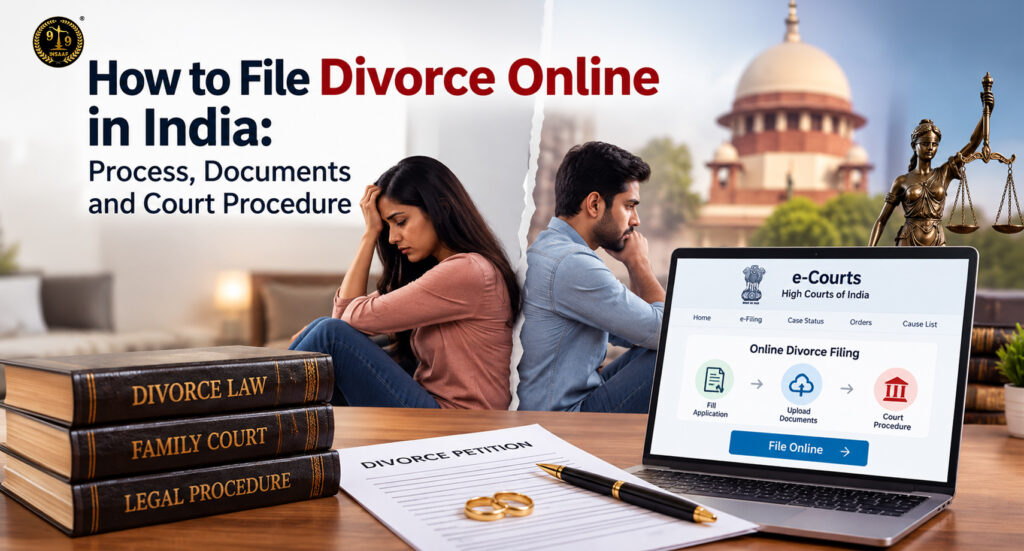
Ending a marriage involves difficult personal decisions and important legal responsibilities. Along with emotional concerns, spouses may need to resolve questions about maintenance, child custody, property, and financial security. Understanding the file divorce online process can help you make informed decisions and prepare for the proceedings.
If you want to file divorce online in India, you can begin with an online legal consultation, prepare documents digitally, and use court e-filing facilities where available. However, submitting documents online does not automatically dissolve a marriage. The applicable legal procedure must be followed, and a competent court must grant the divorce.
This guide explains what online divorce filing means, the documents you may need, the steps involved, and how to approach the process through Insaaf99.
What Does It Mean to File Divorce Online?
Online divorce filing generally refers to electronically submitting a divorce petition and supporting documents through an authorised court system. India’s eCourts infrastructure supports electronic filing in courts that have adopted it. Availability depends on the particular court and its filing arrangements.
An online consultation and a court filing are different stages. A consultation helps you understand your rights, assess your circumstances, and prepare your case. Filing formally places the petition before the court.
Before proceeding, confirm whether the relevant family court accepts electronic divorce petitions and whether additional physical documents are required. Hearings, counselling, statements, or personal appearances may still be necessary. Permission to participate remotely depends on the court’s rules and directions.
Understand the Law Applicable to Your Marriage
The divorce procedure depends on the law governing your marriage. Depending on the circumstances, this may involve the Hindu Marriage Act, the Special Marriage Act, or other applicable matrimonial laws.
Your religion alone may not answer this question. The manner in which the marriage was solemnised or registered can also matter. A lawyer should examine the marriage documents before selecting the legal provisions for your petition.
Avoid using a generic petition downloaded from the internet without checking its suitability. Requirements concerning divorce grounds, separation periods, jurisdiction, and supporting documents may differ.
The examples below concerning mutual consent and court jurisdiction primarily refer to the Hindu Marriage Act, 1955. They should not be treated as identical rules for every marriage.
Mutual Consent Divorce and Contested Divorce
Understanding these two routes helps you decide how to prepare.
Mutual consent divorce involves both spouses agreeing to end the marriage and resolving the terms of separation. Important issues include financial support, child arrangements, belongings, and pending disputes.
Under Section 13B of the Hindu Marriage Act, spouses must have lived separately for at least one year, been unable to live together, and mutually agreed to dissolve the marriage. Consent must remain voluntary through the relevant proceedings.
Contested divorce arises when one spouse seeks divorce without the other’s agreement. The petition must rely on legally recognised grounds under the applicable law, supported by relevant facts and evidence.
A contested case may involve replies, interim applications, evidence, and cross-examination. Disagreement alone does not remove the need to establish a legally available ground.
Documents Required to File Divorce Online
The document checklist depends on your case and the court’s requirements. Commonly relevant documents include:
- Marriage certificate, if available, and other evidence of marriage.
- Identity and address documents.
- Recent photographs, where required.
- Details of both spouses and their current addresses.
- Information about when and where the spouses last lived together.
- Children’s birth certificates, where applicable.
- Income records, bank statements, and financial disclosures.
- A settlement agreement for mutual consent proceedings.
- Relevant evidence supporting a contested petition.
- Details and copies of orders from related cases.
- Required affidavits and advocate authorisation documents.
If you do not have a marriage certificate, discuss alternative evidence with your lawyer. Its absence does not necessarily mean that divorce proceedings are impossible.
Prepare readable scans, keep originals safely, and check names and dates carefully. Upload documents only through appropriate channels, particularly when they contain private financial or family information.
How to File Divorce Online in India
1. Consult a Lawyer About Your Circumstances
Start by explaining the marriage history, separation, children, financial concerns, and any pending cases. Mention threats, coercion, or immediate safety concerns at the outset.
An initial consultation should help identify the applicable law, available divorce route, required evidence, and any urgent applications. You can approach Insaaf99 for an online consultation and clarify the scope of assistance before engaging a lawyer.
2. Identify the Correct Court
The petition must be filed before a court with territorial and subject-matter jurisdiction.
Under Section 19 of the Hindu Marriage Act, relevant locations can include where the marriage took place, where the respondent resides, or where the spouses last lived together. The provision also contains additional options in specified circumstances, including for a wife filing a petition. Your lawyer should verify which option applies to you.
Choosing a convenient city without checking jurisdiction can lead to objections and delay.
3. Prepare the Petition and Supporting Papers
The petition should accurately describe the marriage, relevant events, legal basis, and relief requested. Supporting documents should be organised so the court can understand their relevance.
For mutual consent divorce, prepare clear settlement terms. For contested divorce, connect the factual allegations to the applicable grounds and available evidence.
Read the complete draft before signing. Correct inaccurate statements, missing details, or terms you do not understand.
4. Check the Court’s E-Filing Requirements
Confirm the authorised portal, registration procedure, document formats, signatures, and fee-payment arrangements. Court requirements may differ, so follow the instructions applicable to your filing.
The official e-filing framework accommodates advocates and petitioners appearing in person in participating courts. However, handling your own filing still requires compliance with procedural requirements.
Legal assistance can be particularly useful where maintenance, children, disputed facts, or related litigation are involved.
5. Submit Documents and Address Registry Objections
Enter the required case details, upload the petition and supporting papers, and pay the prescribed court fee through the permitted method.
Keep the submission acknowledgement and payment receipt. The registry may identify defects such as missing documents, incorrect formatting, or incomplete details.
A submission acknowledgement should not be confused with confirmation that the case has been registered without objections. Follow up and correct defects within the required period.
6. Participate in the Court Proceedings
After registration, follow the court’s directions concerning notices, appearances, statements, counselling, mediation, and evidence.
Electronic filing does not eliminate these stages. Your participation requirements depend on the divorce route and the orders passed in your case.
For mutual consent proceedings, both spouses must understand and voluntarily accept the arrangement. In contested proceedings, the court examines the parties’ positions and evidence before deciding the case.
Waiting Period in Mutual Consent Divorce
Under Section 13B(2) of the Hindu Marriage Act, the second motion is ordinarily made no earlier than six months and no later than eighteen months after presentation of the joint petition, provided it has not been withdrawn.
The Supreme Court has recognised that the six-month waiting period can be waived in appropriate cases. Waiver is a judicial decision based on the circumstances; it is not automatic because the spouses request it or file electronically.
Discuss eligibility with your lawyer and distinguish the waiting period from the separate requirement concerning how long the spouses have lived separately.
Resolve Maintenance, Children and Financial Matters Carefully
A divorce settlement should explain how practical responsibilities will be handled after separation. Vague promises can create further disputes.
Where applicable, address maintenance or alimony, payment dates, children’s expenses, custody and contact arrangements, belongings, joint accounts, loans, and jointly owned assets. Consider how payments and document transfers will be recorded.
A divorce decree does not necessarily complete every property transfer or banking formality. Separate documents or procedures may be needed.
Where children are involved, arrangements should focus on their welfare and daily needs. Parents should consider schooling, healthcare, travel, communication, and how future disagreements will be managed.
Obtain legal advice before signing terms that affect long-term financial security or children’s interests.
How Much Does Online Divorce Filing Cost?
There is no single nationwide price covering every divorce case. Expenses may include court fees, legal consultation, drafting, representation, document preparation, and related applications.
A straightforward mutual consent matter may require less work than a contested case involving evidence and multiple disputes. Ask for a written explanation of the services covered and any additional charges.
Do not assume that a consultation fee includes petition drafting, filing, and representation throughout the case. Clarifying this early helps you plan realistically.
How Insaaf99 Can Be Your Starting Point
If you are considering divorce, approaching Insaaf99 for an online legal consultation can help you begin discussing the process and your concerns.
Prepare a short timeline, collect available documents, and list your questions before the consultation. Ask about the applicable law, court jurisdiction, likely stages, and the scope of professional assistance.
Before proceeding, confirm the engagement terms, fees, and who will handle drafting, filing, and court appearances. A clear understanding of these responsibilities helps you take the next step with better preparation and realistic expectations.