Every business with an online presence faces the same fundamental tension. You need quality design work, but your budget tells a different story than what local firms are charging. Expanding your search internationally reveals a vast pool of professionals willing to work for significantly less. Cheap website design becomes not just appealing but seemingly essential.
The problem is that affordability comes with uncertainty. Stories of abandoned projects, plagiarized designs, and unresponsive freelancers circulate widely. These cautionary experiences make many business owners hesitant to take the plunge. That hesitation is understandable but unnecessary.
Working with overseas designers can produce outstanding results. The key is approaching the process with the same rigor you would apply to any important business decision. Below is a proven method for engaging a cheap web designer while safeguarding your project and your budget.
Treat Your Brief as a Contract
A surprising number of outsourcing failures originate from a single document that was never written. Vague project descriptions create ambiguity, and ambiguity becomes expensive when someone is working thousands of miles away. You cannot assume shared context or cultural shorthand.
Outline every page your website will contain. For each one, specify the layout structure, content types, and interactive behaviors you expect. Attach annotated screenshots or wireframes if you have them, and link to reference sites that illustrate your vision.
Your brand assets should be organized and delivered with the brief. Logos in multiple formats, exact color codes, font files, and approved copy all need to arrive before design work begins. Leaving these details for later guarantees delays.
Candidates who respond to your brief with clarifying questions are demonstrating professionalism. Those who promise to deliver everything without asking a single question are showing you something else entirely. Pay attention to which category each person falls into.
Verify Portfolio Claims Independently
A portfolio is a sales tool. It exists to impress you, and that means every claim deserves scrutiny. Attributing work you did not perform to yourself is a widespread problem in online freelancing.
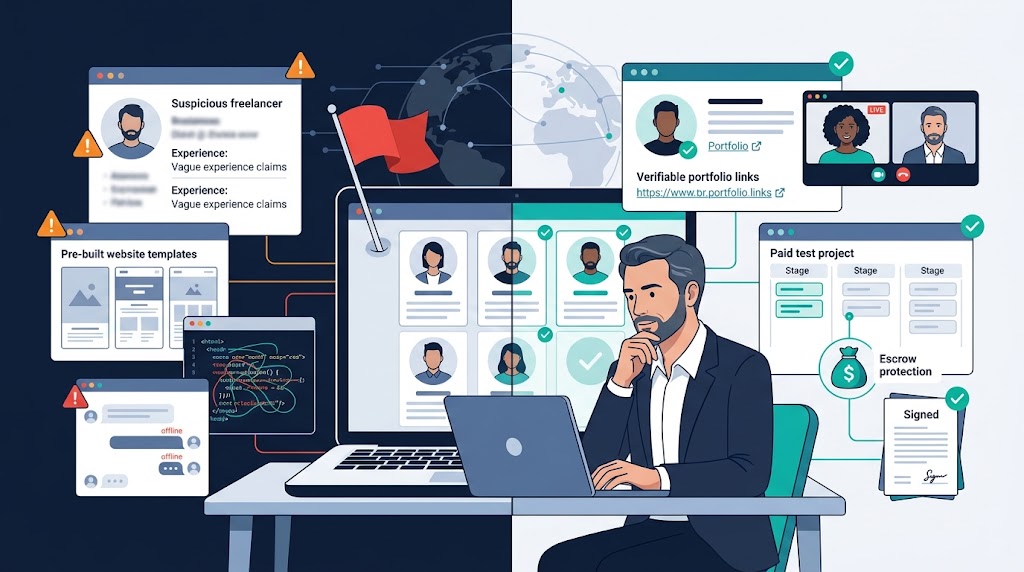
Request live URLs for every project featured in their portfolio. Open each link and navigate through the full site. Test it on your phone, check how fast it loads, and observe whether the design holds together on different screen sizes.
Ask for original source files from their design tool of choice. Figma files with organized layers and named components suggest genuine involvement. Flat image exports with no underlying structure suggest the opposite.
You can also ask for a brief walkthrough of their development approach on a portfolio project. Someone who built a site can describe the technical decisions behind it without hesitation. If the explanations sound generic or rehearsed, proceed with caution.
Prioritize Direct Conversation Over Messages
Written exchanges have their place, but they cannot replace real-time dialogue. A video call lasting fifteen to twenty minutes reveals more about a candidate than fifty email threads. Make it a non-negotiable step in your hiring process.
During the call, ask the candidate to explain a specific technical choice from their portfolio. How did they handle responsive behavior on a particular layout? What approach did they take to optimize performance? Detailed, confident answers indicate genuine expertise.
This conversation also serves as your primary defense against intermediaries. Many profiles on popular freelancing platforms belong to brokers who subcontract work at lower rates. Only the person who actually built something can discuss it at a granular level.
Gauge communication quality carefully throughout the exchange. Projects spanning weeks or months depend on clear, efficient dialogue. A candidate who struggles to articulate ideas during a friendly call will struggle far more when discussing complex revisions under pressure.
Validate Skills Through a Concrete Test
Trust should be earned through demonstration, not assumed from a resume. Before committing your full scope, assign a small paid task that mirrors the kind of work your project requires.
A single responsive landing page makes an excellent trial deliverable. It tests design sensibility, front-end skill, attention to detail, and communication habits all at once. Set a clear deadline and see whether it gets met without reminders.
Evaluate the output thoroughly once it arrives. Inspect the code for organization and readability. Test the page across browsers and devices. Note whether the designer asked smart questions during the process or remained silent until delivery.
This approach costs a modest sum compared to your total budget. Think of it as due diligence rather than an extra expense. A cheap web designer who excels at a small task has earned the opportunity for something larger. One who stumbles has saved you from significant disappointment.
Formalize Payment Terms and Protect Your Funds
Money is where offshore engagements get complicated. Without formal agreements, you have little recourse if things go wrong. Protecting your financial position starts with how you structure payments.
Break the project into phases with defined deliverables for each. Initial concepts, finalized designs, completed development, and post-launch adjustments each warrant their own payment milestone. Tie every disbursement to something concrete you have reviewed.
Escrow platforms add a layer of security that informal arrangements cannot match. Funds remain with a neutral service until you confirm that specific work has been completed to your satisfaction. Both parties operate with clearer accountability.
Your written agreement should extend beyond payment logistics. Document intellectual property transfer terms, revision limits, and the precise scope of each deliverable. When pursuing cheap website design from international providers, having this legal foundation in place becomes even more critical because resolving disputes across borders is inherently more difficult.
Assess Language Proficiency and Schedule Overlap
Communication friction destroys more offshore projects than any technical shortcoming. Misunderstood feedback leads to wasted work, and wasted work leads to frustration on both sides. Evaluate language skills as seriously as you evaluate design skills.
Look for a designer who can rephrase your instructions back to you accurately. This habit signals genuine comprehension rather than surface-level agreement. It also catches misunderstandings early, before they compound into major revisions.
Time zone differences require realistic assessment during the hiring phase. If you are operating on opposite ends of the clock, even simple exchanges stretch across entire business days. That delay accumulates rapidly over a multi-week engagement.
Seek a minimum of three overlapping working hours per day. This window provides enough room for check-ins, quick decisions, and real-time troubleshooting. When evaluating cheap website design candidates from distant regions, schedule compatibility often matters more than a slightly lower rate.
Wrapping Up
Hiring internationally for web design is a sound strategy when executed with care. Skilled professionals operate at every price point around the world. The savings are genuine, and the quality ceiling is high for those who know how to find it.
Start with a meticulous brief that removes guesswork from the equation. Scrutinize portfolios with verifiable evidence. Meet candidates face to face before entrusting them with anything. Run a small trial to confirm capabilities. Protect your payments through milestones and escrow. Ensure communication and scheduling work for both sides.
Follow this sequence consistently and you will separate capable professionals from unreliable operators. The result is a well-built website, a trustworthy working relationship, and money that stays where it belongs. That outcome is entirely achievable with the right preparation.